Centre for Sustainable Tropical Fisheries and Aquaculture, College of Science and Engineering, James Cook University, Townsville, Australia.
Australian Institute of Marine Science, Townsville, Australia.
PLoS One. 2020 Feb 27;15(2):e0228280. doi: 10.1371/journal.pone.0228280. eCollection 2020.
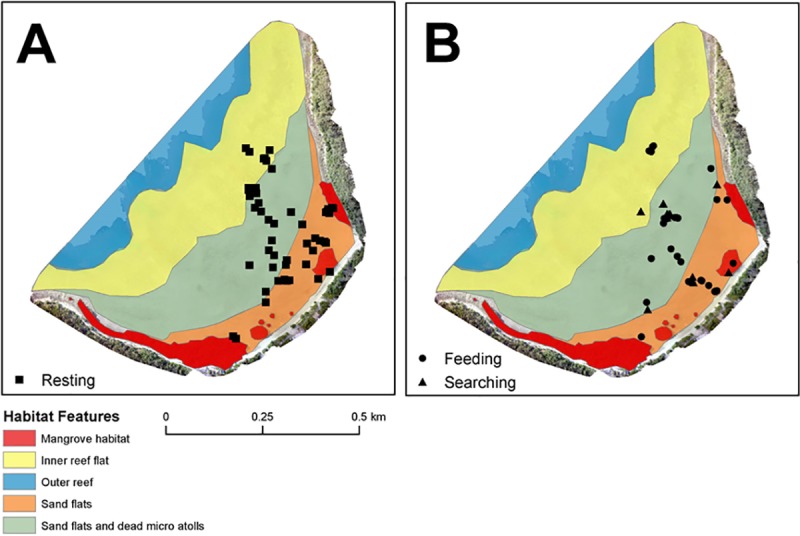
Stingrays are thought to play important ecological roles in coral reef ecosystems. However, little is known about juvenile stingray movement patterns and habitat use in coral reefs. This study used active acoustic telemetry to determine fine-scale diel movement patterns and habitat use of juvenile cowtail stingrays (Pastinachus ater) in a coral reef flat environment. Seven cowtail stingrays (4 males and 3 females) were manually tracked between April and December 2016. Each individual was tracked over 2 days, generating a total of 14 active tracks ranging from 4.91 to 9 h. Specimens moved at an average speed of 2.44 m min-1 ± 0.87 SE, with minimum distances travelled ranging from 546 to 1446 m. Tracking data showed that juvenile cowtail stingrays move in response to tidal cycles, moving faster and in straighter pathways during incoming and outgoing tides. Juvenile cowtail stingrays also showed a strong affinity to sand flat areas and mangrove edge areas. These areas provide food resources and potential refuges for juvenile rays to avoid predators. Coral reef flats were identified as secondary refuge for juveniles during the lowest tides. Future research is necessary to fully unveil the major drivers of juvenile cowtail stingray seasonal and ontogenetic movement patterns and habitat use within coral reef flat environments. This information is important to establish a full understanding of juvenile cowtail stingray ecology, but could also improve management and conservation policies.
黄貂鱼被认为在珊瑚礁生态系统中发挥着重要的生态作用。然而,人们对幼年黄貂鱼在珊瑚礁中的运动模式和栖息地利用知之甚少。本研究使用主动声学遥测技术来确定幼年长尾黄貂鱼(Pastinachus ater)在珊瑚礁平原环境中的昼夜精细移动模式和栖息地利用。2016 年 4 月至 12 月,手动追踪了 7 条长尾黄貂鱼(4 条雄性和 3 条雌性)。每个个体被追踪了两天,总共产生了 14 条主动轨迹,范围从 4.91 到 9 小时。标本的平均移动速度为 2.44 m min-1 ± 0.87 SE,移动的最小距离从 546 到 1446 m 不等。追踪数据显示,幼年长尾黄貂鱼会根据潮汐周期移动,在进出潮时移动速度更快,路径更直。幼年长尾黄貂鱼也对沙质平原和红树林边缘地区有强烈的偏好。这些地区为幼年黄貂鱼提供了食物资源和潜在的避难所,以躲避捕食者。珊瑚礁平原在最低潮时被确定为幼鱼的二级避难所。未来的研究有必要充分揭示幼年长尾黄貂鱼季节性和发育性移动模式和栖息地利用的主要驱动因素,以及它们在珊瑚礁平原环境中的情况。这些信息对于全面了解幼年长尾黄貂鱼的生态学非常重要,但也可以改善管理和保护政策。