Agarwal Stuti, Harter Zachery J, Krishnamachary Balaji, Chen Ling, Nguyen Tyler, Voelkel Norbert F, Dhillon Navneet K
Department of Internal Medicine, University of Kansas Medical Center, Kansas City, KS, USA.
Department of Pulmonary Sciences, Vrije University Medical Center, Amsterdam, The Netherlands.
Pulm Circ. 2020 Feb 4;10(1):2045894019898376. doi: 10.1177/2045894019898376. eCollection 2020 Jan-Mar.
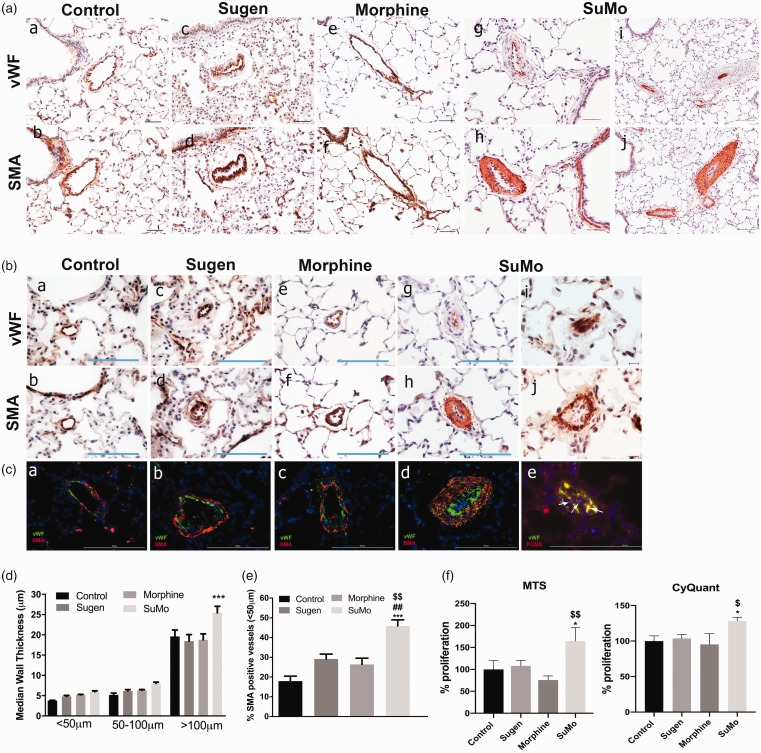
Pulmonary arterial hypertension is a fatal disease associated with pulmonary vascular remodeling and right ventricular hypertrophy. Pre-clinical animal models that reproduce the human pulmonary arterial hypertension process and pharmacological response to available therapies are critical for future drug development. The most prevalent animal model reproducing many aspects of angioobliterative forms of pulmonary arterial hypertension is the rat Sugen/hypoxia model in which Sugen, a vascular endothelial growth factor receptor antagonist, primarily causes initiation of endothelial injury and later in the presence of hypoxia promotes proliferation of apoptosis-resistant endothelial cells. We previously demonstrated that exposure of human pulmonary microvascular endothelium to morphine and HIV-proteins results in initial apoptosis followed by increased proliferation. Here, we demonstrate that the double-hit of morphine and Sugen 5416 (Sugen-morphine) in rats leads to the development of pulmonary arterial hypertension with significant medial hypertrophy of pre-acinar pulmonary arteries along with neo-intimal thickening of intra-acinar vessels. In addition, the pulmonary smooth muscle and endothelial cells isolated from Sugen-morphine rats showed hyperproliferation and apoptotic resistance, respectively, in response to serum starvation. Our findings support that the dual hit model of Sugen 5416 and morphine provides another experimental strategy to induce significant pulmonary vascular remodeling and development of severe pulmonary arterial hypertension pathology in rats without exposure to hypoxia.
肺动脉高压是一种与肺血管重塑和右心室肥厚相关的致命疾病。能够重现人类肺动脉高压进程以及对现有疗法产生药理学反应的临床前动物模型对于未来药物研发至关重要。最常用于重现肺动脉高压血管闭塞性形式诸多方面的动物模型是大鼠Sugen/低氧模型,其中血管内皮生长因子受体拮抗剂Sugen主要引发内皮损伤,随后在低氧环境下促进抗凋亡内皮细胞的增殖。我们之前证明,人类肺微血管内皮细胞暴露于吗啡和HIV蛋白后,最初会发生凋亡,随后增殖增加。在此,我们证明,大鼠体内吗啡与Sugen 5416(Sugen-吗啡)的双重作用会导致肺动脉高压的发展,伴有腺泡前肺动脉明显的中膜肥厚以及腺泡内血管的新内膜增厚。此外,从Sugen-吗啡大鼠分离出的肺平滑肌细胞和内皮细胞分别对血清饥饿表现出增殖亢进和抗凋亡特性。我们的研究结果表明,Sugen 5416与吗啡的双重作用模型为在不暴露于低氧环境的情况下,诱导大鼠发生显著的肺血管重塑和严重肺动脉高压病理发展提供了另一种实验策略。