Cofré Lizama L Eduardo, Bastani Andisheh, van der Walt Anneke, Kilpatrick Trevor, Khan Fary, Galea Mary P
Department of Medicine, Royal Melbourne Hospital, The University of Melbourne, Melbourne, Australia.
Department of Neurosciences, Alfred Health, Central Clinical School, Monash University, Melbourne, Australia.
Mult Scler J Exp Transl Clin. 2020 Feb 11;6(1):2055217320905870. doi: 10.1177/2055217320905870. eCollection 2020 Jan-Mar.
Neural damage at early stages of multiple sclerosis (MS) can subtly affect gait muscle activation patterns. Detecting these changes using current clinical tools, however, is not possible. We propose using muscle coactivation measures to detect these subtle gait changes. This may also help in identifying people with MS (PwMS) that may benefit from strategies aimed at preventing further mobility impairments.
We aimed to determine if coactivation of ankle muscles during gait is greater in PwMS with Expanded Disability Status Scale (EDSS) score <3.5. A secondary aim is to determine whether coactivation increases are speed dependent.
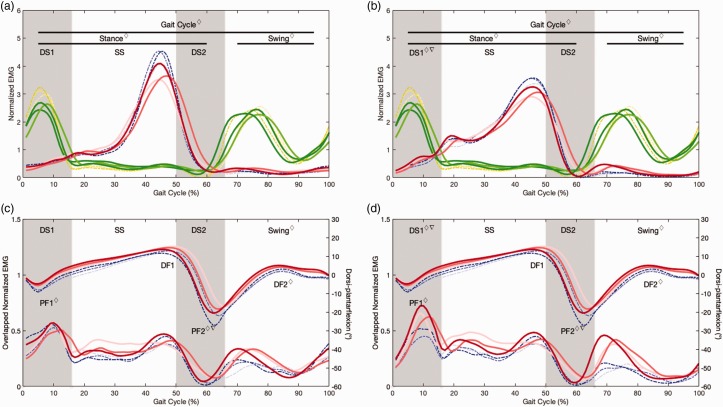
For this study 30 PwMS and 15 healthy controls (HC) walked on a treadmill at 1.0 m/s, 1.2 m/s and 1.4 m/s. Electromyography was recorded from the tibialis anterior (TA), soleus (SO) and lateral gastrocnemius (LG). The coactivation index was calculated between SO/TA and LG/TA. Ankle kinematics data were also collected.
Compared with HC, PwMS exhibited significantly greater SO/TA and LG/TA coactivation, which was greater during early stance and swing phases ( < .01). Speed did not affect coactivation except during early stance. Ankle kinematic changes were also observed.
PwMS exhibited greater ankle muscles coactivation than controls regardless of the speed of walking. These changes in muscle activation may serve as a biomarker of neurodegeneration occurring at early stages of the disease.
多发性硬化症(MS)早期的神经损伤会微妙地影响步态肌肉激活模式。然而,使用当前临床工具无法检测到这些变化。我们建议使用肌肉共同激活测量来检测这些微妙的步态变化。这也可能有助于识别可能从旨在预防进一步行动障碍的策略中受益的多发性硬化症患者(PwMS)。
我们旨在确定扩展残疾状态量表(EDSS)评分<3.5的PwMS在步态期间踝关节肌肉的共同激活是否更大。第二个目的是确定共同激活的增加是否与速度有关。
在本研究中,30名PwMS和15名健康对照者(HC)在跑步机上以1.0米/秒、1.2米/秒和1.4米/秒的速度行走。记录胫骨前肌(TA)、比目鱼肌(SO)和外侧腓肠肌(LG)的肌电图。计算SO/TA和LG/TA之间的共同激活指数。还收集了踝关节运动学数据。
与HC相比,PwMS表现出明显更大的SO/TA和LG/TA共同激活,在早期站立和摆动阶段更大(<0.01)。除了早期站立阶段,速度不影响共同激活。还观察到踝关节运动学变化。
无论行走速度如何,PwMS的踝关节肌肉共同激活均比对照组更大。这些肌肉激活的变化可能作为疾病早期发生的神经退行性变的生物标志物。