Cox Joseph, Linthwaite Blake, Engler Kim, Lessard David, Lebouché Bertrand, Kronfli Nadine
1Chronic Viral Illness Service (CVIS), McGill University Health Centre (MUHC) - Glen Site, 1001, Decarie boulevard - D02.4110, Montreal, QC H4A 3J1 Canada.
2Research Institute of the McGill University Health Centre (RI-MUHC), 2155 Guy Street, 5th Floor, Montreal, QC H3H 2R9 Canada.
Pilot Feasibility Stud. 2020 Feb 21;6:29. doi: 10.1186/s40814-020-0559-6. eCollection 2020.
At the McGill University Health Centre (MUHC), 10% of patients living with HIV do not return for care annually. Currently, no formal system exists to re-engage out-of-care (OOC) patients. Lost & Found, developed using an implementation science approach, is an intervention to re-engage OOC patients. It is based on existing evidence-based interventions and will be adapted for use by nurses at the MUHC. The aims of this study are to simultaneously assess both implementation and effectiveness of Lost & Found in order to determine the viability of a future multisite stepped-wedge cluster randomised trial.
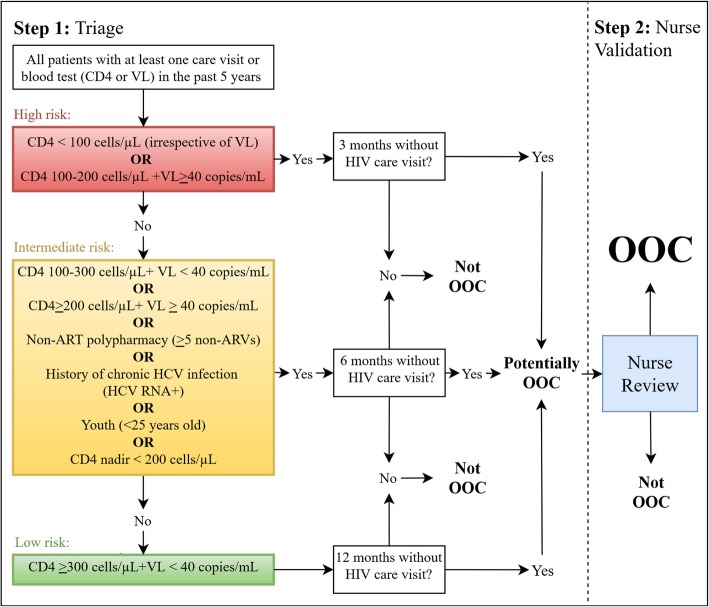
Lost & Found consists of two core elements: identifying and contacting OOC patients. Based on formative work involving MUHC nurses, and the use of a combined implementation framework (enhanced Replicating Effective Programs, Tailored Implementation for Chronic Diseases, and Proctor et al.'s implementation outcomes), we will adapt the intervention to our clinic. Adaptations include the creation of an OOC risk prediction tool, an automated real-time OOC list, and prioritization of high-risk OOC patients for re-engagement. Delivery and ongoing adaptation of the intervention will follow a three-pronged implementation strategy consisting of (1) promoting adaptability; (2) planning, engaging, executing, evaluating, and reflecting cycles; and (3) internal facilitation. This 15-month quasi-experimental pilot study adopts a type II implementation-effectiveness hybrid design. To evaluate implementation, a convergent parallel mixed-methods approach will guide the mixing of qualitative and quantitative data at time points throughout the study. In addition, descriptive and pre-post analyses, for each of the implementation and sustainability phases, will inform evaluations of the cumulative effectiveness and sustainability of the Lost & Found intervention.
This study will provide preliminary evidence for (1) the utility of our chosen implementation strategies and (2) the effectiveness of the intervention. Ultimately, this information may be used to inform future re-engagement efforts using implementation science in other HIV care centres. In addition, the procedures and measurement tools developed for this study will be foundational to the development of a multi-site, randomised stepped wedge study that would provide more robust evidence in support of the Lost & Found intervention.
在麦吉尔大学健康中心(MUHC),10%的艾滋病毒感染者每年未复诊。目前,尚无正式系统用于重新联系失访(OOC)患者。“失而复得”项目采用实施科学方法开发,是一项促使失访患者重新接受治疗的干预措施。该项目基于现有的循证干预措施,并将进行调整以供MUHC的护士使用。本研究的目的是同时评估“失而复得”项目的实施情况和效果,以确定未来多中心阶梯式楔形整群随机试验的可行性。
“失而复得”项目包含两个核心要素:识别和联系失访患者。基于涉及MUHC护士的形成性工作,并使用综合实施框架(强化的有效方案复制、慢性病的定制实施以及普罗克特等人的实施结果),我们将对干预措施进行调整以适用于我们的诊所。调整内容包括创建失访风险预测工具、自动实时失访名单,以及对高风险失访患者进行重新联系的优先级排序。干预措施的实施和持续调整将遵循三管齐下的实施策略,包括:(1)促进适应性;(2)规划、参与、执行、评估和反思循环;(3)内部促进。这项为期15个月的准实验性试点研究采用II型实施-效果混合设计。为评估实施情况,一种收敛平行混合方法将指导在研究的各个时间点对定性和定量数据进行混合。此外,针对实施和可持续性阶段的描述性分析以及前后分析,将为评估“失而复得”干预措施的累积效果和可持续性提供依据。
本研究将为(1)我们所选实施策略的效用和(2)干预措施的有效性提供初步证据。最终,这些信息可用于为其他艾滋病毒护理中心未来运用实施科学进行重新联系工作提供参考。此外,为本研究开发的程序和测量工具将成为多中心随机阶梯式研究发展的基础,该研究将提供更有力的证据来支持“失而复得”干预措施。