Division of Nephrology and Dialysis, Department of Medicine III, Medical University of Vienna, Währingergürtel 18-20, 1090, Vienna, Austria.
Department of Emergency Medicine, Medical University of Vienna, 1090, Vienna, Austria.
BMC Nephrol. 2020 Feb 28;21(1):70. doi: 10.1186/s12882-020-01729-5.
A positive pregnancy test in acute or chronically ill patients has implications for the use of potentially mutagenic or teratogenic products in urgent medical therapies such as the use of chemotherapies or therapies with immunosuppressants, for anesthesia, and for time-sensitive indications like urgent surgery or organ Transplantation. Despite a lack of evidence, it is currently believed that human chorionic gonadotropin serum concentrations are always elevated in female dialysis patients even without pregnancy. It is also believed that human chorionic gonadotropin cannot be used to confirm or exclude pregnancy.
Human chorionic gonadotropin was examined in female dialysis patients (18-50 years of age), and was classified as positive above 5 mlU/ml. In addition, fertility status was determined. For an enhanced index test, the cut-off of 5 mIU/ml was used for potentially fertile patients and 14 mIU/ml for infertile patients to calculate diagnostic test accuracy. The ideal cut-off for human chorionic gonadotropin was estimated using Liu's method with bootstrapped 95% confidence intervals. Predictors of human chorionic gonadotropin increase were analyzed using multivariable linear regression.
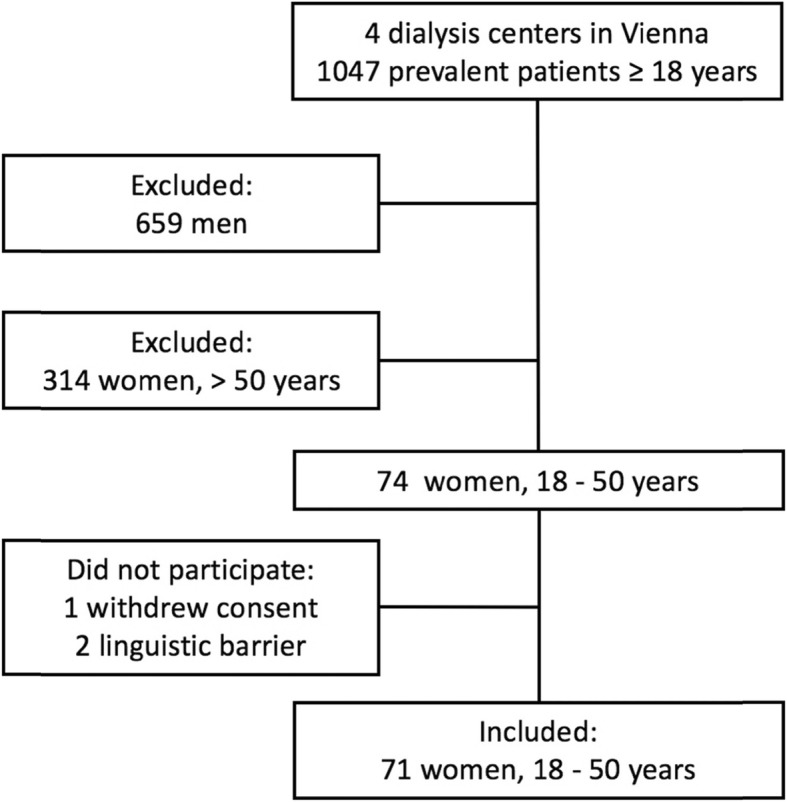
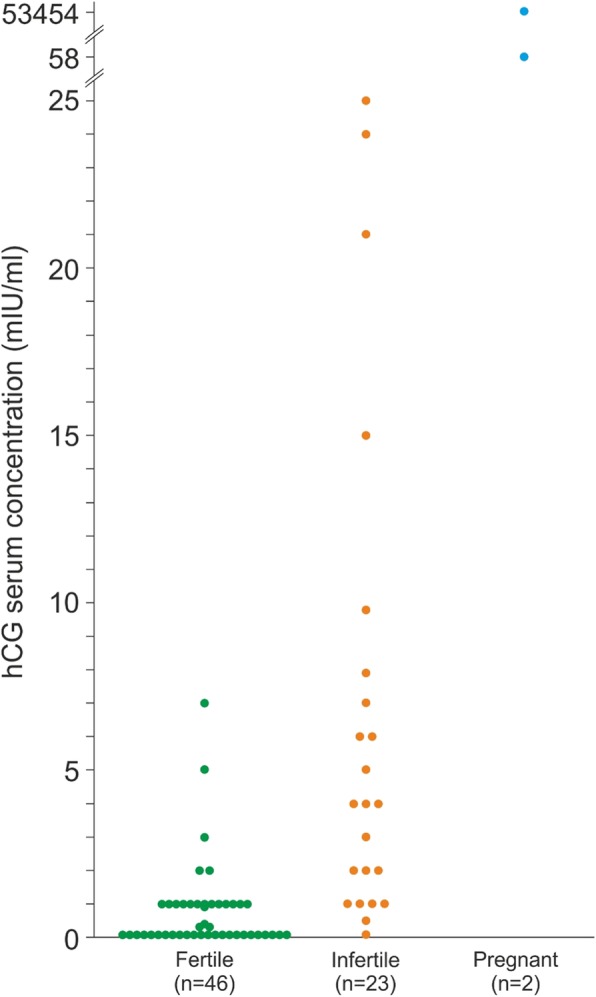
Among 71 women, two (2.8%) were pregnant, 46 (64.8%) potentially fertile, and 23 (32.4%) infertile. We observed human chorionic gonadotropin concentrations > 5 mIU/ml in 10 patients, which had a sensitivity of 100% (95% confidence interval: 100 to 100), a specificity of 86% (95% confidence interval: 77 to 94), a positive predictive value of 17% (95% confidence interval: 8 to 25) and a negative predictive value of 100% (95% confidence interval: 100 to 100) for the diagnosis of pregnancy. Using a cut-off > 14 mIU/ml for infertile patients or the exclusion of infertile patients increased specificity to 93% or 98%, respectively. The ideal cut-off was 25 mIU/ml (95% confidence interval: 17 to 33). Pregnancy and potential fertility, but not age, were independent predictors of human chorionic gonadotropin.
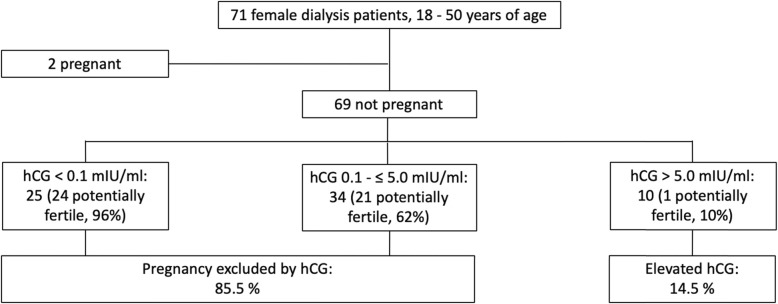
Human chorionic gonadotropin is elevated > 5mIU/ml in 14.5% of non-pregnant dialysis patients of child-bearing age. In potentially fertile women, this cut-off can be used to exclude pregnancy. In case of an unknown fertility status, the ideal human chorionic gonadotropin cut-off was 25 mIU/ml.
在急性或慢性疾病患者中出现妊娠试验阳性,这对紧急医疗治疗中使用潜在致突变或致畸药物具有重要意义,如化疗或免疫抑制剂治疗、麻醉以及紧急手术或器官移植等时间敏感的指征。尽管缺乏证据,但目前人们认为,即使没有怀孕,女性透析患者的血清人绒毛膜促性腺激素浓度总是升高的。人们还认为,人绒毛膜促性腺激素不能用于确认或排除妊娠。
检查了 18-50 岁的女性透析患者的人绒毛膜促性腺激素,将血清浓度 > 5 mlU/ml 定义为阳性。此外,还确定了生育状况。对于增强的指标检测,将 5 mIU/ml 作为潜在生育能力患者的截止值,14 mIU/ml 作为无生育能力患者的截止值,以计算诊断检测的准确性。使用 Liu 方法并通过自举 95%置信区间估计人绒毛膜促性腺激素的理想截止值。使用多变量线性回归分析人绒毛膜促性腺激素升高的预测因素。
在 71 名女性中,有 2 名(2.8%)怀孕,46 名(64.8%)有生育能力,23 名(32.4%)无生育能力。我们观察到 10 名患者的人绒毛膜促性腺激素浓度 > 5 mIU/ml,其灵敏度为 100%(95%置信区间:100-100),特异性为 86%(95%置信区间:77-94),阳性预测值为 17%(95%置信区间:8-25),阴性预测值为 100%(95%置信区间:100-100)。对于妊娠的诊断,使用 > 14 mIU/ml 的截止值用于无生育能力的患者或排除无生育能力的患者,特异性分别提高到 93%或 98%。理想的截止值为 25 mIU/ml(95%置信区间:17-33)。妊娠和潜在生育能力,而不是年龄,是人绒毛膜促性腺激素升高的独立预测因素。
在育龄非妊娠透析患者中,有 14.5%的人绒毛膜促性腺激素浓度 > 5mIU/ml。在有生育能力的女性中,这个截止值可用于排除妊娠。如果不知道生育能力状况,理想的人绒毛膜促性腺激素截止值为 25 mIU/ml。