MRC London Institute of Medical Sciences, Faculty of Medicine, Imperial College London, Hammersmith Hospital Campus, London, UK; Department of Psychiatry, University of Cambridge, Cambridge, UK; Cambridgeshire and Peterborough NHS Foundation Trust, Cambridge, UK.
MRC London Institute of Medical Sciences, Faculty of Medicine, Imperial College London, Hammersmith Hospital Campus, London, UK; Institute of Psychiatry, Psychology and Neuroscience, King's College London, London, UK.
Brain Behav Immun. 2020 Jul;87:901-909. doi: 10.1016/j.bbi.2020.02.010. Epub 2020 Feb 27.
The magnitude and variability of cytokine alterations in depression are not clear.
To perform an up to date meta-analysis of mean differences of immune markers in depression, and to quantify and test for evidence of heterogeneity in immune markers in depression by conducting a meta-analysis of variability to ascertain whether only a sub-group of patients with depression show evidence of inflammation.
Studies that reported immune marker levels in peripheral blood in patients with depression and matched healthy controls in the MEDLINE database from inception to August 29th 2018 were examined.
Case-control studies that reported immune marker levels in peripheral blood in patients with depression and healthy controls were selected.
Means and variances (SDs) were extracted for each measure to calculate effect sizes, which were combined using multivariate meta-analysis.
Hedges g was used to quantify mean differences. Relative variability of immune marker measurements in patients compared with control groups as indexed by the coefficient of variation ratio (CVR).
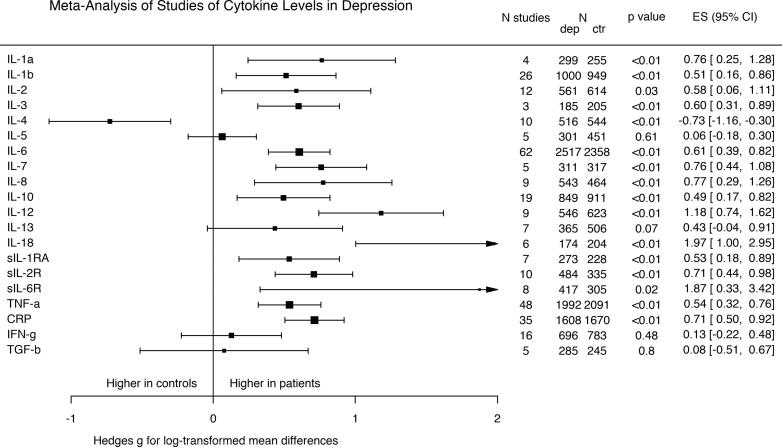
A total of 107 studies that reported measurements from 5,166 patients with depression and 5,083 controls were included in the analyses. Levels of CRP (g = 0.71; 95%CI: 0.50-0.92; p < 0.0001); IL-3 (g = 0.60; 95%CI: 0.31-0.89; p < 0.0001); IL-6 (g = 0.61; 95%CI: 0.39-0.82; p < 0.0001); IL-12 (g = 1.18; 95%CI: 0.74-1.62; p < 0.0001); IL-18 (g = 1.97; 95%CI: 1.00-2.95; p < 0.0001); sIL-2R (g = 0.71; 95%CI: 0.44-0.98; p < 0.0001); and TNFα (g = 0.54; 95%CI: 0.32-0.76; p < 0.0001) were significantly higher in patients with depression. These findings were robust to a range of potential confounds and moderators. Mean-scaled variability, measured as CVR, was significantly lower in patients with depression for CRP (CVR = 0.85; 95%CI: 0.75-0.98; p = 0.02); IL-12 (CVR = 0.61; 95%CI: 0.46-0.80; p < 0.01); and sIL-2R (CVR = 0.85; 95%CI: 0.73-0.99; p = 0.04), while it was unchanged for IL-3, IL-6, IL-18, and TNF α.
Depression is confirmed as a pro-inflammatory state. Some of the inflammatory markers elevated in depression, including CRP and IL-12, show reduced variability in patients with depression, therefore supporting greater homogeneity in terms of an inflammatory phenotype in depression. Some inflammatory marker elevations in depression do not appear due to an inflamed sub-group, but rather to a right shift of the immune marker distribution.
抑郁症中细胞因子变化的幅度和可变性尚不清楚。
对抑郁症免疫标志物的平均差异进行最新的荟萃分析,并通过进行变异性荟萃分析来量化和检验抑郁症免疫标志物是否存在异质性,以确定是否只有一小部分抑郁症患者表现出炎症的证据。
在 MEDLINE 数据库中从成立到 2018 年 8 月 29 日,检查了抑郁症患者和匹配的健康对照组外周血免疫标志物水平的病例对照研究。
选择了报告抑郁症患者和健康对照组外周血免疫标志物水平的病例对照研究。
提取了每个测量值的平均值和方差(SD),以计算效应大小,并用多元荟萃分析进行综合。
使用 Hedges g 来量化平均值差异。患者与对照组相比,免疫标志物测量的相对变异性,以变异系数比(CVR)表示。
对来自 5166 名抑郁症患者和 5083 名对照组的测量值进行了 107 项研究。CRP(g=0.71;95%CI:0.50-0.92;p<0.0001);IL-3(g=0.60;95%CI:0.31-0.89;p<0.0001);IL-6(g=0.61;95%CI:0.39-0.82;p<0.0001);IL-12(g=1.18;95%CI:0.74-1.62;p<0.0001);IL-18(g=1.97;95%CI:1.00-2.95;p<0.0001);sIL-2R(g=0.71;95%CI:0.44-0.98;p<0.0001);和 TNFα(g=0.54;95%CI:0.32-0.76;p<0.0001)在抑郁症患者中明显升高。这些发现对一系列潜在的混杂因素和调节剂具有稳健性。以 CVR 衡量的平均标度变异性在抑郁症患者中显著降低,包括 CRP(CVR=0.85;95%CI:0.75-0.98;p=0.02);IL-12(CVR=0.61;95%CI:0.46-0.80;p<0.01);和 sIL-2R(CVR=0.85;95%CI:0.73-0.99;p=0.04),而 IL-3、IL-6、IL-18 和 TNFα 则没有变化。
抑郁症被确认为一种促炎状态。一些在抑郁症中升高的炎症标志物,包括 CRP 和 IL-12,在抑郁症患者中表现出较低的变异性,因此支持在抑郁症中炎症表型的更大同质性。抑郁症中一些炎症标志物的升高似乎不是由于炎症亚群引起的,而是由于免疫标志物分布的右移。