Huang Jiaan, Yang Xiaoyan, Wu Jiayi, Kuang Yanping, Wang Yun
Department of Assisted Reproduction, Shanghai Ninth People's Hospital Affiliated to Shanghai Jiao Tong University School of Medicine, Shanghai, China.
Front Physiol. 2020 Feb 12;11:74. doi: 10.3389/fphys.2020.00074. eCollection 2020.
Extended embryo culture has been reported to affect perinatal outcome regarding higher risks of large for gestational age (LGA) and preterm birth (PTB) yet decreased risk of small for gestational age (SGA). However, existing data about the obstetric outcome and the safety for offspring resulting from the transfer of day 7 blastocysts is rare.
To compare obstetric and perinatal outcome using embryos vitrified on day 7 with those vitrified on day 3, day 5, and day 6.
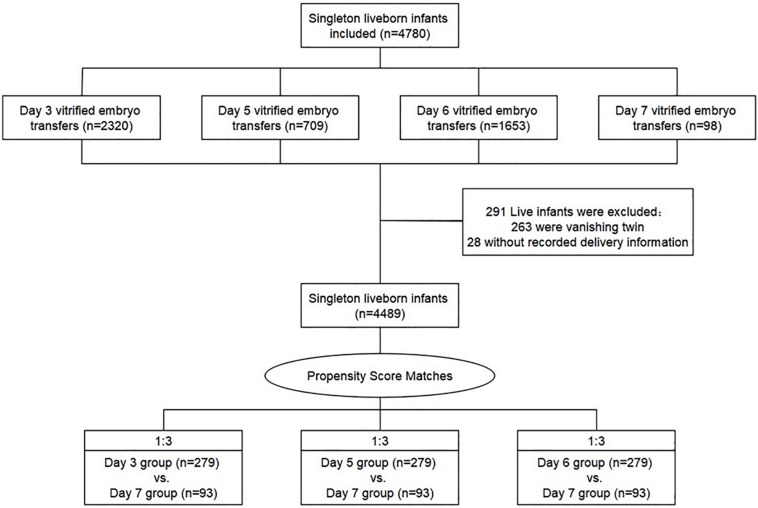
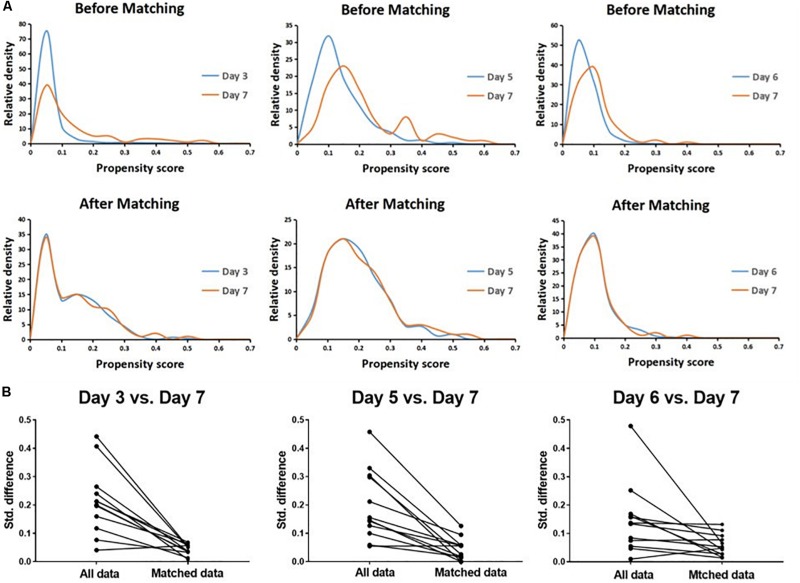
Data were collected from 4489 infertile women who gave birth to live-born singletons after vitrified-warmed embryo transfer cycles from January 1, 2006 to December 31, 2017. Singletons were compared depending on the age of embryos. Main perinatal outcome parameters included PTB (gestational age < 37 weeks), very PTB (VPTB, gestational age < 32 weeks), LGA (birthweights > 90th percentiles), and SGA (birthweights < 10th percentiles). Obstetric outcomes included gestational diabetes (GDM), pregnancy-induced hypertension (PIH), preterm premature rupture of membranes (PPROM), pre-eclampsia, placenta previa, placental abruption, and postpartum hemorrhage. Propensity score matching (PSM) was used to adjust the confounding factors across groups and then analyze the association between culture period and the outcome measures.
After PSM, the transfer of day 7 blastocysts was associated with higher birth weight -scores and increased incidence of very large for gestational age (VLGA) compared with the transfer of day 3 cleavage-stage embryos while the incidence of PTB, low birth weight (LBW), SGA did not reach statistical significance. Moreover, comparable perinatal outcome was found in the comparison of day 7 vs. day 5 and day 7 vs. day 6. Day 7 blastocysts did not result in adverse obstetric outcome compared with day 3, day 5, and day 6 embryos, respectively.
In vitrified-warmed transfer cycles, day 7 blastocysts were associated with adverse perinatal outcome regarding higher risk of VLGA compared with day 3 cleavage-stage embryo, while blastocysts with diverse growth rates embrace similar developmental viability regardless of blastocysts vitrified on day 5, day 6, or day 7.
据报道,延长胚胎培养会影响围产期结局,即巨大儿(LGA)和早产(PTB)风险增加,但小于胎龄儿(SGA)风险降低。然而,关于第7天囊胚移植的产科结局及子代安全性的现有数据很少。
比较第7天玻璃化冷冻胚胎与第3天、第5天和第6天玻璃化冷冻胚胎的产科和围产期结局。
收集2006年1月1日至2017年12月31日期间4489例接受玻璃化冷冻胚胎移植周期后分娩单胎活产儿的不孕妇女的数据。根据胚胎年龄对单胎进行比较。主要围产期结局参数包括早产(孕周<37周)、极早早产(VPTB,孕周<32周)、巨大儿(出生体重>第90百分位数)和小于胎龄儿(出生体重<第10百分位数)。产科结局包括妊娠期糖尿病(GDM)、妊娠高血压(PIH)、胎膜早破(PPROM)、子痫前期、前置胎盘、胎盘早剥和产后出血。采用倾向得分匹配(PSM)调整组间混杂因素,然后分析培养期与结局指标之间的关联。
PSM后,与第3天卵裂期胚胎移植相比,第7天囊胚移植与更高的出生体重评分及极巨大儿(VLGA)发生率增加相关,而早产、低出生体重(LBW)、小于胎龄儿的发生率未达到统计学意义。此外,第7天与第5天、第7天与第6天的比较中发现围产期结局相当。与第3天、第5天和第6天的胚胎相比,第7天囊胚未导致不良产科结局。
在玻璃化冷冻胚胎移植周期中,与第3天卵裂期胚胎相比,第7天囊胚与极巨大儿风险增加的不良围产期结局相关,而不同生长速率的囊胚无论在第5天、第6天还是第7天玻璃化冷冻,都具有相似的发育活力。