Aasebø Kristine, Dragomir Anca, Sundström Magnus, Mezheyeuski Artur, Edqvist Per-Henrik, Eide Geir Egil, Ponten Fredrik, Pfeiffer Per, Glimelius Bengt, Sorbye Halfdan
Department of Clinical Science, University of Bergen, Bergen, Norway.
Department of Pathology, Uppsala University Hospital, Uppsala, Sweden.
Front Oncol. 2020 Feb 11;10:8. doi: 10.3389/fonc.2020.00008. eCollection 2020.
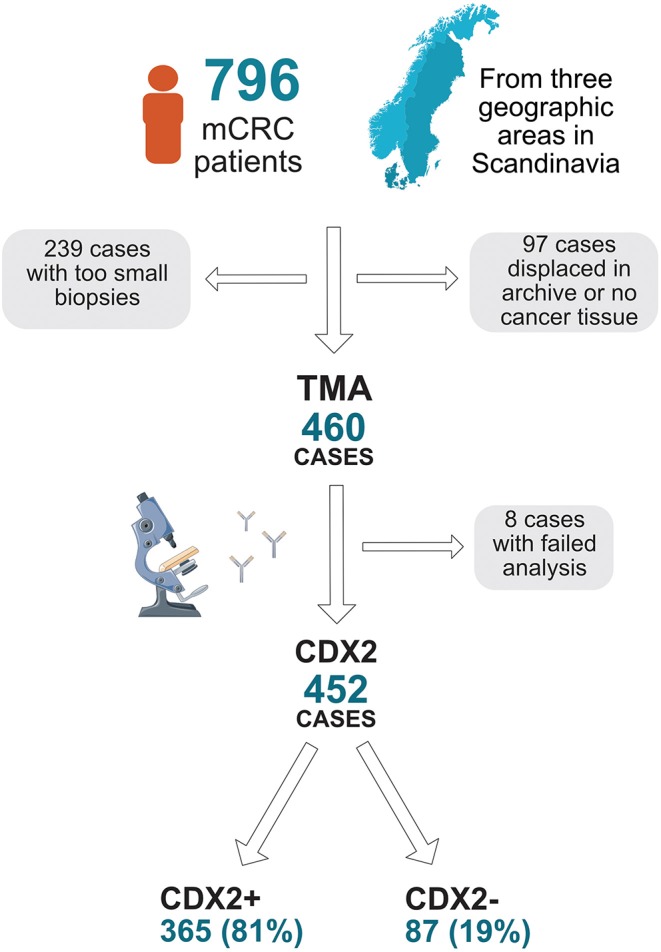
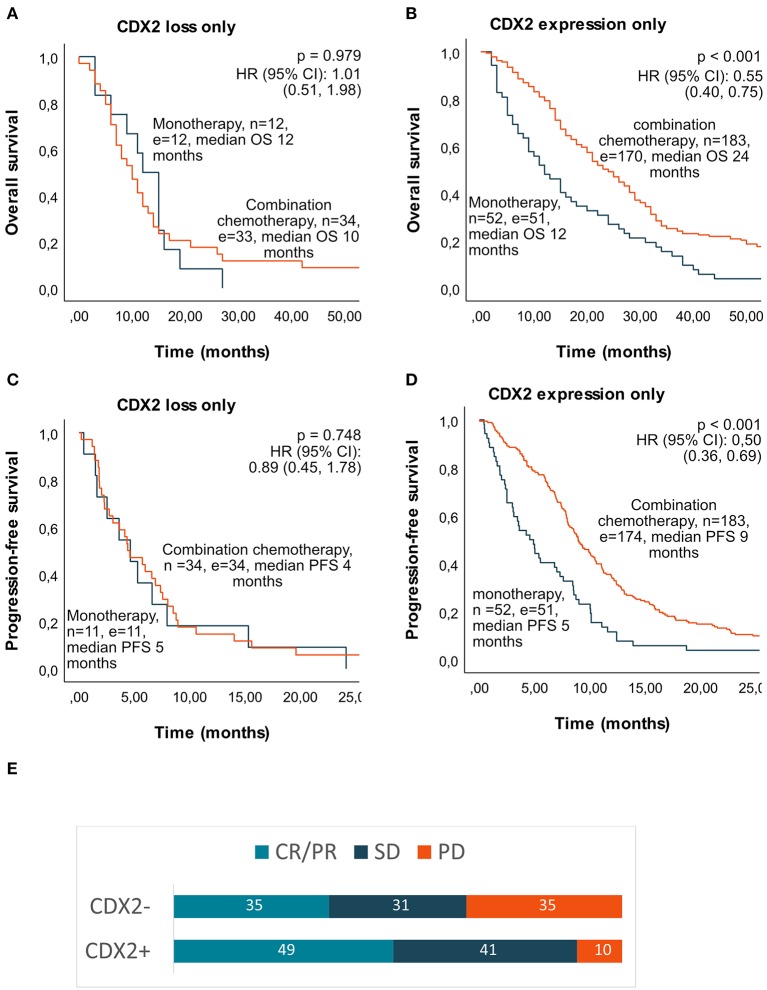
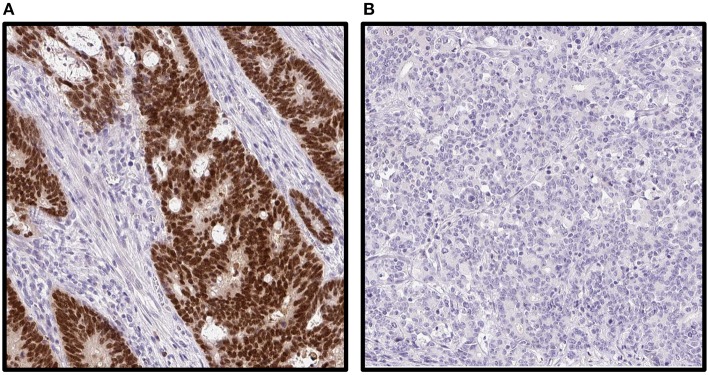
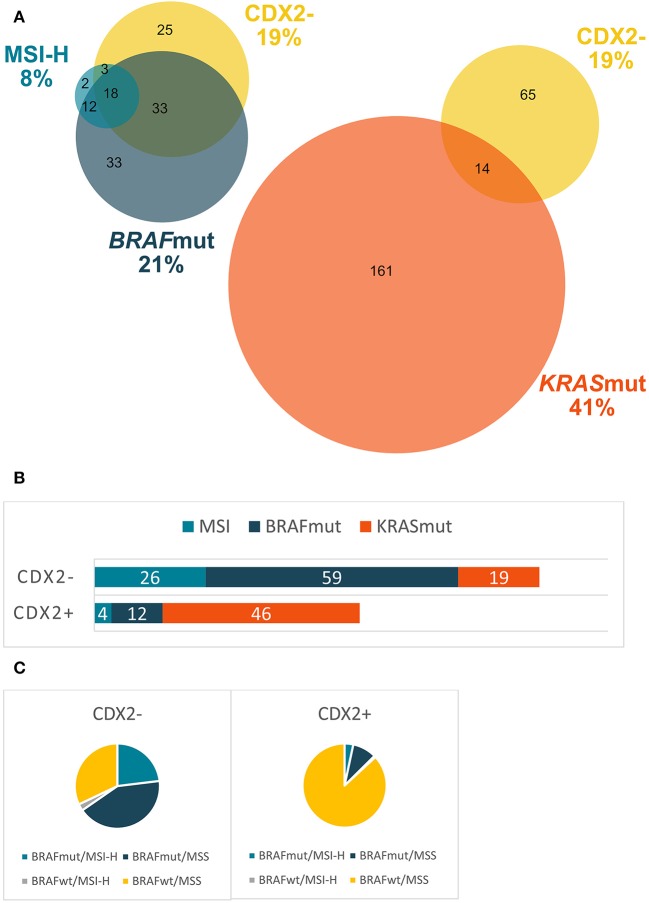
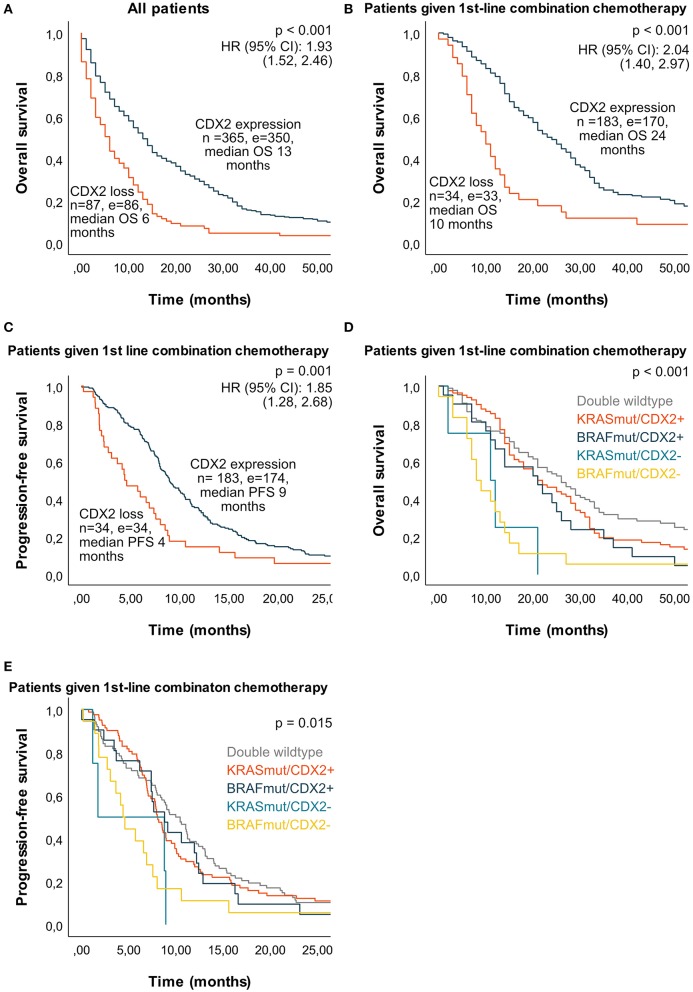
Survival of metastatic colorectal cancer (mCRC) patients has improved, but mainly for trial patients. New predictive and prognostic biomarkers validated in the general mCRC population are needed. Caudal-type homeobox 2 (CDX2) is an intestine-specific transcription factor with potential prognostic and predictive effect, but the importance in mCRC has not been fully investigated. Immunohistochemistry analysis of CDX2 was performed in a Scandinavian population-based cohort of mCRC ( = 796). Frequency, clinical and tumor characteristics, response rate, progression-free survival, and overall survival (OS) were estimated. Loss of CDX2 expression was found in 87 (19%) of 452 stained cases, in 53% if mutated (mut) and in 9% if mutated (mut). CDX2 loss was associated with microsatellite instability, mut, and poor differentiation and inversely associated with mut. Patients with CDX2 loss received less first-line (53 vs. 64%, = 0.050) and second-line (23 vs. 39%, = 0.006) chemotherapy and secondary surgery (1 vs. 9%, = 0.019). Median progression-free survival and OS for patients given first-line combination chemotherapy was 4 and 10 months if CDX2 loss vs. 9 and 24 months if CDX2 expressed ( = 0.001, < 0.001). Immediate progression on first-line combination chemotherapy was seen in 35% of patients with CDX2 loss vs. 10% if CDX2 expressed ( = 0.003). Median OS in patients with mut or mut and CDX2 expressed in tumor (both 21 months) was comparable to wild-type patients (27 months). However, if CDX2 loss, median OS was only 8 and 11 months in mut and mut cases, respectively, and 10 months in double wild-type patients. In multivariate analysis, CDX2 loss (hazard ratio: 1.50, = 0.027) and mut (hazard ratio: 1.62, = 0.012) were independent poor prognostic markers for OS. In a population-based cohort of mCRC patients, CDX2 loss is an independent poor prognostic marker. Expression of CDX2 defines a new subgroup of mut cases with a much better prognosis. Loss of CDX2 defines a small group of mut cases with a worse prognosis. Patients with CDX2 loss receive less palliative chemotherapy with less benefit and rarely reach secondary surgery.
转移性结直肠癌(mCRC)患者的生存率有所提高,但主要是试验患者。需要在一般mCRC人群中验证新的预测和预后生物标志物。尾型同源盒2(CDX2)是一种肠道特异性转录因子,具有潜在的预后和预测作用,但在mCRC中的重要性尚未得到充分研究。对斯堪的纳维亚基于人群的mCRC队列(n = 796)进行了CDX2的免疫组织化学分析。估计了频率、临床和肿瘤特征、缓解率、无进展生存期和总生存期(OS)。在452例染色病例中的87例(19%)发现CDX2表达缺失,KRAS突变(mut)时为53%,NRAS突变(mut)时为9%。CDX2缺失与微卫星不稳定性、KRAS mut相关,与分化差相关,与NRAS mut呈负相关。CDX2缺失的患者接受一线化疗(53%对64%,P = 0.050)和二线化疗(23%对39%,P = 0.006)以及二次手术(1%对9%,P = 0.019)的比例较低。一线联合化疗患者中,CDX2缺失者的中位无进展生存期和OS分别为4个月和10个月,而CDX2表达者为9个月和24个月(P = 0.001,P < 0.001)。一线联合化疗时,35%的CDX2缺失患者立即进展,而CDX2表达者为10%(P = 0.003)。肿瘤中KRAS mut或NRAS mut且CDX2表达的患者(均为21个月)的中位OS与野生型患者(27个月)相当。然而,如果CDX2缺失,KRAS mut和NRAS mut病例的中位OS分别仅为8个月和11个月,双野生型患者为10个月。在多变量分析中,CDX2缺失(风险比:1.50,P = 0.027)和KRAS mut(风险比:1.62,P = 0.012)是OS的独立不良预后标志物。在基于人群的mCRC患者队列中,CDX2缺失是独立的不良预后标志物。CDX2表达定义了一个预后好得多的KRAS mut病例新亚组。CDX2缺失定义了一小群预后较差的NRAS mut病例。CDX2缺失的患者接受的姑息化疗较少,获益较少,很少能进行二次手术。