Zhang Yi, Wu Miaomiao, Ma Jiwei, Wei Guangfeng, Ling Yun, Zhang Renyuan, Huang Yunhui
Institute of New Energy for Vehicles, Shanghai Key Laboratory for Development and Application of Metallic Functional Materials, School of Materials Science and Engineering, Tongji University, Shanghai, 201804, P. R. China.
Shanghai Key Laboratory of Chemical Assessment and Sustainability, School of Chemical Science and Engineering, Tongji University, Shanghai, 200092, P. R. China.
ACS Cent Sci. 2020 Feb 26;6(2):232-240. doi: 10.1021/acscentsci.9b01166. Epub 2020 Jan 29.
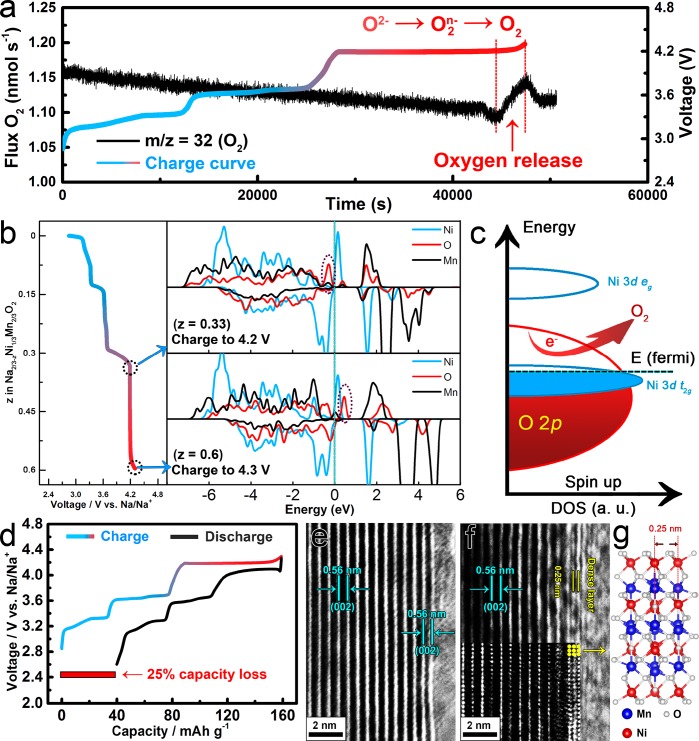
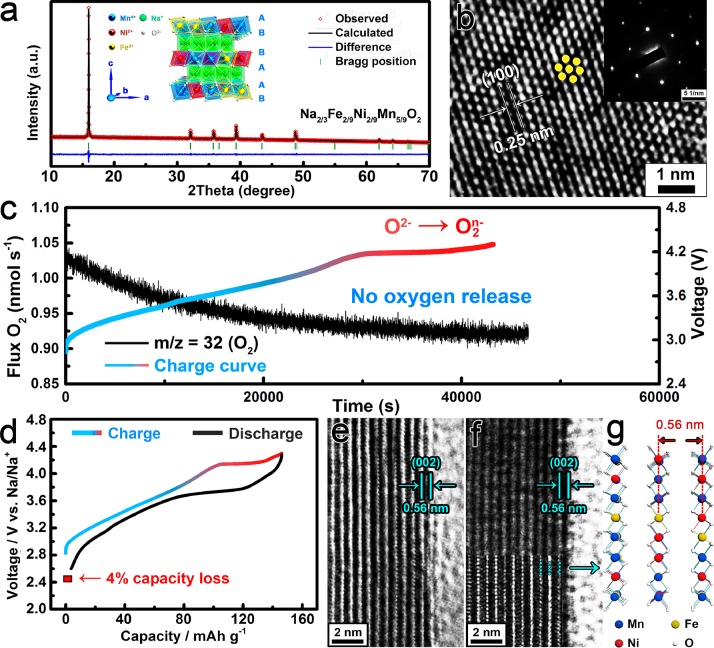
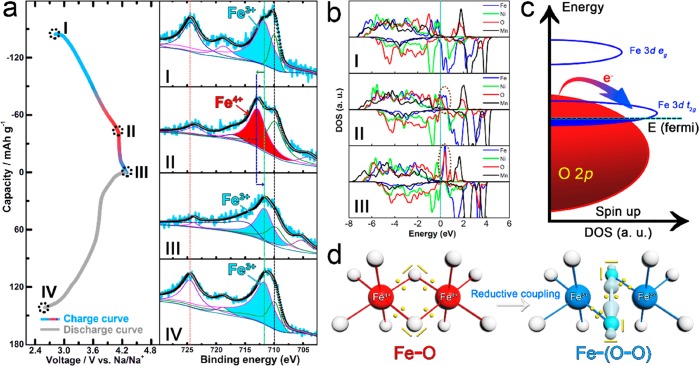
Sodium layered transition metal oxides have been considered as promising cathode materials for sodium ion batteries due to their large capacity and high operating voltage. However, mechanism investigations of chemical evolution and capacity failure at high voltage are inadequate. As a representative cathode, NaNiMnO, the capacity contribution at a 4.2 V plateau has long been assigned to the redox of the Ni/Ni couple, while at the same time it suffers large irreversible capacity loss during the initial discharging process. In this work, we prove that the capacity at the 4.2 V plateau is contributed to the irreversible O/O /O evolution based on in situ differential electrochemical mass spectrometry and density functional theory calculation results. Besides, a phenomenon of oxygen release and subsequent surface lattice densification is observed, which is responsible for the large irreversible capacity loss during the initial cycle. Furthermore, the oxygen release is successfully suppressed by Fe substitution due to the formation of a unique Fe-(O-O) species, which effectively stabilizes the reversibility of the O/O redox at high operating voltage. Our findings provide a new understanding of the chemical evolution in layered transition metal oxides at high operating voltage. Increasing the covalency of the TM-O bond has been proven to be effective in suppressing the oxygen release and hence improving the electrochemical performance.
钠层状过渡金属氧化物因其大容量和高工作电压,被认为是钠离子电池很有前景的正极材料。然而,对其在高电压下化学演变和容量衰减机制的研究还不够充分。作为一种典型的正极材料,NaNiMnO在4.2 V平台的容量贡献长期以来一直被归因于Ni/Ni电对的氧化还原,而与此同时,它在初次放电过程中会遭受较大的不可逆容量损失。在这项工作中,基于原位差分电化学质谱和密度泛函理论计算结果,我们证明了4.2 V平台的容量是由不可逆的O/O /O演变所贡献的。此外,还观察到氧释放及随后的表面晶格致密化现象,这是初次循环中出现较大不可逆容量损失的原因。此外,由于形成了独特的Fe-(O-O)物种,通过Fe取代成功抑制了氧释放,这有效地稳定了高工作电压下O/O 氧化还原的可逆性。我们的研究结果为层状过渡金属氧化物在高工作电压下的化学演变提供了新的认识。已证明提高TM-O键的共价性可有效抑制氧释放,从而改善电化学性能。