Division of Pharmacotherapy and Experimental Therapeutics, UNC Eshelman School of Pharmacy, University of North Carolina at Chapel Hill, Chapel Hill, North Carolina (K.I., N.S., M.M.M., C.G., K.L.R.B.) and Drug Metabolism and Pharmacokinetics Research Department, Teijin Pharma Limited, Hino, Tokyo, Japan (K.I.).
Division of Pharmacotherapy and Experimental Therapeutics, UNC Eshelman School of Pharmacy, University of North Carolina at Chapel Hill, Chapel Hill, North Carolina (K.I., N.S., M.M.M., C.G., K.L.R.B.) and Drug Metabolism and Pharmacokinetics Research Department, Teijin Pharma Limited, Hino, Tokyo, Japan (K.I.)
J Pharmacol Exp Ther. 2020 May;373(2):261-268. doi: 10.1124/jpet.119.263459. Epub 2020 Mar 3.
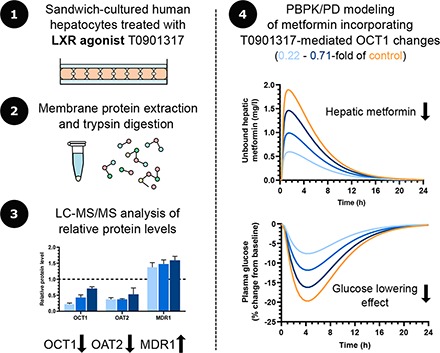
In vitro approaches for predicting drug-drug interactions (DDIs) caused by alterations in transporter protein regulation are not well established. However, reports of transporter regulation via nuclear receptor (NR) modulation by drugs are increasing. This study examined alterations in transporter protein levels in sandwich-cultured human hepatocytes (SCHH; = 3 donors) measured by liquid chromatography-tandem mass spectrometry-based proteomic analysis after treatment with N-[4-(1,1,1,3,3,3-hexafluoro-2-hydroxypropan-2-yl)phenyl]-N-(2,2,2-trifluoroethyl)benzenesulfonamide (T0901317), the first described synthetic liver X receptor agonist. T0901317 treatment (10 μM, 48 hours) decreased the levels of organic cation transporter (OCT) 1 (0.22-, 0.43-, and 0.71-fold of control) and organic anion transporter (OAT) 2 (0.38-, 0.38-, and 0.53-fold of control) and increased multidrug resistance protein (MDR) 1 (1.37-, 1.48-, and 1.59-fold of control). The induction of NR downstream gene expression supports the hypothesis that T0901317 off-target effects on farnesoid X receptor and pregnane X receptor activation are responsible for the unexpected changes in OCT1, OAT2, and MDR1. Uptake of the OCT1 substrate metformin in SCHH was decreased by T0901317 treatment. Effects of decreased OCT1 levels on metformin were simulated using a physiologically-based pharmacokinetic (PBPK) model. Simulations showed a clear decrease in metformin hepatic exposure resulting in a decreased pharmacodynamic effect. This DDI would not be predicted by the modest changes in simulated metformin plasma concentrations. Altogether, the current study demonstrated that an approach combining SCHH, proteomic analysis, and PBPK modeling is useful for revealing tissue concentration-based DDIs caused by unexpected regulation of hepatic transporters by NR modulators. SIGNIFICANCE STATEMENT: This study utilized an approach combining sandwich-cultured human hepatocytes, proteomic analysis, and physiologically based pharmacokinetic modeling to evaluate alterations in pharmacokinetics (PK) and pharmacodynamics (PD) caused by transporter regulation by nuclear receptor modulators. The importance of this approach from a mechanistic and clinically relevant perspective is that it can reveal drug-drug interactions (DDIs) caused by unexpected regulation of hepatic transporters and enable prediction of altered PK and PD changes, especially for tissue concentration-based DDIs.
目前,体外预测药物诱导的转运蛋白调节导致的药物相互作用(DDI)的方法尚未完全建立。然而,越来越多的报道表明,药物可通过核受体(NR)调节来改变转运蛋白。本研究采用液质联用蛋白质组学分析方法,检测了 N-[4-(1,1,1,3,3,3-六氟-2-羟基丙基)苯基]-N-(2,2,2-三氟乙基)苯磺酰胺(T0901317)处理后,体外培养的人肝细胞(SCHH)中转运蛋白水平的变化。T0901317(10μM,48 小时)处理可降低有机阳离子转运蛋白 1(OCT1)(对照的 0.22-0.43-0.71 倍)和有机阴离子转运蛋白 2(OAT2)(对照的 0.38-0.38-0.53 倍)的水平,并增加多药耐药蛋白 1(MDR1)(对照的 1.37-1.48-1.59 倍)。NR 下游基因表达的诱导支持这样一种假设,即 T0901317 对法尼醇 X 受体和孕烷 X 受体激活的非靶标效应是导致 OCT1、OAT2 和 MDR1 发生意外变化的原因。T0901317 处理可降低 SCHH 中 OCT1 底物二甲双胍的摄取。使用基于生理学的药代动力学(PBPK)模型模拟 OCT1 水平降低对二甲双胍的影响。模拟结果表明,二甲双胍肝暴露明显减少,导致药效作用降低。这种药物相互作用不会被模拟二甲双胍血浆浓度的适度变化所预测。总之,本研究表明,结合体外培养的人肝细胞、蛋白质组学分析和基于生理学的药代动力学建模的方法,可用于揭示核受体调节剂对肝转运体的意外调节导致的组织浓度为基础的药物相互作用。
本研究采用结合体外培养的人肝细胞、蛋白质组学分析和基于生理学的药代动力学建模的方法,评估了核受体调节剂对转运蛋白调节引起的药代动力学(PK)和药效学(PD)的改变。从机制和临床相关的角度来看,这种方法的重要性在于,它可以揭示由于肝转运体的意外调节而导致的药物相互作用,并能够预测改变的 PK 和 PD 变化,特别是对于组织浓度为基础的药物相互作用。