• 文献检索
  • 文档翻译
  • 深度研究
  • 学术资讯
  • Suppr Zotero 插件Zotero 插件
  • 邀请有礼
  • 套餐&价格
  • 历史记录
应用&插件
Suppr Zotero 插件Zotero 插件浏览器插件Mac 客户端Windows 客户端微信小程序
定价
高级版会员购买积分包购买API积分包
服务
文献检索文档翻译深度研究API 文档MCP 服务
关于我们
关于 Suppr公司介绍联系我们用户协议隐私条款
关注我们

Suppr 超能文献

核心技术专利:CN118964589B侵权必究
粤ICP备2023148730 号-1Suppr @ 2026

文献检索

告别复杂PubMed语法,用中文像聊天一样搜索,搜遍4000万医学文献。AI智能推荐,让科研检索更轻松。

立即免费搜索

文件翻译

保留排版,准确专业,支持PDF/Word/PPT等文件格式,支持 12+语言互译。

免费翻译文档

深度研究

AI帮你快速写综述,25分钟生成高质量综述,智能提取关键信息,辅助科研写作。

立即免费体验

秘鲁商业百香果(Passiflora ligularis)对番石榴实蝇(双翅目:实蝇科)和南美果蝇(Anastrepha fraterculus)的非寄主状态。

Nonhost Status of Commercial Sweet Granadilla (Passiflora ligularis) in Peru to Ceratitis capitata (Diptera: Tephritidae) and Anastrepha fraterculus.

机构信息

Servicio Nacional de Sanidad Agraria (SENASA), La Molina 1915, La MOlina, Lima, Peru.

出版信息

J Econ Entomol. 2020 Jun 6;113(3):1158-1175. doi: 10.1093/jee/toaa026.

DOI:10.1093/jee/toaa026
PMID:32128582
原文链接:https://pmc.ncbi.nlm.nih.gov/articles/PMC7275692/
Abstract

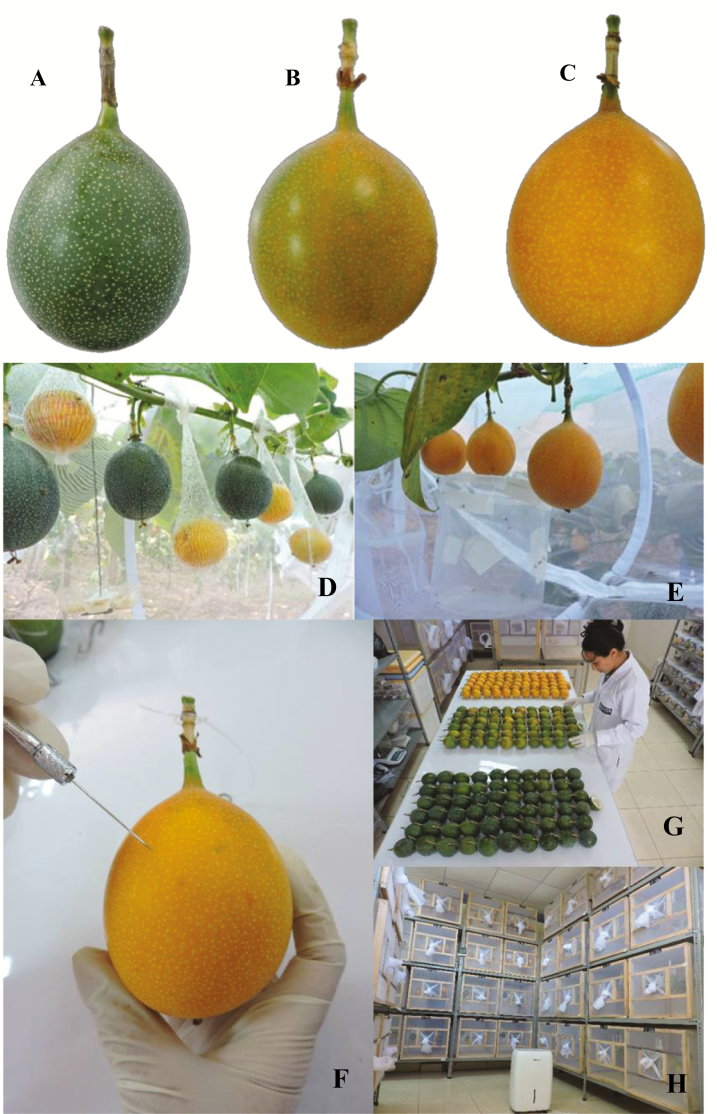
The host status of sweet granadilla (Passifflora ligularis Juss.) to Ceratitis capitata (Wiedemann) and Anastrepha fraterculus (Wiedemann) in Peru was determined. Experiments were conducted in Pasco (Peru) in four different orchards, over 2 yr (2016 and 2017), two orchards per year. Choice (granadilla plus natural host) and no-choice foraging behavior trials were conducted using sleeves under field conditions, and forced infestation was examined in laboratory cages, with five females per fruit. The development time of C. capitata was determined, and the oviposition behavior of C. capitata and A. fraterculus was examined. Three fruit maturity stages of intact (n = 1,320) and punctured (n = 1,320) granadilla fruits were examined. Adult C. capitata (n = 4,418) and A. fraterculus (n = 2,484) were trapped in the orchards, and commercial granadilla fruits (n = 1,940) sampled and dissected. Fruit fly infestation was not found in any intact granadilla fruits. Larvae and pupae were found inside punctured granadilla only in fruits broken after 20 d, and adults only emerged when those pupae were removed from the fruit. Ceratitis capitata development time was longer in punctured granadilla than that in host fruit. In the oviposition test, A. fraterculus and C. capitata did not lay eggs in intact granadilla, and C. capitata laid eggs in punctured fruits but larvae were not found. Because of the resistance mechanisms of the pericarp, commercial fruits of Passiflora ligularis are not a natural host of C. capitata and A. fraterculus in Peru.

摘要

在秘鲁,确定了甜百香果(Passiflora ligularis Juss.)对桔小实蝇(Ceratitis capitata Wiedemann)和南美番荔枝实蝇(Anastrepha fraterculus Wiedemann)的寄主地位。在秘鲁帕斯科(Pasco)的四个不同果园进行了为期两年(2016 年和 2017 年)的实验,每年两个果园。在田间条件下使用套管进行了选择(百香果加天然寄主)和非选择觅食行为试验,并在实验室笼中进行了强制感染试验,每个果实有 5 只雌性。测定了桔小实蝇的发育时间,并观察了桔小实蝇和南美番荔枝实蝇的产卵行为。检查了完整(n = 1,320)和穿孔(n = 1,320)百香果果实的三个成熟阶段。在果园中捕获了成年桔小实蝇(n = 4,418)和南美番荔枝实蝇(n = 2,484),并对商业百香果果实(n = 1,940)进行了取样和解剖。在任何完整的百香果果实中都没有发现实蝇幼虫。只有在穿孔百香果果实破裂 20 天后,才发现幼虫和蛹,只有当这些蛹从果实中取出时,成虫才会出现。在穿孔百香果中,桔小实蝇的发育时间比在寄主果实中更长。在产卵试验中,A. fraterculus 和 C. capitata 不在完整的百香果中产卵,C. capitata 在穿孔的果实中产卵,但未发现幼虫。由于果皮的抗虫机制,秘鲁商业百香果不是桔小实蝇和南美番荔枝实蝇的天然寄主。
https://cdn.ncbi.nlm.nih.gov/pmc/blobs/3b44/7275692/d529a80bf69d/toaa026f0005.jpg
https://cdn.ncbi.nlm.nih.gov/pmc/blobs/3b44/7275692/c69ea6f15b9b/toaa026f0001.jpg
https://cdn.ncbi.nlm.nih.gov/pmc/blobs/3b44/7275692/9ab52e758d50/toaa026f0002.jpg
https://cdn.ncbi.nlm.nih.gov/pmc/blobs/3b44/7275692/31e5c78e68df/toaa026f0003.jpg
https://cdn.ncbi.nlm.nih.gov/pmc/blobs/3b44/7275692/c17a322119f0/toaa026f0004.jpg
https://cdn.ncbi.nlm.nih.gov/pmc/blobs/3b44/7275692/d529a80bf69d/toaa026f0005.jpg
https://cdn.ncbi.nlm.nih.gov/pmc/blobs/3b44/7275692/c69ea6f15b9b/toaa026f0001.jpg
https://cdn.ncbi.nlm.nih.gov/pmc/blobs/3b44/7275692/9ab52e758d50/toaa026f0002.jpg
https://cdn.ncbi.nlm.nih.gov/pmc/blobs/3b44/7275692/31e5c78e68df/toaa026f0003.jpg
https://cdn.ncbi.nlm.nih.gov/pmc/blobs/3b44/7275692/c17a322119f0/toaa026f0004.jpg
https://cdn.ncbi.nlm.nih.gov/pmc/blobs/3b44/7275692/d529a80bf69d/toaa026f0005.jpg

相似文献

1
Nonhost Status of Commercial Sweet Granadilla (Passiflora ligularis) in Peru to Ceratitis capitata (Diptera: Tephritidae) and Anastrepha fraterculus.秘鲁商业百香果(Passiflora ligularis)对番石榴实蝇(双翅目:实蝇科)和南美果蝇(Anastrepha fraterculus)的非寄主状态。
J Econ Entomol. 2020 Jun 6;113(3):1158-1175. doi: 10.1093/jee/toaa026.
2
Native and introduced host plants of Anastrepha fraterculus and Ceratitis capitata (Diptera: Tephritidae) in northwestern Argentina.阿根廷西北部番荔枝实蝇和地中海实蝇(双翅目:实蝇科)的本地及引入寄主植物
J Econ Entomol. 2003 Aug;96(4):1108-18. doi: 10.1093/jee/96.4.1108.
3
Oviposition performance of tephritid polyphagous Anastrepha fraterculus and Ceratitis capitata during three periods of exposure to fruit.在暴露于果实的三个时期内,多食性桔小实蝇和瓜实蝇的产卵性能。
Braz J Biol. 2022 Oct 21;82:e266065. doi: 10.1590/1519-6984.266065. eCollection 2022.
4
Toxic effect of citrus peel constituents on Anastrepha fraterculus Wiedemann and Ceratitis capitata Wiedemann immature stages.柑橘皮成分对墨西哥按实蝇和地中海实蝇未成熟阶段的毒性作用。
J Agric Food Chem. 2014 Oct 15;62(41):10084-91. doi: 10.1021/jf503063b. Epub 2014 Oct 6.
5
Search hours for food attractant by Anastrepha fraterculus and Ceratitis capitata (Diptera: Tephritidae) adults in guava orchards.番石榴果园中,桔小实蝇和地中海实蝇(双翅目:实蝇科)成虫寻找食物引诱剂的时间。
An Acad Bras Cienc. 2023 Apr 17;95(2):e20201880. doi: 10.1590/0001-3765202320201880. eCollection 2023.
6
Nonhost status of commercial Persea americana 'Hass' to Anastrepha ludens, Anastrepha obliqua, Anastrepha serpentina, and Anastrepha striata (Diptera: Tephritidae) in Mexico.墨西哥商业鳄梨品种‘哈斯’对墨西哥按实蝇、斜纹按实蝇、蛇形按实蝇和条纹按实蝇(双翅目:实蝇科)的非寄主状态
J Econ Entomol. 2004 Apr;97(2):293-309. doi: 10.1603/0022-0493-97.2.293.
7
Natural Parasitism Influences Biological Control Strategies Against Both Global Invasive Pests Ceratitis capitata (Diptera: Tephritidae) and Drosophila suzukii (Diptera: Drosophilidae), and the Neotropical-Native Pest Anastrepha fraterculus (Diptera: Tephritidae).自然寄生影响针对全球入侵害虫地中海实蝇(双翅目:实蝇科)和斑翅果蝇(双翅目:果蝇科)以及新热带-本地害虫南美果蝇(双翅目:实蝇科)的生物防治策略。
Environ Entomol. 2022 Dec 16;51(6):1120-1135. doi: 10.1093/ee/nvac085.
8
Oviposition of fruit flies (Diptera: Tephritidae) and its relation with the pericarp of citrus fruits.果蝇(双翅目:实蝇科)的产卵行为及其与柑橘类果实果皮的关系。
Braz J Biol. 2018 Aug;78(3):443-448. doi: 10.1590/1519-6984.167661. Epub 2017 Oct 30.
9
Functional response and preference of Diachasmimorpha longicaudata (Hymenoptera: Braconidae) in Ceratitis capitata and Anastrepha fraterculus (Diptera: Tephritidae).长管臀小卷蛾(膜翅目:长尾小蜂科)对地中海实蝇和瓜实蝇(双翅目:实蝇科)的功能反应和偏好。
An Acad Bras Cienc. 2021 Oct 22;93(4):e20190935. doi: 10.1590/0001-3765202120190935. eCollection 2021.
10
Susceptibility of Brazilian Populations of Anastrepha fraterculus, Ceratitis capitata (Diptera: Tephritidae), and Drosophila suzukii (Diptera: Drosophilidae) to Selected Insecticides.巴西人群体对番石榴实蝇、地中海实蝇(双翅目:实蝇科)和铃木氏果蝇(双翅目:果蝇科)对选定杀虫剂的敏感性。
J Econ Entomol. 2021 Jun 11;114(3):1291-1297. doi: 10.1093/jee/toab050.

本文引用的文献

1
Repellency, toxicity, and anti-oviposition of essential oil of Gardenia jasminoides and its four major chemical components against whiteflies and mites.栀子精油及其四种主要化学成分对白粉虱和螨虫的驱避性、毒性和拒食作用。
Sci Rep. 2018 Jun 20;8(1):9375. doi: 10.1038/s41598-018-27366-5.
2
Host status of avocado ('Hass') to Ceratitis capitata, Ceratitis rosa, and Ceratitis cosyra (Diptera: Tephritidae) in South Africa.南非鳄梨(‘哈斯’品种)对地中海实蝇、蔷薇实蝇和科西拉实蝇(双翅目:实蝇科)的寄主状况
J Econ Entomol. 2009 Aug;102(4):1448-59. doi: 10.1603/029.102.0408.
3
Fruit fly (Diptera: Tephritidae) host status determination: critical conceptual, methodological, and regulatory considerations.
果蝇(双翅目:实蝇科)寄主状态的确定:关键的概念、方法和监管考量
Annu Rev Entomol. 2008;53:473-502. doi: 10.1146/annurev.ento.53.103106.093350.
4
Confidence limits and sample size for determining nonhost status of fruits and vegetables to tephritid fruit flies as a quarantine measure.作为一种检疫措施,确定水果和蔬菜对实蝇的非寄主状态的置信限和样本量。
J Econ Entomol. 2007 Apr;100(2):251-7. doi: 10.1603/0022-0493(2007)100[251:classf]2.0.co;2.
5
Nonhost status of commercial Persea americana 'Hass' to Anastrepha ludens, Anastrepha obliqua, Anastrepha serpentina, and Anastrepha striata (Diptera: Tephritidae) in Mexico.墨西哥商业鳄梨品种‘哈斯’对墨西哥按实蝇、斜纹按实蝇、蛇形按实蝇和条纹按实蝇(双翅目:实蝇科)的非寄主状态
J Econ Entomol. 2004 Apr;97(2):293-309. doi: 10.1603/0022-0493-97.2.293.