Division of Thoracic Oncology, Shizuoka Cancer Center, 1007 Shimonagakubo, Nagaizumi, Sunto-gun, Shizuoka, 411-8777, Japan.
Clinical Research Center, Shizuoka Cancer Center, Shizuoka, Japan.
Invest New Drugs. 2020 Oct;38(5):1612-1617. doi: 10.1007/s10637-020-00917-2. Epub 2020 Mar 3.
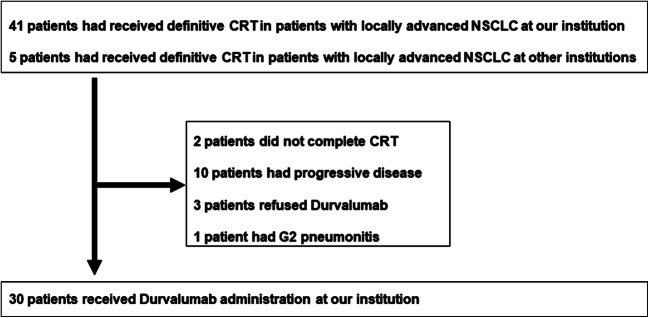
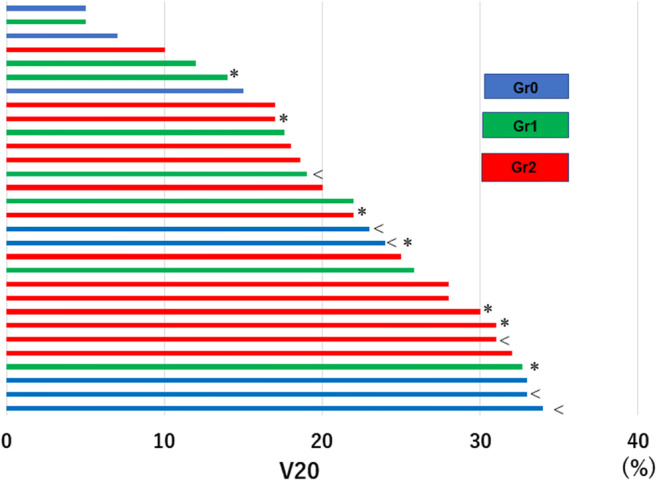
Introduction Durvalumab has been shown to confer a survival benefit after definitive chemoradiotherapy in the patients with locally advanced non-small cell lung cancer, but no studies have attempted to identify risk factors for pneumonitis after durvalumab therapy. The purpose of this study was to investigate associations between clinical and radiation dose-volume factors, and the severity of pneumonitis. Methods We retrospectively assessed the cases of 30 patients who had been started on durvalumab therapy between July 2018 and February 2019. In this study we evaluated the percentage of lung volume receiving radiation dose in excess of 20 Gy (V20) as radiation dose-volume factor. We compared V20 and some baseline factors between a grade 0 or 1 (Gr 0/1) pneumonitis group and a grade 2 or more (≥Gr 2) pneumonitis group, and we performed a logistic regression analysis to establish the associations between variables and ≥ Gr 2 pneumonitis. Results Pneumonitis had developed in 22 patients (73.3%): Gr 1/2/3-5 in 8 (26.7%)/14 (46.7%) /0 (0%), respectively. The difference in V20 between the Gr 0/1 group and Gr 2 group (median: 20.5% vs. 23.5%, p = 0.505) was not statistically significant, and thus V20 was not a risk factor for Gr 2 pneumonitis (odds ratio: 1.047, p = 0.303). None of the clinical factors, including sex, age, smoking history, presence of baseline pneumonitis, type of radiation therapy, location of lesion and facility, were risk factors. Conclusions Our study suggest that the severity of pneumonitis after durvalumab is unrelated to V20 or any of the clinical factors assessed in this study.
度伐利尤单抗在局部晚期非小细胞肺癌患者接受根治性放化疗后显示出生存获益,但尚无研究试图确定度伐利尤单抗治疗后发生肺炎的风险因素。本研究旨在探讨临床和放射剂量-体积因素与肺炎严重程度之间的关系。
我们回顾性评估了 30 例于 2018 年 7 月至 2019 年 2 月开始度伐利尤单抗治疗的患者病例。在本研究中,我们将接受超过 20Gy(V20)剂量的肺体积百分比评估为放射剂量-体积因素。我们比较了 V20 和一些基线因素在 0 或 1 级(Gr 0/1)肺炎组和 2 级或更高(≥Gr 2)肺炎组之间的差异,并进行逻辑回归分析以确定变量与≥Gr 2 肺炎之间的关系。
22 例患者(73.3%)出现肺炎:Gr 1/2/3-5 分别为 8 例(26.7%)/14 例(46.7%)/0 例(0%)。Gr 0/1 组和 Gr 2 组之间的 V20 差异无统计学意义(中位数:20.5% vs. 23.5%,p=0.505),因此 V20 不是 Gr 2 肺炎的危险因素(比值比:1.047,p=0.303)。包括性别、年龄、吸烟史、基线肺炎存在情况、放疗类型、病变位置和机构在内的所有临床因素均不是危险因素。
我们的研究表明,度伐利尤单抗治疗后肺炎的严重程度与 V20 或本研究评估的任何临床因素无关。