Facultad de Ingeniería, Universidad Autónoma de Baja California, Mexicali, Mexico.
Facultad de Enfermería, Universidad Autónoma de Baja California, Mexicali, Mexico.
JMIR Mhealth Uhealth. 2020 Mar 2;8(3):e14680. doi: 10.2196/14680.
Problems with prospective memory, which refers to the ability to remember future intentions, cause deficits in basic and instrumental activities of daily living, such as taking medications. Older adults show minimal deficits when they rely on mostly preserved and relatively automatic associative retrieval processes. On the basis of this, we propose to provide external cues to support the automatic retrieval of an intended action, that is, to take medicines. To reach this end, we developed the Medication Ambient Display (MAD), a system that unobtrusively presents relevant information (unless it requires the users' attention) and uses different abstract modalities to provide external cues that enable older adults to easily take their medications on time and be aware of their medication adherence.
This study aimed to assess the adoption and effect of external cues provided through ambient displays on medication adherence in older adults.
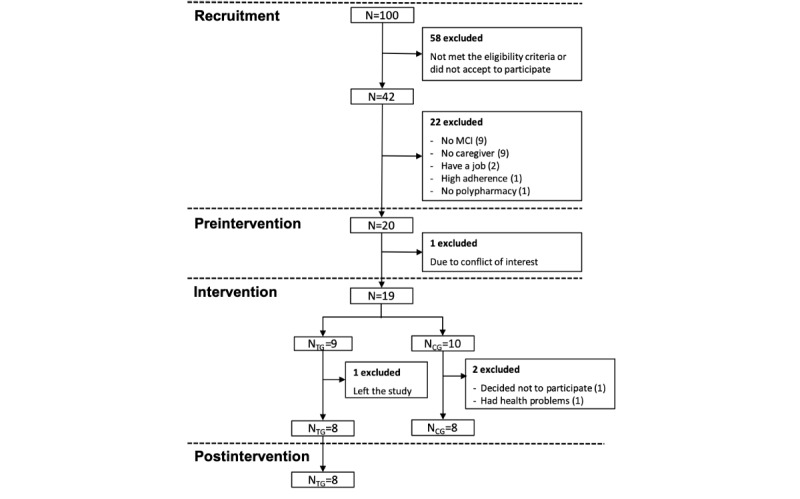
A total of 16 older adults, who took at least three medications and had mild cognitive impairment, participated in the study. We conducted a 12-week feasibility study in which we used a mixed methods approach to collect qualitative and quantitative evidence. The study included baseline, intervention, and postintervention phases. Half of the participants were randomly allocated to the treatment group (n=8), and the other half was assigned to the control group (n=8). During the study phases, research assistants measured medication adherence weekly through the pill counting technique.
The treatment group improved their adherence behavior from 80.9% at baseline to 95.97% using the MAD in the intervention phase. This decreased to 76.71% in the postintervention phase when the MAD was no longer being used. Using a one-way repeated measures analysis of variance and a post hoc analysis using the Tukey honestly significant difference test, we identified a significant statistical difference between the preintervention and intervention phases (P=.02) and between the intervention and postintervention phases (P=.002). In addition, the medication adherence rate of the treatment group (95.97%) was greater than that of the control group (88.18%) during the intervention phase. Our qualitative results showed that the most useful cues were the auditory reminders, followed by the stylized representations of medication adherence. We also found that the MAD's external cues not only improved older adults' medication adherence but also mediated family caregivers' involvement.
The findings of this study demonstrate that using ambient modalities for implementing external cues is useful for drawing the attention of older adults to remind them to take medications and to provide immediate awareness on adherence behavior.
ClinicalTrials.gov NCT04289246; https://tinyurl.com/ufjcz97.
前瞻性记忆是指记住未来意图的能力,它会导致基本和工具性日常生活活动出现障碍,例如服药。老年人在依赖大部分保存且相对自动的联想检索过程时,仅会出现最小的缺陷。基于这一点,我们提出提供外部线索来支持对预期动作的自动检索,即服药。为了达到这个目的,我们开发了 Medication Ambient Display(MAD)系统,该系统可以毫不突兀地呈现相关信息(除非需要用户的注意),并使用不同的抽象模式提供外部线索,使老年人能够轻松按时服药并了解他们的用药依从性。
本研究旨在评估通过环境显示提供的外部线索对老年人用药依从性的采用和效果。
共有 16 名认知障碍程度较轻、至少服用三种药物的老年人参与了这项研究。我们进行了为期 12 周的可行性研究,采用混合方法收集定性和定量证据。该研究包括基线期、干预期和干预后。一半参与者被随机分配到治疗组(n=8),另一半被分配到对照组(n=8)。在研究期间,研究助理每周通过药丸计数技术测量用药依从性。
在干预期使用 MAD 时,治疗组的依从性从基线时的 80.9%提高到 95.97%。当不再使用 MAD 时,这一比例在干预后阶段下降至 76.71%。通过单向重复测量方差分析和 Tukey 诚实显著差异检验的事后分析,我们发现干预前和干预阶段之间(P=.02)以及干预和干预后阶段之间(P=.002)存在显著的统计学差异。此外,在干预阶段,治疗组的用药依从率(95.97%)高于对照组(88.18%)。我们的定性结果表明,最有用的线索是听觉提醒,其次是药物依从性的风格化表示。我们还发现,MAD 的外部线索不仅提高了老年人的用药依从性,还促进了家庭照顾者的参与。
本研究结果表明,使用环境模态来实施外部线索对于吸引老年人的注意力以提醒他们服药并提供对服药依从性的即时意识非常有用。
ClinicalTrials.gov NCT04289246;https://tinyurl.com/ufjcz97。