Emergency Intensive Care Unit, Emergency Department, The First Affiliated Hospital of Wenzhou Medical University, Wenzhou, 325000, People's Republic of China.
Trauma Research Center, Fourth Medical of the Chinese PLA General Hospital, Beijing, 100048, People's Republic of China.
Crit Care. 2020 Mar 4;24(1):75. doi: 10.1186/s13054-020-2798-6.
Although current guidelines for AKI suggested against the use of furosemide in AKI management, the effect of furosemide on outcomes in real-world clinical settings remains uncertain. The aim of the present study was to investigate the association between furosemide administration and outcomes in critically ill patients with AKI using real-world data.
Critically ill patients with AKI were identified from the Medical Information Mart for Intensive Care (MIMIC)-III database. Propensity score (PS) matched analysis was used to match patients receiving furosemide to those without diuretics treatment. Linear regression, logistic regression model, and Cox proportional hazards model were used to assess the associations between furosemide and length of stay, recovery of renal function, and in-hospital and 90-day mortality, respectively.
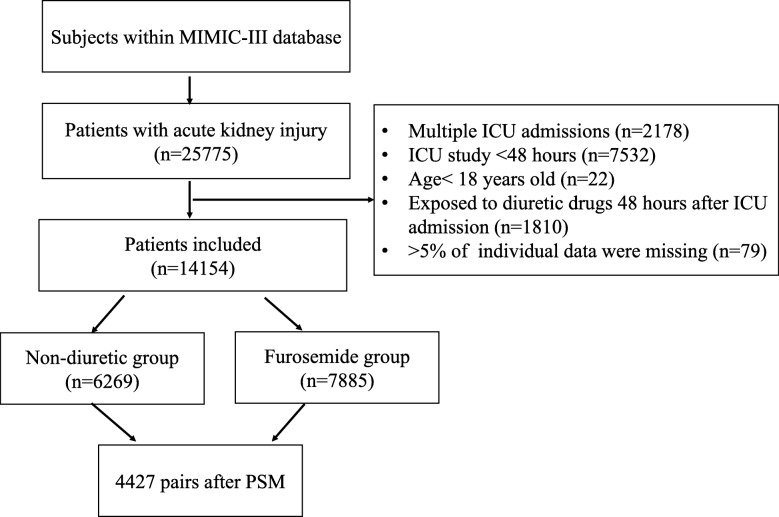
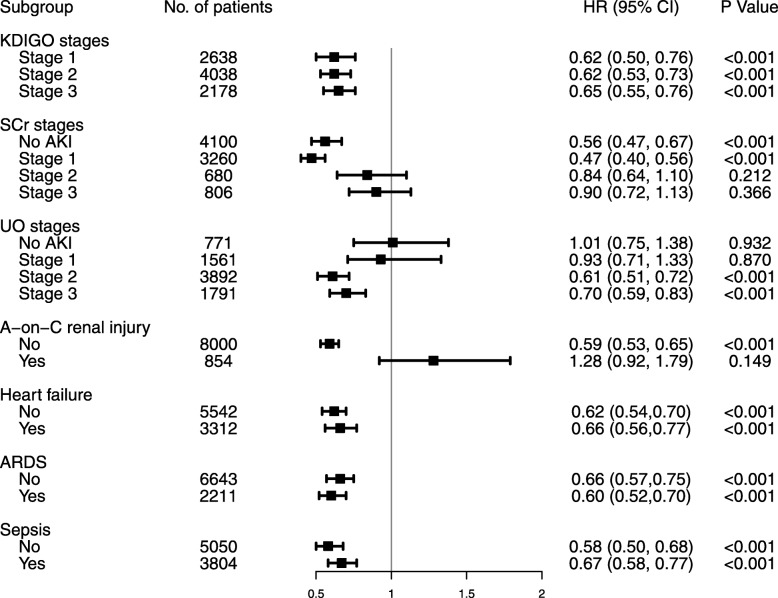
A total of 14,154 AKI patients were included in the data analysis. After PS matching, 4427 pairs of patients were matched between the patients who received furosemide and those without diuretics treatment. Furosemide was associated with reduced in-hospital mortality [hazard ratio (HR) 0.67; 95% CI 0.61-0.74; P < 0.001] and 90-day mortality [HR 0.69; 95% CI 0.64-0.75; P < 0.001], and it was also associated with the recovery of renal function [HR 1.44; 95% CI 1.31-1.57; P < 0.001] in over-all AKI patients. Nevertheless, results illustrated that furosemide was not associated with reduced in-hospital mortality in patients with AKI stage 0-1 defined by UO criteria, AKI stage 2-3 according to SCr criteria, and in those with acute-on-chronic (A-on-C) renal injury.
Furosemide administration was associated with improved short-term survival and recovery of renal function in critically ill patients with AKI. Furosemide was especially effective in patients with AKI UO stage 2-3 degree. However, it was not effective in those with AKI SCr stage 2-3 and chronic kidney disease. The results need to be verified in randomized controlled trials.
尽管目前急性肾损伤(AKI)指南建议避免在 AKI 管理中使用呋塞米,但呋塞米在真实临床环境中的疗效仍不确定。本研究旨在使用真实世界数据探讨 AKI 危重症患者中呋塞米给药与结局的关系。
从医疗信息集市重症监护数据库(MIMIC-III 数据库)中确定 AKI 危重症患者。采用倾向评分(PS)匹配分析将接受呋塞米治疗的患者与未接受利尿剂治疗的患者进行匹配。采用线性回归、逻辑回归模型和 Cox 比例风险模型分别评估呋塞米与住院时间、肾功能恢复以及院内和 90 天死亡率之间的关系。
共纳入 14154 例 AKI 患者进行数据分析。经过 PS 匹配后,在接受呋塞米和未接受利尿剂治疗的患者中,共匹配了 4427 对患者。呋塞米与院内死亡率降低相关[风险比(HR)0.67;95%置信区间(CI)0.61-0.74;P<0.001]和 90 天死亡率降低相关[HR 0.69;95%CI 0.64-0.75;P<0.001],并且与总体 AKI 患者的肾功能恢复相关[HR 1.44;95%CI 1.31-1.57;P<0.001]。然而,结果表明,在 UO 标准定义的 AKI 0-1 期、SCr 标准定义的 AKI 2-3 期以及急性合并慢性(A-on-C)肾损伤患者中,呋塞米与降低院内死亡率无关。
在 AKI 危重症患者中,呋塞米给药与短期生存率提高和肾功能恢复相关。呋塞米在 AKI UO 2-3 度患者中效果尤其显著。然而,在 AKI SCr 2-3 期和慢性肾脏病患者中,呋塞米无效。结果需要在随机对照试验中进一步验证。