Temprado Jean-Jacques, Torre Marta Maria, Langeard Antoine, Julien-Vintrou Marine, Devillers-Réolon Louise, Sleimen-Malkoun Rita, Berton Eric
Aix-Marseille Université and CNRS, UMR 7287 Institut des Sciences du Mouvement Etienne-Jules Marey, Marseille, France.
Università degli Studi di Roma "Foro Italico," Rome, Italy.
Front Aging Neurosci. 2020 Feb 18;12:29. doi: 10.3389/fnagi.2020.00029. eCollection 2020.
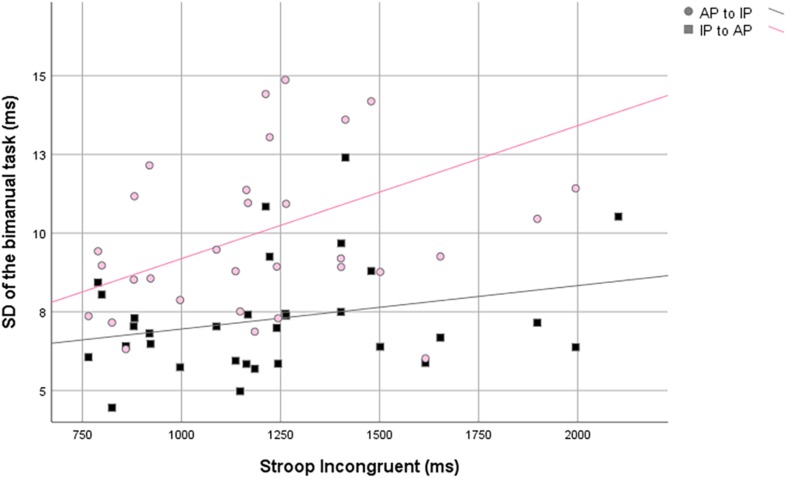
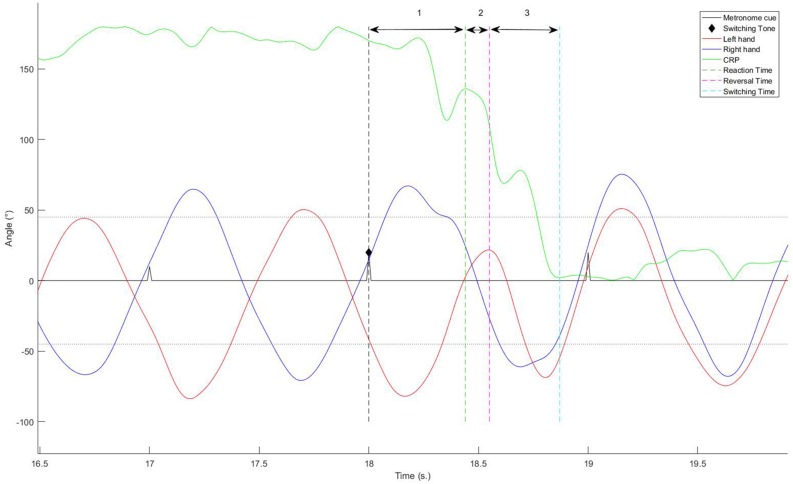
The study investigated the consequences of age-related decline in inhibition processes on intentional switching between bimanual coordination patterns. Fifteen young (24±2.8 years) and 20 older adults (69±5.3 years) performed Stroop tasks and bimanual coordination tasks. Stroop tasks included neutral, congruent, and incongruent conditions. Response time and error rate were measured. Bimanual coordination tasks consisted of performing in-phase (IP) and anti-phase (AP) patterns. Participants were requested to switch as quickly as possible from one pattern to the other, resulting in two different switching directions (AP to IP; IP to AP). Mean and standard deviation (SD) of the continuous relative phase (CRP) were calculated pre- and post-switching for each participant. Total switching time (TST) was measured. The switching phase was also decomposed into reaction time (RT) and reversal time (REvT). Pearson correlation analyses were performed to test for correlations between: (i) SD of CRP and response time in Stroop tasks, and (ii) switching times (TST, RT, RevT) and response time in Stroop task, respectively. In addition, parallel mediation analyses were conducted. Results showed that: (i) the AP pattern was less stable than the IP pattern in both young and older adults, (ii) coordination patterns were less stable in older adults, (iii) response times in Stroop task were longer in the incongruent condition, and (iv) RespTs were longer in older than in young participants, whatever the condition. In the bimanual coordination task, RT, RevT, and TST increased with age. The stability of the IP pattern was correlated with the response times observed in neutral and congruent conditions, while the stability of the AP pattern was correlated with response time observed in the incongruent condition. Correlation and mediation analyses showed that, in the AP to IP switching direction, RT and RevT were both significantly correlated with response times observed in the incongruent condition of Stroop task. These findings suggest that inhibition processes are involved in switching between bimanual coordination patterns, at least to trigger the early phase of switching. They also support the hypothesis that inhibition processes are more involved in maintaining the AP pattern and switching to the IP pattern. Finally, age-related changes in switching times seem to be prominently mediated by alterations of inhibition processes.
该研究调查了与年龄相关的抑制过程衰退对双手协调模式之间有意转换的影响。15名年轻人(24±2.8岁)和20名老年人(69±5.3岁)进行了斯特鲁普任务和双手协调任务。斯特鲁普任务包括中性、一致和不一致条件。测量了反应时间和错误率。双手协调任务包括同相(IP)和反相(AP)模式。要求参与者尽可能快地从一种模式切换到另一种模式,从而产生两种不同的切换方向(AP到IP;IP到AP)。计算了每个参与者在切换前后连续相对相位(CRP)的均值和标准差(SD)。测量了总切换时间(TST)。切换阶段也被分解为反应时间(RT)和反转时间(REvT)。进行了皮尔逊相关分析,以检验以下两者之间的相关性:(i)CRP的SD与斯特鲁普任务中的反应时间,以及(ii)切换时间(TST、RT、RevT)与斯特鲁普任务中的反应时间。此外,还进行了平行中介分析。结果表明:(i)在年轻人和老年人中,AP模式都比IP模式不稳定,(ii)老年人的协调模式更不稳定,(iii)在不一致条件下,斯特鲁普任务中的反应时间更长,以及(iv)无论在何种条件下,老年人的反应时间都比年轻人长。在双手协调任务中,RT、RevT和TST随年龄增长而增加。IP模式的稳定性与在中性和一致条件下观察到的反应时间相关,而AP模式的稳定性与在不一致条件下观察到的反应时间相关。相关和中介分析表明,在从AP到IP的切换方向上,RT和RevT都与在斯特鲁普任务的不一致条件下观察到的反应时间显著相关。这些发现表明,抑制过程参与了双手协调模式之间的切换,至少是为了触发切换的早期阶段。它们还支持这样一种假设,即抑制过程更多地参与维持AP模式并切换到IP模式。最后,与年龄相关的切换时间变化似乎主要由抑制过程的改变介导。