Menditto Alessio, Antonicelli Roberto
Cardiology Unit, Italian National Research Centre on Aging, Ancona, Italy.
J Geriatr Cardiol. 2020 Jan;17(1):51-57. doi: 10.11909/j.issn.1671-5411.2020.01.004.
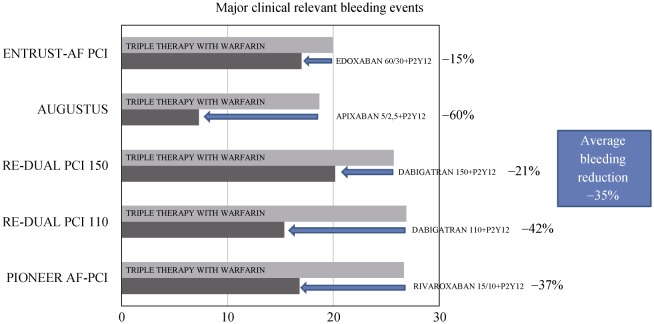
Atrial fibrillation (AF) is a very common arrhythmia in clinical practice. Its incidence and prevalence are age-related and are growing in the last years. Age is a risk factor also for coronary artery disease (CAD), and with the evolution of preventive care, the first event (acute coronary syndrome (ACS) or percutaneous coronary intervention (PCI)) takes place at a later age. If elderly patients with AF and CAD undergo ACS or PCI, they have indication to assume triple therapy. Triple therapy (oral anticoagulation (OAC) plus dual antiplatelet therapy (DAPT)) exposes patients to high bleeding risk. In the last 10 years, several clinical trials have tested dual therapy (OAC plus single antiplatelet therapy) in AF patients who undergo ACS or elective PCI. WOEST trial has tested warfarin + clopidogrel against triple therapy. PIONEER AF-PCI trial has tested low-dose rivaroxaban + P2Y12 inhibitor or very low-dose rivaroxaban + DAPT against standard triple therapy with warfarin. RE-DUAL PCI trial has tested two doses of dabigatran + P2Y12 inhibitor against standard triple therapy with Warfarin. AUGUSTUS trial has tested apixaban against warfarin both in dual therapy with P2Y12 inhibitor and in triple therapy with a P2Y12 inhibitor and aspirin. ENTRUST-AF PCI, last published study, has tested edoxaban + P2Y12 inhibitor against triple therapy. All these trials show dual therapy reduces significantly bleeding risk than triple therapy. In this paper, we analyze these clinical trials to understand if dual therapy results can be applied to elderly patients and what is probably the better approach in elderly AF patients undergo to ACS or PCI.
心房颤动(AF)是临床实践中一种非常常见的心律失常。其发病率和患病率与年龄相关,且在过去几年中呈上升趋势。年龄也是冠状动脉疾病(CAD)的一个危险因素,随着预防保健的发展,首次事件(急性冠状动脉综合征(ACS)或经皮冠状动脉介入治疗(PCI))发生的年龄较晚。如果患有AF和CAD的老年患者接受ACS或PCI治疗,他们有指征接受三联疗法。三联疗法(口服抗凝药(OAC)加双联抗血小板治疗(DAPT))使患者面临高出血风险。在过去10年中,多项临床试验对接受ACS或择期PCI治疗的AF患者进行了双联疗法(OAC加单联抗血小板治疗)的测试。WOEST试验对比了华法林+氯吡格雷与三联疗法。先锋AF-PCI试验对比了低剂量利伐沙班+P2Y12抑制剂或极低剂量利伐沙班+DAPT与华法林标准三联疗法。RE-DUAL PCI试验对比了两剂达比加群+P2Y12抑制剂与华法林标准三联疗法。AUGUSTUS试验在与P2Y12抑制剂的双联疗法以及与P2Y12抑制剂和阿司匹林的三联疗法中,对比了阿哌沙班与华法林。ENTRUST-AF PCI(最新发表的研究)对比了依度沙班+P2Y12抑制剂与三联疗法。所有这些试验均表明,双联疗法比三联疗法显著降低了出血风险。在本文中,我们分析这些临床试验,以了解双联疗法的结果是否可应用于老年患者,以及在接受ACS或PCI治疗的老年AF患者中,哪种方法可能是更好的选择。