Teramo Antonella, Barilà Gregorio, Calabretto Giulia, Vicenzetto Cristina, Gasparini Vanessa Rebecca, Semenzato Gianpietro, Zambello Renato
Hematology and Clinical Immunology Section, Department of Medicine (DIMED), Padova University School of Medicine, Padova, Italy.
Veneto Institute of Molecular Medicine (VIMM), Padova, Italy.
Front Oncol. 2020 Feb 18;10:152. doi: 10.3389/fonc.2020.00152. eCollection 2020.
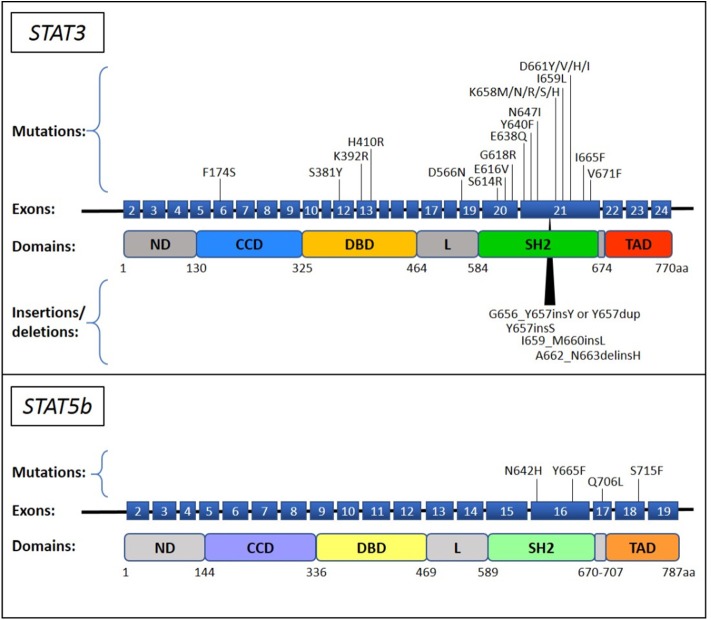
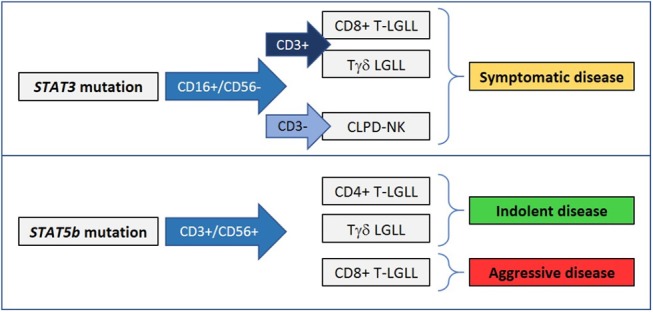
Large granular lymphocyte leukemia (LGLL) is a chronic proliferation of clonal cytotoxic lymphocytes, usually presenting with cytopenias and yet lacking a specific therapy. The disease is heterogeneous, including different subsets of patients distinguished by LGL immunophenotype (CD8+ Tαβ, CD4+ Tαβ, Tγδ, NK) and the clinical course of the disease (indolent/symptomatic/aggressive). Even if the etiology of LGLL remains elusive, evidence is accumulating on the genetic landscape driving and/or sustaining chronic LGL proliferations. The most common gain-of-function mutations identified in LGLL patients are on and genes, which have been recently recognized as clonal markers and were included in the 2017 WHO classification of the disease. A significant correlation between mutations and symptomatic disease has been highlighted. At variance, mutations could have a different clinical impact based on the immunophenotype of the mutated clone. In fact, they are regarded as the signature of an aggressive clinical course with a poor prognosis in CD8+ T-LGLL and aggressive NK cell leukemia, while they are devoid of negative prognostic significance in CD4+ T-LGLL and Tγδ LGLL. Knowing the specific distribution of mutations helps identify the discrete mechanisms sustaining LGL proliferations in the corresponding disease subsets. Some patients equipped with wild type genes are characterized by less frequent mutations in different genes, suggesting that other pathogenetic mechanisms are likely to be involved. In this review, we discuss how the LGLL mutational pattern allows a more precise and detailed tumor stratification, suggesting new parameters for better management of the disease and hopefully paving the way for a targeted clinical approach.
大颗粒淋巴细胞白血病(LGLL)是一种克隆性细胞毒性淋巴细胞的慢性增殖性疾病,通常表现为血细胞减少,但缺乏特异性治疗方法。该疾病具有异质性,包括根据LGL免疫表型(CD8 + Tαβ、CD4 + Tαβ、Tγδ、NK)和疾病临床进程(惰性/有症状/侵袭性)区分的不同患者亚群。即使LGLL的病因仍不明确,但关于驱动和/或维持慢性LGL增殖的基因图谱的证据正在积累。在LGLL患者中鉴定出的最常见的功能获得性突变存在于 和 基因上,这些基因最近被确认为克隆标志物,并被纳入2017年世界卫生组织该疾病分类中。已强调 突变与有症状疾病之间存在显著相关性。相比之下, 突变可能根据突变克隆的免疫表型产生不同的临床影响。事实上,它们被视为CD8 + T-LGLL和侵袭性NK细胞白血病中侵袭性临床进程和预后不良的标志,而在CD4 + T-LGLL和Tγδ LGLL中它们没有负面预后意义。了解 突变的具体分布有助于确定在相应疾病亚群中维持LGL增殖的离散机制。一些具有野生型 基因的患者其不同基因的突变频率较低,这表明可能涉及其他致病机制。在本综述中,我们讨论了LGLL突变模式如何实现更精确和详细的肿瘤分层,提出了更好管理该疾病的新参数,并有望为靶向临床方法铺平道路。