New York City Department of Health and Mental Hygiene, New York City, NY, USA.
Centers for Disease Control and Prevention, Atlanta, GA, USA.
Sci Adv. 2020 Feb 26;6(9):eaax0586. doi: 10.1126/sciadv.aax0586. eCollection 2020 Feb.
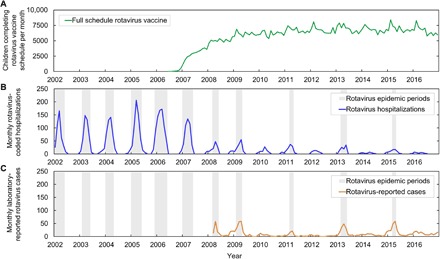
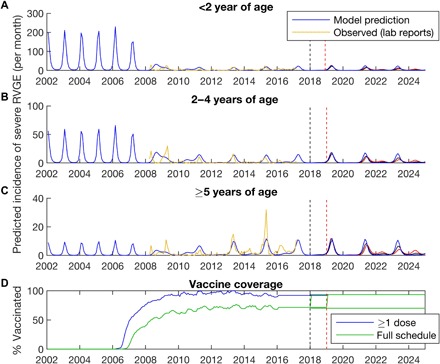
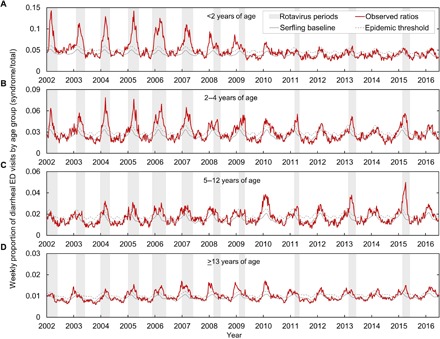
Prediction skill is a key test of models for epidemic dynamics. However, future validation of models against out-of-sample data is rare, partly because of a lack of timely surveillance data. We address this gap by analyzing the response of rotavirus dynamics to infant vaccination. Syndromic surveillance of emergency department visits for diarrhea in New York City reveals a marked decline in diarrheal incidence among infants and young children, in line with data on rotavirus-coded hospitalizations and laboratory-confirmed cases, and a shift from annual to biennial epidemics increasingly affecting older children and adults. A published mechanistic model qualitatively predicted these patterns more than 2 years in advance. Future efforts to increase vaccination coverage may disrupt these patterns and lead to further declines in the incidence of rotavirus-attributable gastroenteritis.
预测能力是疫情动力学模型的关键检验。然而,由于缺乏及时的监测数据,针对样本外数据对模型进行未来验证的情况很少见。我们通过分析轮状病毒动力学对婴儿疫苗接种的反应来解决这一差距。纽约市急诊科腹泻就诊的症状监测显示,婴儿和幼儿的腹泻发病率明显下降,与轮状病毒编码的住院和实验室确诊病例数据一致,并且从年度流行转为两年一次的流行,越来越多的影响到年龄较大的儿童和成人。一个已发表的机械模型提前 2 年多定性地预测了这些模式。未来增加疫苗接种覆盖率的努力可能会打破这些模式,并导致轮状病毒相关胃肠炎发病率进一步下降。