Orthodontic Clinic, National Health Service, Växjö, Sweden.
Department of Orthodontics, University of Malmö, Sweden.
Eur J Orthod. 2021 Apr 3;43(2):121-127. doi: 10.1093/ejo/cjaa010.
To evaluate whether retention is needed after orthodontic treatment of impacted maxillary canines.
Two-arm parallel group single-centre randomized controlled trial.
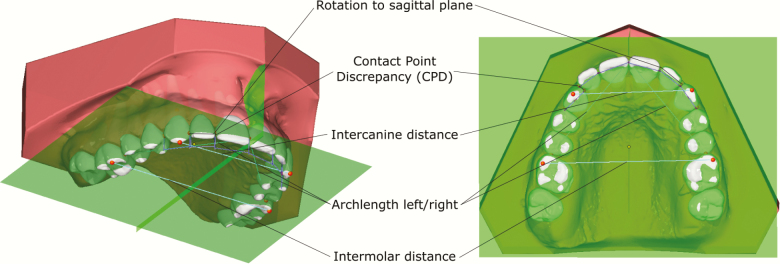
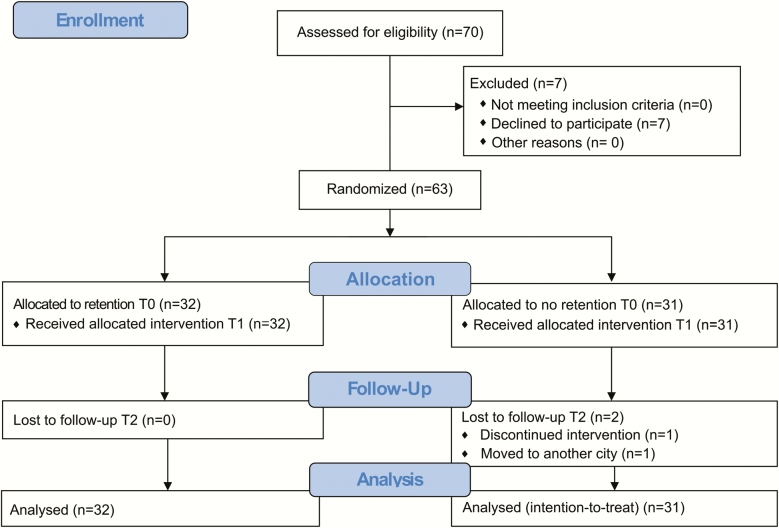
Sixty-three patients, 39 girls and 24 boys, were recruited to the study. The inclusion criteria were patients with at least one impacted or unerupted maxillary canine, and moderate irregularity of the maxillary six anterior teeth according to Little's index (LI). After gaining informed consent from the patient and their custodians, the patients were randomized to one of two groups, i.e. to a non-retention group or a retention group. The randomization process was prepared and carried out by an independent person not involved in the trial and the randomization used blocks of 20 (10 + 10). Primary outcomes were changes in single contact point discrepancy, and LI measured on digitalized three-dimensional study casts 1-year post-treatment. The study casts were anonymized before assessment and the changes were blinded for the assessor. Data were evaluated on an intention-to-treat basis. Thus, all randomized patients were incorporated into the final analysis. In the non-retention group a 10-week interim period was used to detect patients who eventually have a relapse immediately after treatment. If so, the patient got the arch-wire reinserted. Most patients in the retention group received a vacuum-formed retainer and pretreatment spacing cases got a bonded retainer.
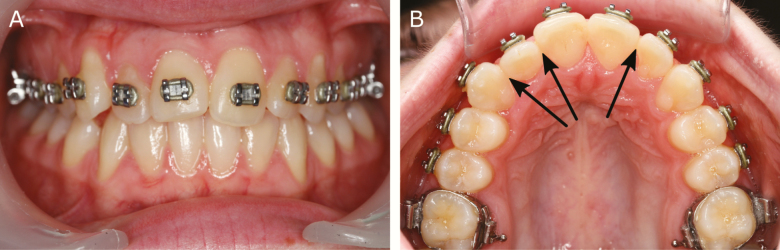
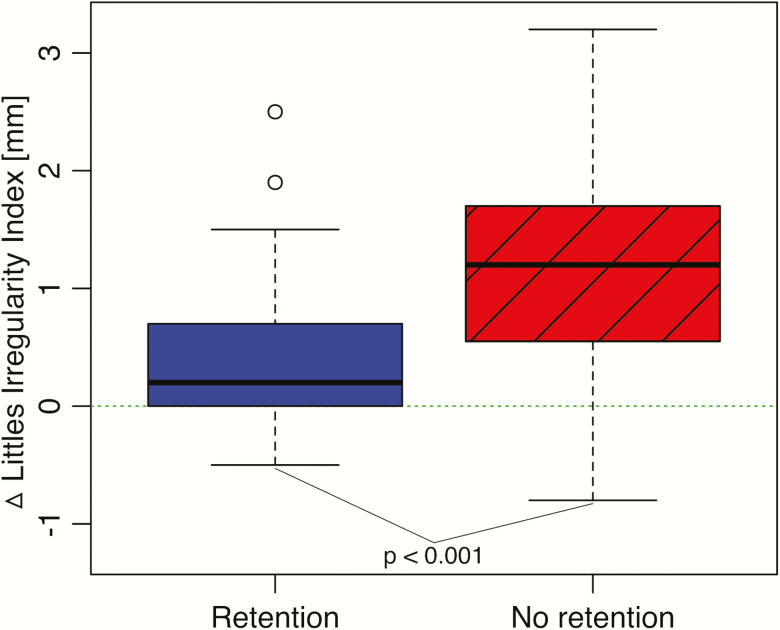
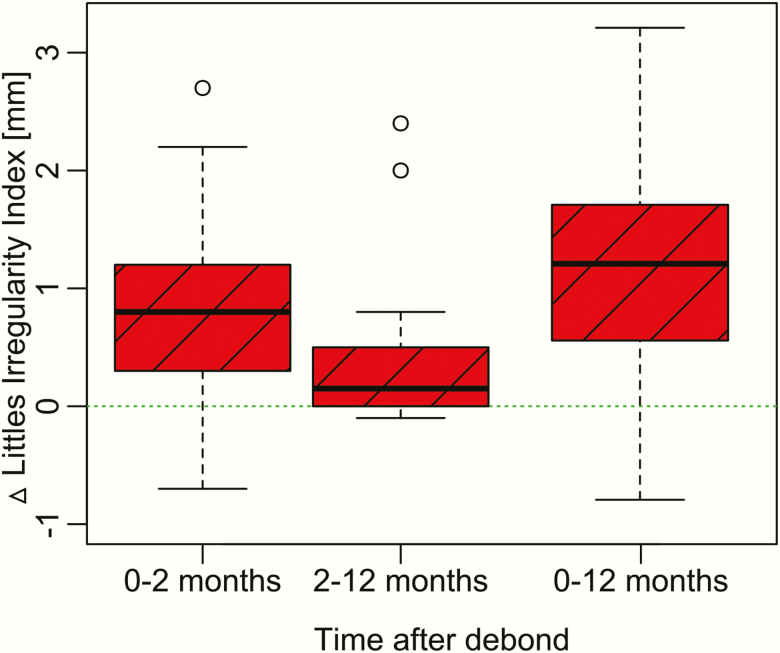
Mean irregularity change was 0.4 mm in the retention and 1.3 mm in the non-retention group (P < 0.001). Maximum change was 2.5 mm in the retention and 3.2 mm in the non-retention group (P < 0.001). Most changes in the non-retention group occurred during the 10-week interim period. In the non-retention group, one patient developed contact point discrepancy of >2 mm during the interim period and was realigned.
One patient met the stopping guideline criteria. This patient had the arch wire reinserted for 2 months. After realignment, the patient received a retention appliance.
The trial was a single-centre study and short-term changes were evaluated.
Changes between the retention and the non-retention group were statistically but not clinically significant. Since satisfactory clinical results 1-year post-treatment were found in the non-retention group, retention does not appear to be needed. The 10-week interim period was useful in detecting patients who might have a relapse immediately after treatment.
The trial was not registered.
评估上颌尖牙正畸治疗后是否需要保持。
双臂平行组单中心随机对照试验。
共招募了 63 名患者,其中 39 名女孩和 24 名男孩。纳入标准为至少有一颗上颌埋伏或未萌出的尖牙,以及上颌六颗前牙根据 Little 指数(LI)存在中度不齐。在获得患者及其监护人的知情同意后,患者被随机分配到两组之一,即非保持组或保持组。随机过程由不参与试验的独立人员准备和进行,且随机使用 20 个块(10+10)。主要结局是在治疗后 1 年数字化三维研究模型上测量的单接触点差异和 LI 的变化。研究模型在评估前进行了匿名化,评估者对变化进行了盲法。数据基于意向治疗进行评估。因此,所有随机患者均纳入最终分析。在非保持组中,使用 10 周的间隔期来检测治疗后立即复发的患者。如果是这样,患者将重新插入弓丝。保持组的大多数患者佩戴了真空成型保持器,预处理间隙病例则佩戴了粘结保持器。
保持组的平均不整齐度变化为 0.4mm,非保持组为 1.3mm(P<0.001)。最大变化分别为保持组 2.5mm和非保持组 3.2mm(P<0.001)。非保持组的大多数变化发生在 10 周的间隔期内。在非保持组中,一名患者在间隔期内出现>2mm的接触点差异,并进行了重新排列。
一名患者符合停止准则标准。该患者重新插入弓丝 2 个月。重新排列后,患者佩戴了保持器。
该试验为单中心研究,评估了短期变化。
保持组和非保持组之间的变化在统计学上有意义,但在临床上无意义。由于非保持组在治疗后 1 年获得了令人满意的临床结果,因此似乎不需要保持。10 周的间隔期有助于检测治疗后立即可能复发的患者。
该试验未注册。