Pandey Anand, Singh Abhishek, Ali Wahid, Srivastava Anurag, Gupta Archika, Kureel Shiv Narain, Rawat Jiledar, Wakhlu Ashish
Department of Pediatric Surgery, King George's Medical University, Lucknow, Uttar Pradesh, India.
Department of Pathology, King George's Medical University, Lucknow, Uttar Pradesh, India.
J Indian Assoc Pediatr Surg. 2020 Mar-Apr;25(2):96-102. doi: 10.4103/jiaps.JIAPS_22_19. Epub 2020 Jan 28.
Infantile hemangioma is the most common tumor of infancy. Currently, propranolol is a preferred drug for treating hemangioma. The exact mechanism of action of propranolol is not known. In this study, we attempted to assess whether propranolol has any effect on vascular endothelial growth factor (VEGF) and tissue inhibitor of metalloproteinase-2 (TIMP-2) over a period of time, and if it is there, how long it affects it.
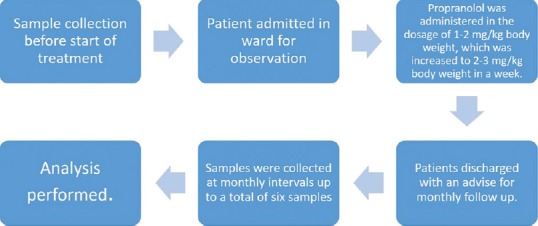
Propranolol was administered in the dosage of 2-3 mg/kg. The first serum sample was collected before starting the propranolol treatment. Thereafter, samples were collected at monthly intervals up to a total of six samples. The samples were assessed for TIMP-2 and VEGF using enzyme-linked immunosorbent assay kit.
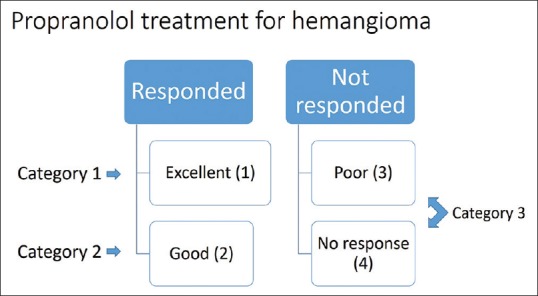
The duration of this study was from June 2016 to November 2017. The total number of patients in this study was 15. Thirteen patients responded to treatment. The mean age of patients was 7.1 months. The mean value of baseline VEGF was 0.234 ± 0.059 and that of TIMP-2 was 1.338 ± 0.679. As compared to baseline value, the value was statistically not significant in any of sequential values. In category-wise analysis, apart from statistically significant value in the 6 month in excellent category and good response category in the 1 month, all other values did not reveal any significant change in VEGF analysis. The analysis of TIMP-2 revealed a significant change in the levels from Sample 2 to Sample 6 in the excellent response group; however, the levels did not show a specific trend either increasing or decreasing.
Despite its beneficial action in regression of hemangioma, the exact mechanism is yet to be identified. The exact duration of treatment needs further evaluation.
婴儿血管瘤是婴儿期最常见的肿瘤。目前,普萘洛尔是治疗血管瘤的首选药物。普萘洛尔的确切作用机制尚不清楚。在本研究中,我们试图评估普萘洛尔在一段时间内对血管内皮生长因子(VEGF)和基质金属蛋白酶-2组织抑制剂(TIMP-2)是否有任何影响,以及如果有影响,其影响持续多长时间。
以2 - 3mg/kg的剂量给予普萘洛尔。在开始普萘洛尔治疗前采集第一份血清样本。此后,每月采集一次样本,共采集六个样本。使用酶联免疫吸附测定试剂盒对样本进行TIMP-2和VEGF评估。
本研究的时间跨度为2016年6月至2017年11月。本研究的患者总数为15例。13例患者对治疗有反应。患者的平均年龄为7.1个月。基线VEGF的平均值为0.234±0.059,TIMP-2的平均值为1.338±0.679。与基线值相比,在任何连续值中该值均无统计学意义。在分类分析中,除了在优秀类别中的第6个月和良好反应类别中的第1个月有统计学意义外,VEGF分析中的所有其他值均未显示出任何显著变化。TIMP-2分析显示,优秀反应组中从样本2到样本6的水平有显著变化;然而,这些水平也没有呈现出上升或下降的特定趋势。
尽管普萘洛尔在血管瘤消退方面具有有益作用,但其确切机制仍有待确定。确切的治疗持续时间需要进一步评估。