Department of Radiation Oncology, The First Hospital of Jilin University, Changchun 130021, China.
Department of Internal Medicine, Florida Hospital, Orlando, FL 32803, USA.
Int J Biol Sci. 2020 Feb 4;16(6):1035-1043. doi: 10.7150/ijbs.40880. eCollection 2020.
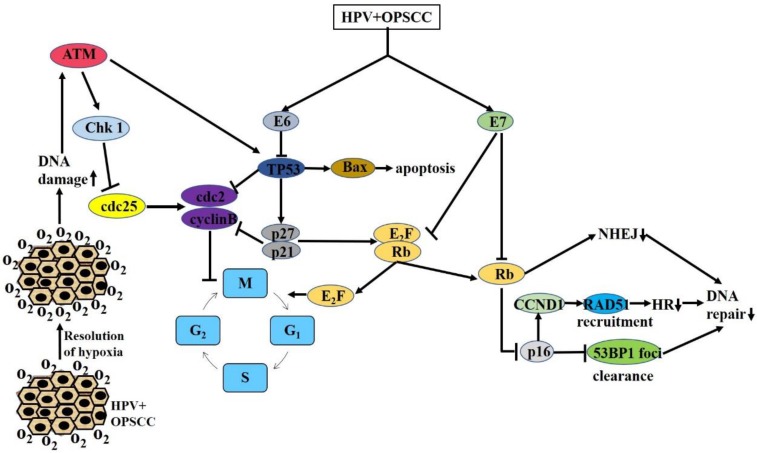
Oropharyngeal squamous cell carcinoma (OPSCC) is an important type of head and neck squamous cell carcinoma (HNSCC). The traditional risk factors for OPSCC include carcinogen intake, smoking, alcohol consumption, and lifestyle. In recent years, cases of human papillomavirus (HPV)-related OPSCC have gradually increased. At present, HPV-related OPSCC in developed Western countries comprise up to 90% of all OPSCC cases, while in other developing countries, the proportion of HPV-related OPSCC cases is also gradually increasing. Compared with HPV-negative OPSCC, HPV-positive OPSCC patients have better overall survival rates and local control rates and this improved prognosis may be related to the increased radiosensitivity of HPV-positive tumors. Due to this more favorable prognosis, many downgraded treatment schemes are gradually emerging, including simple radiotherapy instead of concurrent radiotherapy or reduced radiotherapy dose. However, there is insufficient theoretical basis for such schemes. Some studies have shown that delayed repair of DNA damage after radiation, G2/M arrest, increased hypoxia, and decreased proliferation capacity are the main reasons for the increased radiosensitivity of HPV-positive tumor cells. In this review, we discuss the four principles of tumor cell damage caused by radiation, including repair, reoxygenation, redistribution, and regeneration in order to reveal the mechanism whereby HPV increases the radiosensitivity of tumor cells. An attempt was made to provide sufficient information to facilitate more individualized treatment for HPV-positive OPSCC patients, under the premise of good tumor control.
口咽鳞状细胞癌(OPSCC)是头颈部鳞状细胞癌(HNSCC)的重要类型。OPSCC 的传统危险因素包括致癌物摄入、吸烟、饮酒和生活方式。近年来,人乳头瘤病毒(HPV)相关的 OPSCC 病例逐渐增多。目前,在发达的西方国家,HPV 相关的 OPSCC 占所有 OPSCC 病例的 90%以上,而在其他发展中国家,HPV 相关的 OPSCC 病例比例也在逐渐增加。与 HPV 阴性 OPSCC 相比,HPV 阳性 OPSCC 患者的总生存率和局部控制率更好,这种改善的预后可能与 HPV 阳性肿瘤的放射敏感性增加有关。由于这种更有利的预后,许多降级治疗方案逐渐出现,包括单纯放疗而不是同期放化疗或减少放疗剂量。然而,这些方案缺乏充分的理论依据。一些研究表明,放射后 DNA 损伤的延迟修复、G2/M 期阻滞、增加的缺氧和降低的增殖能力是 HPV 阳性肿瘤细胞放射敏感性增加的主要原因。在这篇综述中,我们讨论了放射引起肿瘤细胞损伤的四个原则,包括修复、再氧合、再分布和再生,以揭示 HPV 增加肿瘤细胞放射敏感性的机制。试图在良好的肿瘤控制的前提下,为 HPV 阳性 OPSCC 患者提供足够的信息,以实现更个体化的治疗。