Dalapati Goutam Kumar, Masudy-Panah Saeid, Moakhar Roozbeh Siavash, Chakrabortty Sabyasachi, Ghosh Siddhartha, Kushwaha Ajay, Katal Reza, Chua Chin Sheng, Xiao Gong, Tripathy Sudhiranjan, Ramakrishna Seeram
Department of Physics SRM University - AP Amaravati Andhra Pradesh 522502 India.
Institute of Materials Research and Engineering ASTAR (Agency for Science, Technology and Research) 2 Fusionopolis Way; Innovis, #08-03 Singapore 138634 Singapore.
Glob Chall. 2020 Jan 24;4(3):1900087. doi: 10.1002/gch2.201900087. eCollection 2020 Mar.
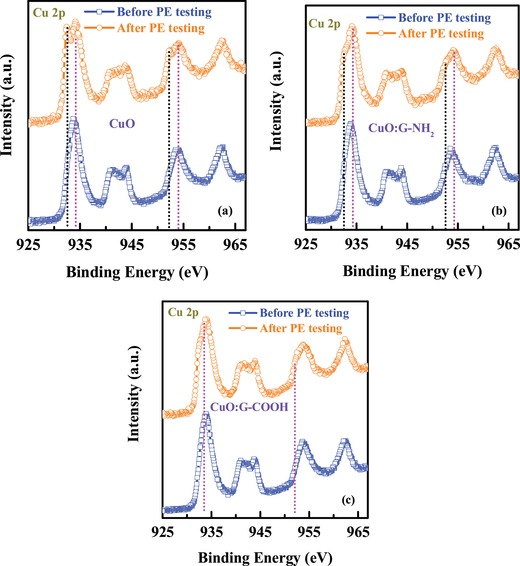
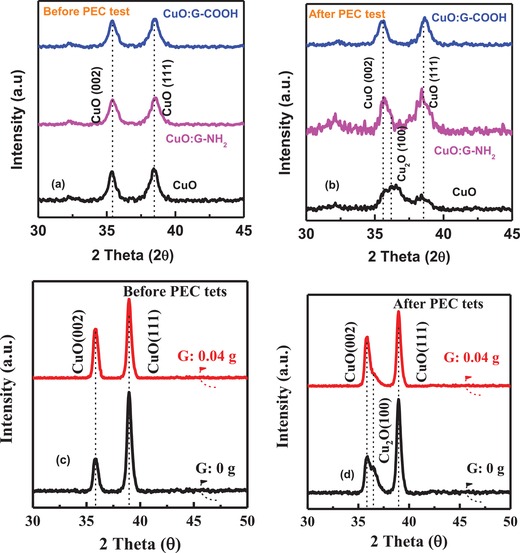
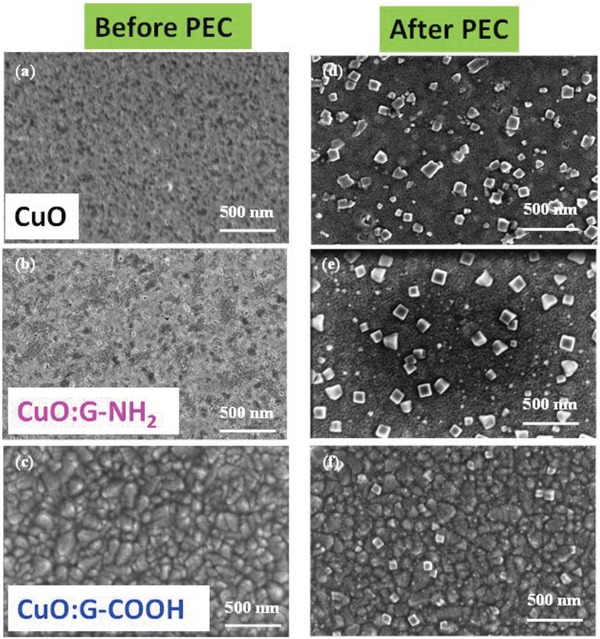
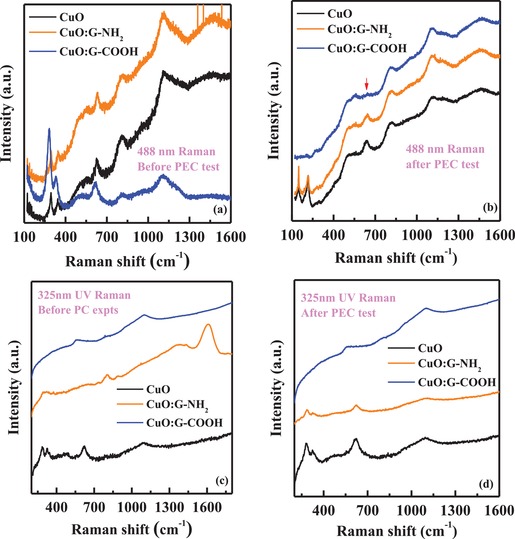
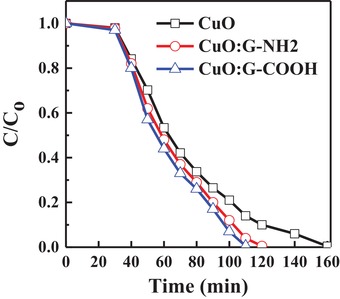
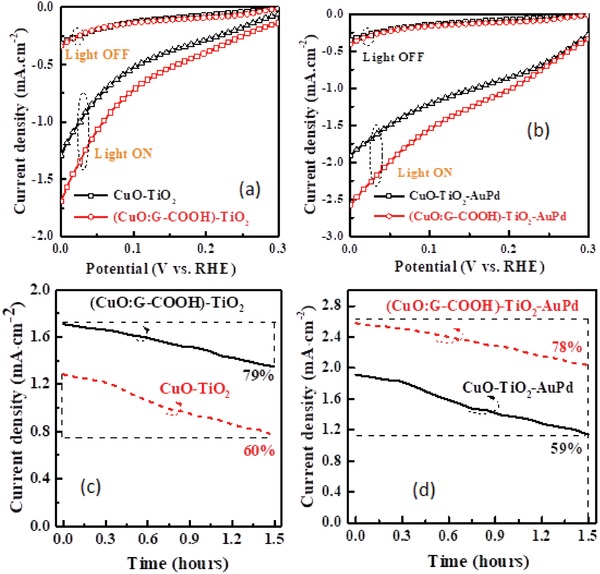
Cupric oxide (CuO) is a promising candidate as a photocathode for visible-light-driven photo-electrochemical (PEC) water splitting. However, the stability of the CuO photocathode against photo-corrosion is crucial for developing CuO-based PEC cells. This study demonstrates a stable and efficient photocathode through the introduction of graphene into CuO film (CuO:G). The CuO:G composite electrodes are prepared using graphene-incorporated CuO sol-gel solution via spin-coating techniques. The graphene is modified with two different types of functional groups, such as amine (-NH) and carboxylic acid (-COOH). The -COOH-functionalized graphene incorporation into CuO photocathode exhibits better stability and also improves the photocurrent generation compare to control CuO electrode. In addition, -COOH-functionalized graphene reduces the conversion of CuO phase into cuprous oxide (CuO) during photo-electrochemical reaction due to effective charge transfer and leads to a more stable photocathode. The reduction of CuO to CuO phase is significantly lesser in CuO:G-COOH as compared to CuO and CuO:G-NH photocathodes. The photocatalytic degradation of methylene blue (MB) by CuO, CuO:G-NH and CuO:G-COOH is also investigated. By integrating CuO:G-COOH photocathode with a sol-gel-deposited TiO protecting layer and Au-Pd nanostructure, stable and efficient photocathode are developed for solar hydrogen generation.
氧化铜(CuO)作为用于可见光驱动的光电化学(PEC)水分解的光阴极是一个有前途的候选材料。然而,CuO光阴极对光腐蚀的稳定性对于开发基于CuO的PEC电池至关重要。本研究通过将石墨烯引入CuO薄膜(CuO:G)中展示了一种稳定且高效的光阴极。采用含石墨烯的CuO溶胶 - 凝胶溶液通过旋涂技术制备了CuO:G复合电极。石墨烯用两种不同类型的官能团进行了改性,如胺基(-NH)和羧基(-COOH)。与对照CuO电极相比,将羧基功能化的石墨烯掺入CuO光阴极表现出更好的稳定性,并且还提高了光电流的产生。此外,由于有效的电荷转移,羧基功能化的石墨烯减少了光电化学反应过程中CuO相转变为氧化亚铜(Cu₂O)的情况,并导致更稳定的光阴极。与CuO和CuO:G - NH光阴极相比,CuO:G - COOH中CuO向Cu₂O相的还原明显更少。还研究了CuO、CuO:G - NH和CuO:G - COOH对亚甲基蓝(MB)的光催化降解。通过将CuO:G - COOH光阴极与溶胶 - 凝胶沉积的TiO保护层和Au - Pd纳米结构集成,开发出了用于太阳能制氢的稳定且高效的光阴极。