Aoki Kai, Sugasawa Takehito, Yanazawa Kouki, Watanabe Koichi, Takemasa Tohru, Takeuchi Yoshinori, Aita Yuichi, Yahagi Naoya, Yoshida Yasuko, Kuji Tomoaki, Sekine Nanami, Takeuchi Kaoru, Ueda Haruna, Kawakami Yasushi, Takekoshi Kazuhiro
Graduate School of Comprehensive Human Sciences, University of Tsukuba, Tsukuba, Japan.
Laboratory of Laboratory/Sports medicine, Division of Clinical Medicine, Faculty of Medicine, University of Tsukuba, Tsukuba, Japan.
PeerJ. 2020 Feb 25;8:e8595. doi: 10.7717/peerj.8595. eCollection 2020.
With the rapid progress of genetic engineering and gene therapy methods, the World Anti-Doping Agency has raised concerns regarding gene doping, which is prohibited in sports. However, there is no standard method available for detecting transgenes delivered by injection of naked plasmids. Here, we developed a detection method for detecting transgenes delivered by injection of naked plasmids in a mouse model that mimics gene doping.
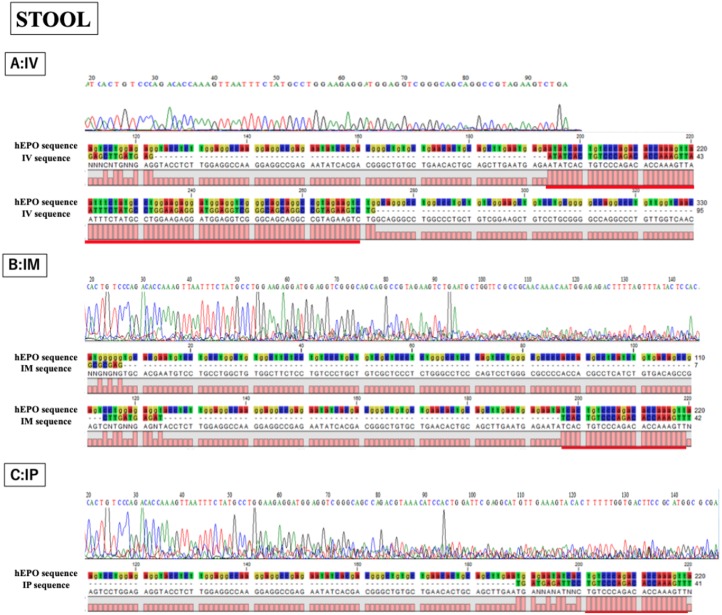
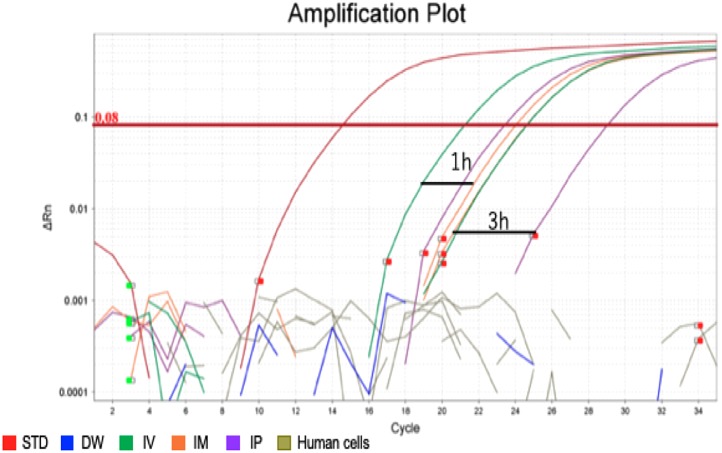
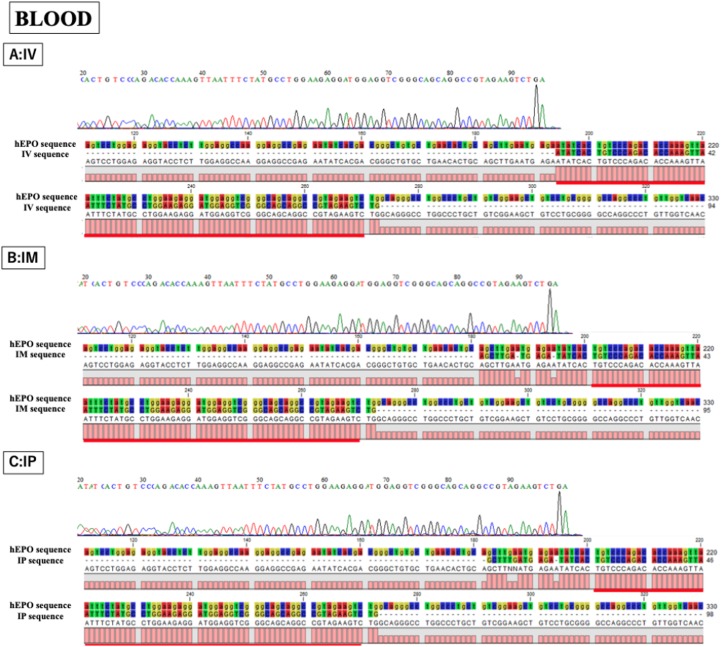
Whole blood from the tail tip and one piece of stool were used as pre-samples of injection. Next, a plasmid vector containing the human erythropoietin (hEPO) gene was injected into mice through intravenous (IV), intraperitoneal (IP), or local muscular (IM) injection. At 1, 2, 3, 6, 12, 24, and 48 h after injection, approximately 50 µL whole blood was collected from the tail tip. One piece of stool was collected at 6, 12, 24, and 48 h. From each sample, total DNA was extracted and transgene fragments were analyzed by Taqman quantitative PCR (qPCR) and SYBR green qPCR.
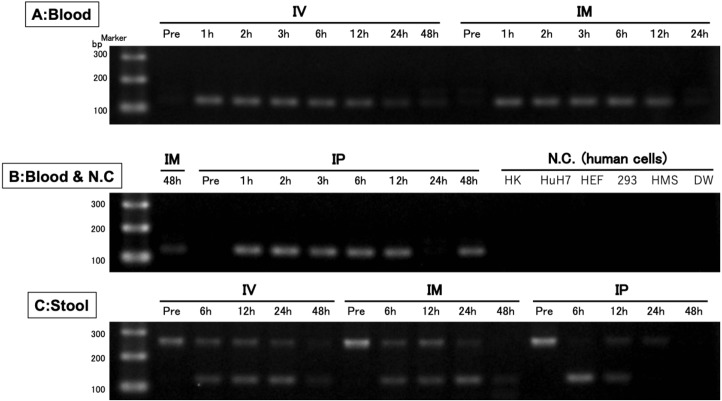
In whole blood DNA samples evaluated by Taqman qPCR, the transgene fragments were detected at all time points in the IP sample and at 1, 2, 3, 6, and 12 h in the IV and IM samples. In the stool-DNA samples, the transgene fragments were detected at 6, 12, 24, and 48 h in the IV and IM samples by Taqman qPCR. In the analysis by SYBR green qPCR, the transgene fragments were detected at some time point in both specimens; however, many non-specific amplicons were detected.
These results indicate that transgene fragments evaluated after each injection method of naked plasmids were detected in whole-blood and stool DNA samples. These findings may facilitate the development of methods for detecting gene doping.
随着基因工程和基因治疗方法的迅速发展,世界反兴奋剂机构对基因兴奋剂提出了关注,基因兴奋剂在体育赛事中是被禁止的。然而,目前尚无用于检测通过注射裸质粒递送的转基因的标准方法。在此,我们开发了一种检测方法,用于在模拟基因兴奋剂的小鼠模型中检测通过注射裸质粒递送的转基因。
将来自尾尖的全血和一块粪便用作注射前样本。接下来,通过静脉内(IV)、腹腔内(IP)或局部肌肉(IM)注射将含有人类促红细胞生成素(hEPO)基因的质粒载体注射到小鼠体内。在注射后1、2、3、6、12、24和48小时,从尾尖采集约50μL全血。在6、12、24和48小时采集一块粪便。从每个样本中提取总DNA,并通过Taqman定量PCR(qPCR)和SYBR green qPCR分析转基因片段。
在通过Taqman qPCR评估的全血DNA样本中,IP样本在所有时间点均检测到转基因片段,IV和IM样本在1、2、3、6和12小时检测到转基因片段。在粪便DNA样本中,通过Taqman qPCR在IV和IM样本的6、12、24和48小时检测到转基因片段。在通过SYBR green qPCR分析中,两个样本在某些时间点均检测到转基因片段;然而,检测到许多非特异性扩增子。
这些结果表明,在全血和粪便DNA样本中检测到了裸质粒每种注射方法后评估的转基因片段。这些发现可能有助于基因兴奋剂检测方法的开发。