Merz Simon, Meyerhoff Hauke S, Frings Christian, Spence Charles
Department of Psychology, Cognitive Psychology, University of Trier, Universitätsring 15, 54286, Trier, Germany.
Leibniz-Institut für Wissensmedien, Tübingen, Germany.
Atten Percept Psychophys. 2020 Jul;82(5):2618-2629. doi: 10.3758/s13414-020-01989-1.
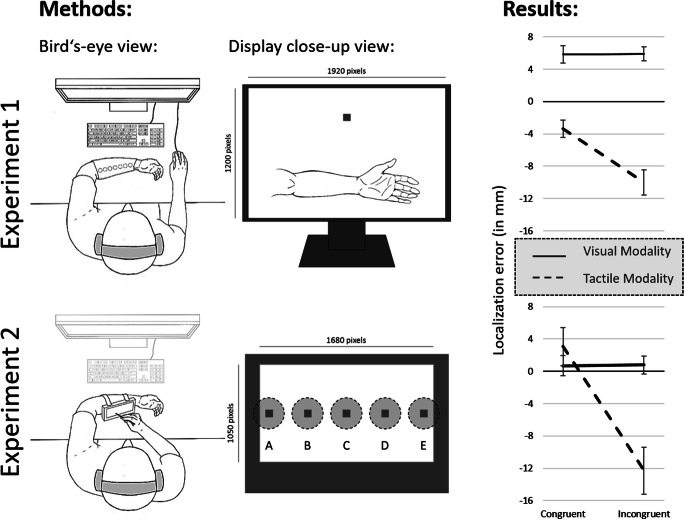
After an object disappears, the vanishing point is shifted in the direction of motion, a phenomenon known as representational momentum. The present study focused on the relationship between motion information and spatial location in a crossmodal setting. In two visuotactile experiments, we studied how motion information in one sensory modality affects the perceived final location of a motion signal (congruent vs. incongruent left-right motion direction) in another modality. The results revealed a unidirectional crossmodal influence of motion information on spatial localization performance. While visual motion information influenced the perceived final location of the tactile stimulus, tactile motion information had no influence on visual localization. These results therefore extend the existing literature on crossmodal influences on spatial location and are discussed in relation to current theories of multisensory perception.
物体消失后,消失点会朝着运动方向移动,这一现象被称为表征动量。本研究聚焦于跨通道环境中运动信息与空间位置之间的关系。在两项视觉触觉实验中,我们研究了一种感觉模态中的运动信息如何影响另一种模态中运动信号(一致与不一致的左右运动方向)的感知最终位置。结果揭示了运动信息对空间定位表现的单向跨通道影响。虽然视觉运动信息影响了触觉刺激的感知最终位置,但触觉运动信息对视觉定位没有影响。因此,这些结果扩展了关于跨通道对空间位置影响的现有文献,并结合当前的多感官感知理论进行了讨论。