Department of Pathology, Brigham and Women's Hospital, Harvard Medical School.
Department of Pediatric Oncology, Dana-Farber Cancer Institute and Harvard Medical School, Boston, MA.
Am J Surg Pathol. 2020 Jul;44(7):922-933. doi: 10.1097/PAS.0000000000001447.
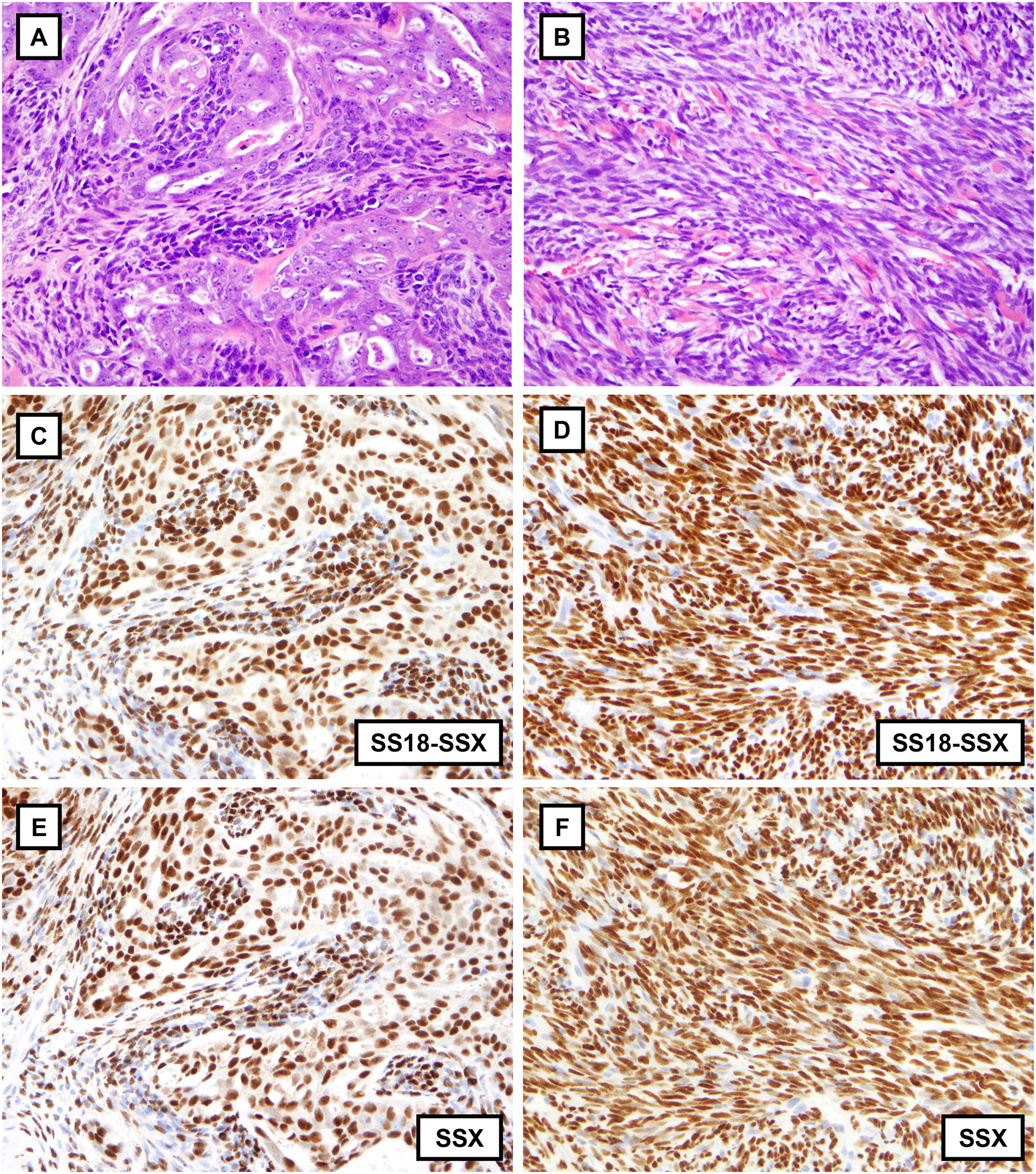
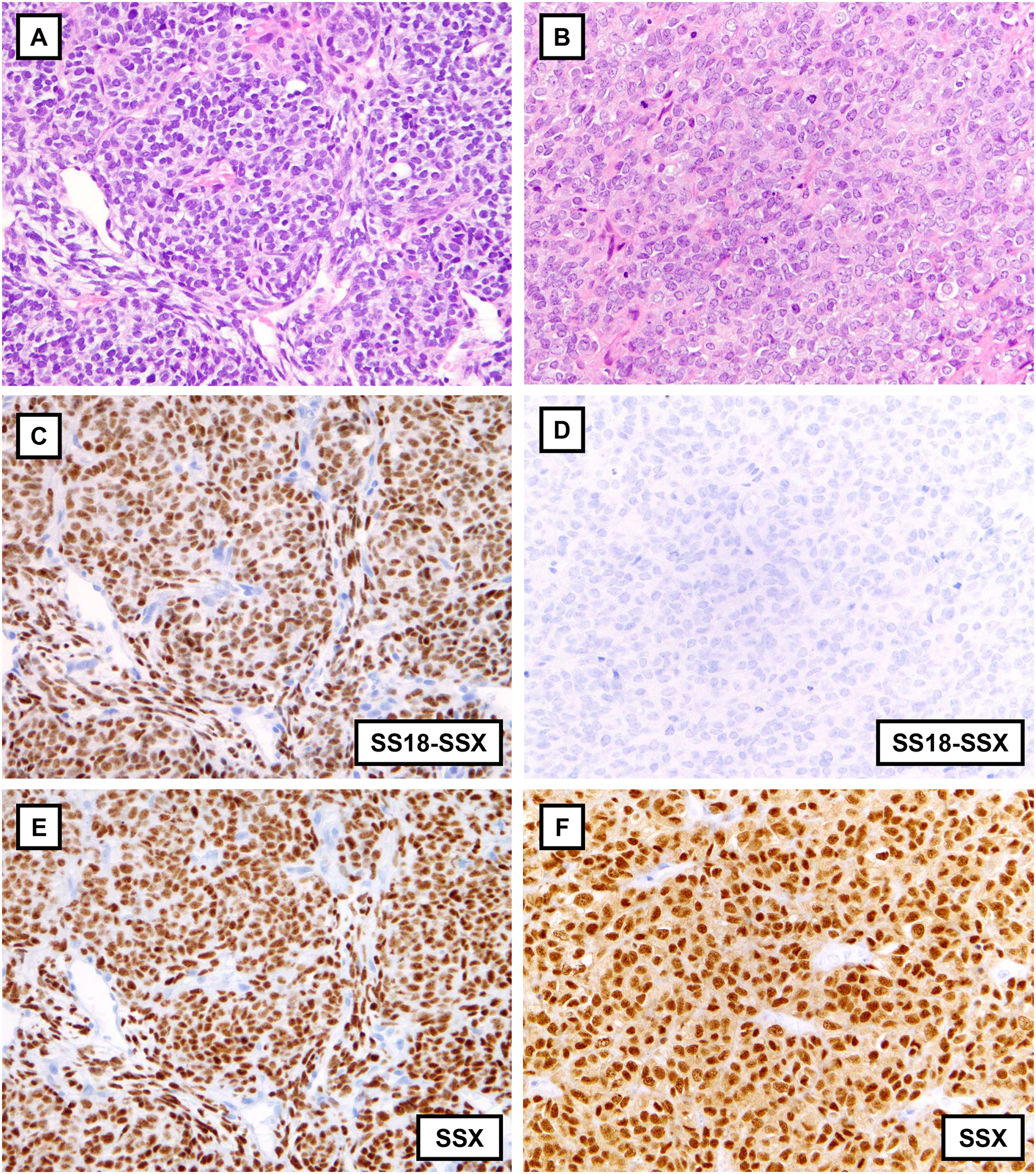
Synovial sarcoma (SS), an aggressive soft tissue sarcoma with a predilection for the extremities of young adults, harbors the pathognomonic t(X;18)(p11;q11) translocation, resulting in SS18-SSX rearrangements. SS includes monophasic, biphasic, and poorly differentiated variants, which show considerable histologic overlap with a range of other tumor types, making the diagnosis challenging on limited biopsies. Immunohistochemistry (IHC) is routinely used in the differential diagnosis; however, presently available markers lack specificity. Thus, cytogenetic or molecular genetic techniques are often employed to confirm the diagnosis. Here, we report the development and characterization of 2 novel antibodies: an SS18-SSX fusion-specific antibody (E9X9V, designed to the breakpoint) as well as an SSX-specific antibody (E5A2C, designed to the SSX C-terminus). We validated the selectivity and specificity of the antibodies using immunoblotting, immunoprecipitation, and chromatin immunoprecipitation followed by next-generation sequencing in SS cell lines and demonstrated that both antibodies capture SS18-SSX on chromatin at established target sites (eg, TLE1 and BCL2) genome-wide. Using IHC in whole sections from 400 tumors including 100 genetically confirmed cases of SS and 300 histologic mimics, the SS18-SSX fusion-specific antibody revealed strong diffuse nuclear staining in 95 of 100 (95%) SS cases, whereas none of the 300 control tumors showed any staining. The SSX antibody showed strong diffuse nuclear staining in all 100 (100%) SS cases; 13 (4%) of the 300 other tumors were also positive, 5 of which displayed >50% nuclear staining. In summary, a novel SS18-SSX fusion-specific antibody is highly sensitive (95%) and specific (100%) for SS, and an antibody to the SSX C-terminus is also highly sensitive (100%), but slightly less specific (96%). IHC using the SS18-SSX antibody could replace molecular genetic or cytogenetic testing in most cases, and these reagents together will also provide the research community with valuable tools for further biochemical and genomic interrogation of the SS18-SSX fusion protein.
滑膜肉瘤(SS)是一种侵袭性软组织肉瘤,好发于年轻成人的四肢,具有特征性的 t(X;18)(p11;q11)易位,导致 SS18-SSX 重排。SS 包括单相、双相和低分化变体,与一系列其他肿瘤类型具有明显的组织学重叠,因此在有限的活检中诊断具有挑战性。免疫组织化学(IHC)常用于鉴别诊断;然而,目前可用的标志物缺乏特异性。因此,细胞遗传学或分子遗传学技术通常用于确认诊断。在这里,我们报告了两种新型抗体的开发和特性:一种是 SS18-SSX 融合特异性抗体(E9X9V,设计到断点),以及一种 SSX 特异性抗体(E5A2C,设计到 SSX C 末端)。我们使用免疫印迹、免疫沉淀和染色质免疫沉淀,随后进行下一代测序,在 SS 细胞系中验证了抗体的选择性和特异性,并证明两种抗体都可以在整个基因组范围内捕获 SS18-SSX 在染色质上的靶位点(例如,TLE1 和 BCL2)。使用 400 个肿瘤的全切片进行免疫组织化学染色,包括 100 个经基因证实的 SS 病例和 300 个组织学模拟病例,SS18-SSX 融合特异性抗体在 100 个 SS 病例中的 95 个(95%)显示强烈弥漫性核染色,而 300 个对照肿瘤中没有任何染色。SSX 抗体在 100 个 SS 病例中均显示强烈弥漫性核染色;300 个其他肿瘤中有 13 个(4%)也是阳性的,其中 5 个显示 >50%的核染色。总之,一种新型的 SS18-SSX 融合特异性抗体具有高度的敏感性(95%)和特异性(100%),针对 SS,而针对 SSX C 末端的抗体也具有高度的敏感性(100%),但特异性略低(96%)。使用 SS18-SSX 抗体的免疫组织化学染色可以替代分子遗传学或细胞遗传学检测,在大多数情况下,这些试剂还将为研究界提供有价值的工具,用于进一步对 SS18-SSX 融合蛋白进行生化和基因组研究。