Division of Brain, Imaging and Behaviour, Krembil Brain Institute, Krembil Research Institute, University Health Network, M5T2S8, Toronto, Canada; Institute of Medical Science, Faculty of Medicine, University of Toronto, M5S1A8, Toronto, Canada.
Division of Brain, Imaging and Behaviour, Krembil Brain Institute, Krembil Research Institute, University Health Network, M5T2S8, Toronto, Canada.
Neuroimage Clin. 2020;26:102230. doi: 10.1016/j.nicl.2020.102230. Epub 2020 Feb 26.
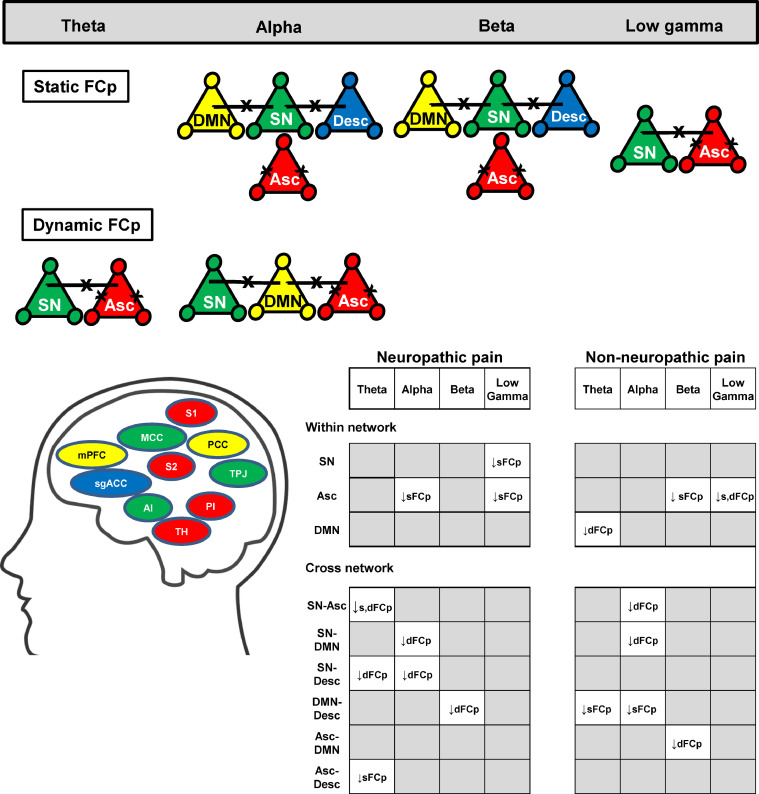
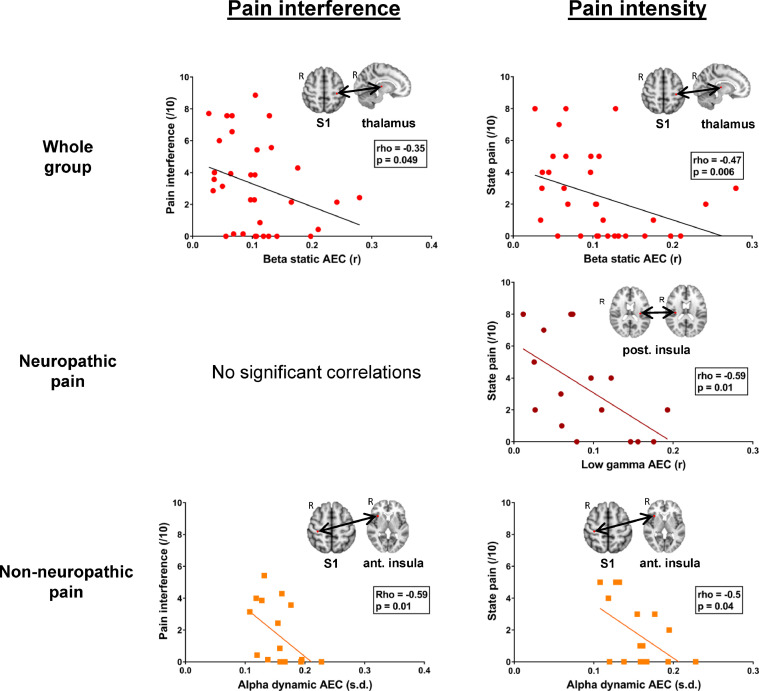
Sensory perceptions are coded by complex neural dynamics of regional communication in the brain. Thus, sensory abnormalities such as chronic pain may occur when neural dynamics go awry. Previous studies of cross-network dynamic functional connectivity in chronic pain identified abnormalities but were based on functional MRI which only captures slow temporal features. Here we conducted a magnetoencephalography (MEG) study to investigate fine temporal dynamics of aberrant cross-regional and cross-network communication of the dynamic pain connectome in patients with chronic pain. We also introduced a novel measure, dynamic functional coupling, to quantify the variability of brain communication. The study was performed in 33 people who had chronic pain associated with multiple sclerosis and 30 healthy controls. We found that patients with chronic pain exhibited abnormalities in cross-network functional coupling across multiple frequency bands (theta, alpha, beta, gamma), between the salience network and 3 other networks: the ascending nociceptive pathway, descending anti-nociceptive pathway, and the default mode network. However, these cross-network abnormalities involved different frequency bands in patients with neuropathic versus non-neuropathic chronic pain. Furthermore, cross-network abnormalities were linked to pain severity and pain interference. Our findings implicate broadband cross-network abnormalities as hallmark features of chronic pain in multiple sclerosis.
感觉知觉是通过大脑中区域间通讯的复杂神经动力学来编码的。因此,当神经动力学出现异常时,可能会出现慢性疼痛等感觉异常。先前对慢性疼痛中的跨网络动态功能连接的研究已经确定了异常,但这些研究是基于仅能捕捉到缓慢时间特征的功能磁共振成像。在这里,我们进行了一项脑磁图(MEG)研究,以调查慢性疼痛患者动态疼痛连接组中跨区域和跨网络的异常交叉区域和交叉网络通讯的精细时间动态。我们还引入了一种新的测量方法,即动态功能耦合,以量化大脑通讯的可变性。该研究在 33 名患有与多发性硬化症相关的慢性疼痛的人和 30 名健康对照者中进行。我们发现,慢性疼痛患者在多个频带(θ、α、β、γ)的跨网络功能耦合中表现出异常,包括突显网络与另外 3 个网络之间的异常:上行伤害感受通路、下行抗伤害感受通路和默认模式网络。然而,在神经病理性和非神经病理性慢性疼痛患者中,这些跨网络异常涉及不同的频带。此外,跨网络异常与疼痛严重程度和疼痛干扰有关。我们的研究结果表明,宽带跨网络异常是多发性硬化症中慢性疼痛的标志性特征。