Department of Microbiology, Immunology, and Cell Biology, West Virginia University, Morgantown, WV 26506, USA.
Department of Neuroscience, West Virginia University, Morgantown, WV 26506, USA.
Cells. 2020 Mar 4;9(3):611. doi: 10.3390/cells9030611.
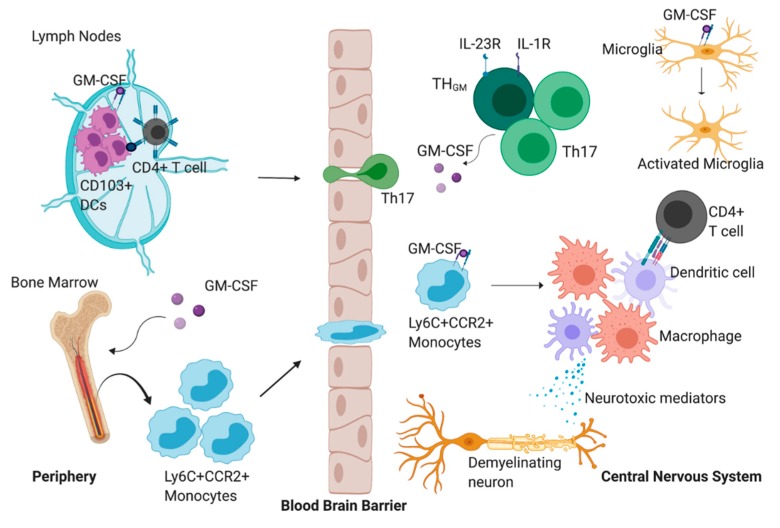
Multiple sclerosis (MS) is an immune-mediated disease that predominantly impacts the central nervous system (CNS). Animal models have been used to elucidate the underpinnings of MS pathology. One of the most well-studied models of MS is experimental autoimmune encephalomyelitis (EAE). This model was utilized to demonstrate that the cytokine granulocyte-macrophage colony-stimulating factor (GM-CSF) plays a critical and non-redundant role in mediating EAE pathology, making it an ideal therapeutic target. In this review, we will first explore the role that GM-CSF plays in maintaining homeostasis. This is important to consider, because any therapeutics that target GM-CSF could potentially alter these regulatory processes. We will then focus on current findings related to the function of GM-CSF signaling in EAE pathology, including the cell types that produce and respond to GM-CSF and the role of GM-CSF in both acute and chronic EAE. We will then assess the role of GM-CSF in alternative models of MS and comment on how this informs the understanding of GM-CSF signaling in the various aspects of MS immunopathology. Finally, we will examine what is currently known about GM-CSF signaling in MS, and how this has promoted clinical trials that directly target GM-CSF.
多发性硬化症(MS)是一种主要影响中枢神经系统(CNS)的免疫介导性疾病。动物模型已被用于阐明 MS 病理学的基础。最受研究的 MS 模型之一是实验性自身免疫性脑脊髓炎(EAE)。该模型被用于证明细胞因子集落刺激因子(GM-CSF)在介导 EAE 病理学方面发挥着关键和非冗余的作用,使其成为理想的治疗靶点。在这篇综述中,我们将首先探讨 GM-CSF 在维持内稳态方面的作用。这一点很重要,因为任何针对 GM-CSF 的治疗方法都可能改变这些调节过程。然后,我们将重点关注与 GM-CSF 信号在 EAE 病理学中的功能相关的最新发现,包括产生和响应 GM-CSF 的细胞类型,以及 GM-CSF 在急性和慢性 EAE 中的作用。然后,我们将评估 GM-CSF 在 MS 的其他模型中的作用,并评论这如何告知 GM-CSF 信号在 MS 免疫病理学各个方面的理解。最后,我们将研究目前已知的 MS 中的 GM-CSF 信号,以及这如何促进直接针对 GM-CSF 的临床试验。