Liu Wanhai, Wang Xiang, Liu Xingxia, Yu Changping, Fang Ming, Ye Wenhua
School of Electronic Information and Electrical Engineering, Tianshui Normal University, Tianshui, 741000, China.
Research Center of Computational Physics, Mianyang Normal University, Mianyang, 621000, China.
Sci Rep. 2020 Mar 6;10(1):4201. doi: 10.1038/s41598-020-60207-y.
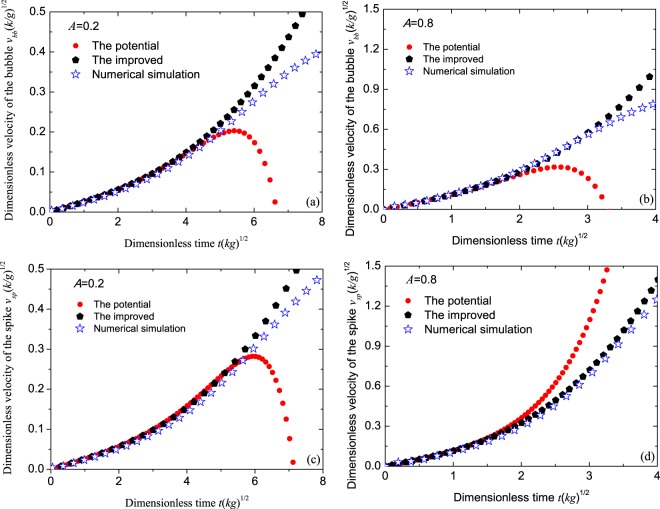
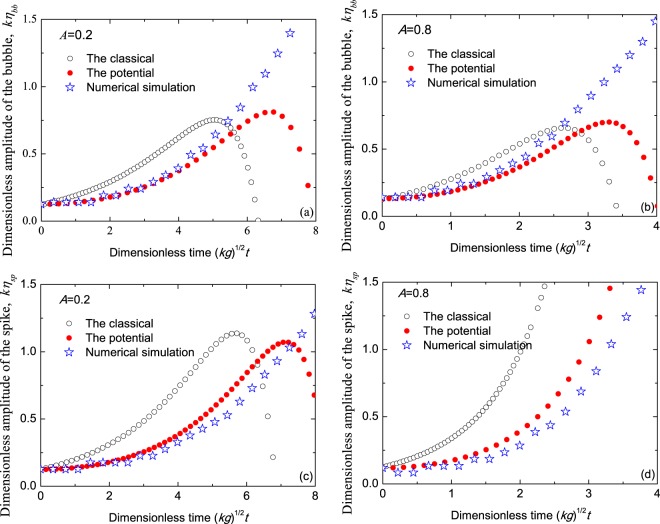
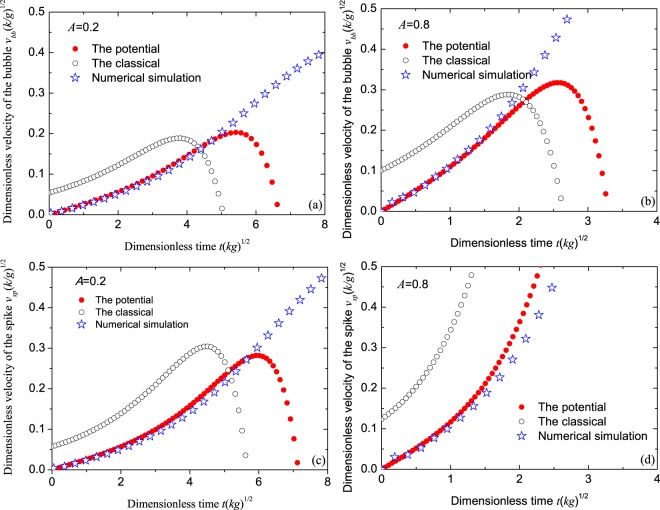
The validity of theoretical investigation on Rayleigh-Taylor instability (RTI) with nonlinearity is quite important, especially for the simplest and the commonest case of a pure single-mode RTI, while its previous explicit solution in weakly nonlinear scheme is found to have several defections. In this paper, this RTI is strictly solved by the method of the potential functions up to the third order at the weakly nonlinear stage for arbitrary Atwood numbers. It is found that the potential solution includes terms of both the stimulating and inhibiting RTI, while the terms of the decreasing RTI are omitted in the classical solution of the weakly nonlinear scheme, resulting in a big difference between these two results. For the pure single-mode cosine perturbation, comparisons among the classical result, the present potential result and numerical simulations, in which the two dimensional Euler equations are used, are carefully performed. Our result is in a better agreement with the numerical simulations than the classical one before the saturation time. To avoid the tedious expressions and improve a larger valid range of the solution, the method of the Taylor expansion is employed and the velocities of the bubble and spike are, respectively, obtained. Comparisons between the improved and the simulation results show that the improved theory can better predict the evolution of the interface from the linear to weakly nonlinear, even to later of the nonlinear stages.
对具有非线性的瑞利 - 泰勒不稳定性(RTI)进行理论研究的有效性非常重要,特别是对于最简单且最常见的纯单模RTI情况,然而其先前在弱非线性方案中的显式解被发现存在若干缺陷。本文针对任意阿特伍德数,在弱非线性阶段采用势函数方法对该RTI进行了严格求解,直至三阶。结果发现,势函数解包含了促进和抑制RTI的项,而在弱非线性方案的经典解中遗漏了抑制RTI的项,导致这两个结果存在很大差异。对于纯单模余弦扰动,仔细比较了经典结果、本文的势函数结果以及使用二维欧拉方程的数值模拟结果。在达到饱和时间之前,我们的结果与数值模拟的吻合度比经典结果更好。为了避免冗长的表达式并扩大解的有效范围,采用了泰勒展开方法,分别得到了气泡和尖峰的速度。改进后的理论与模拟结果的比较表明,改进后的理论能够更好地预测界面从线性到弱非线性,甚至到非线性后期阶段的演化。