Department of Medicine, Endocrinology; Erasmus Medical Center, GD Rotterdam, The Netherlands.
Department of Paediatric Oncology/Haematology, Erasmus MC - Sophia Children's Hospital, CN Rotterdam, The Netherlands.
J Clin Endocrinol Metab. 2020 Apr 1;105(4):e1397-407. doi: 10.1210/clinem/dgz279.
Pituitary hormonal deficiencies in patients with craniopharyngioma may impair their bone health.
To investigate bone health in patients with craniopharyngioma.
Retrospective cross-sectional study.
Dutch and Swedish referral centers.
Patients with craniopharyngioma (n = 177) with available data on bone health after a median follow-up of 16 years (range, 1-62) were included (106 [60%] Dutch, 93 [53%] male, 84 [48%] childhood-onset disease).
Fractures, dual X-ray absorptiometry-derived bone mineral density (BMD), and final height were evaluated. Low BMD was defined as T- or Z-score ≤-1 and very low BMD as ≤-2.5 or ≤-2.0, respectively.
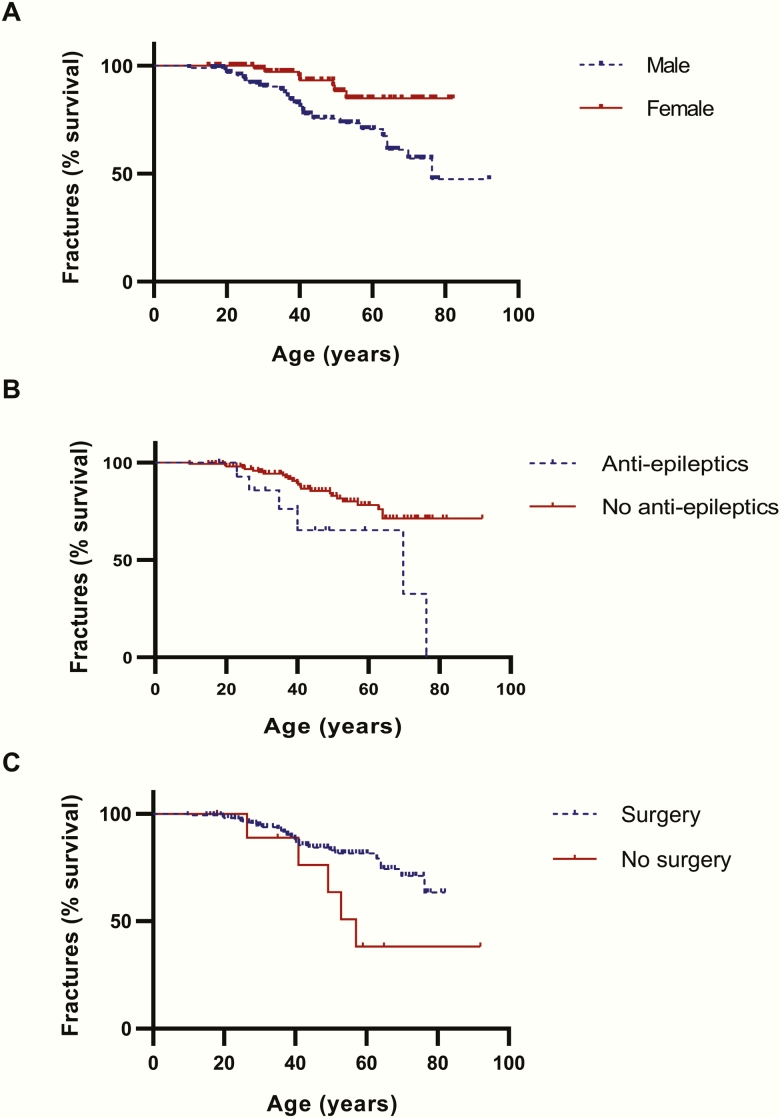
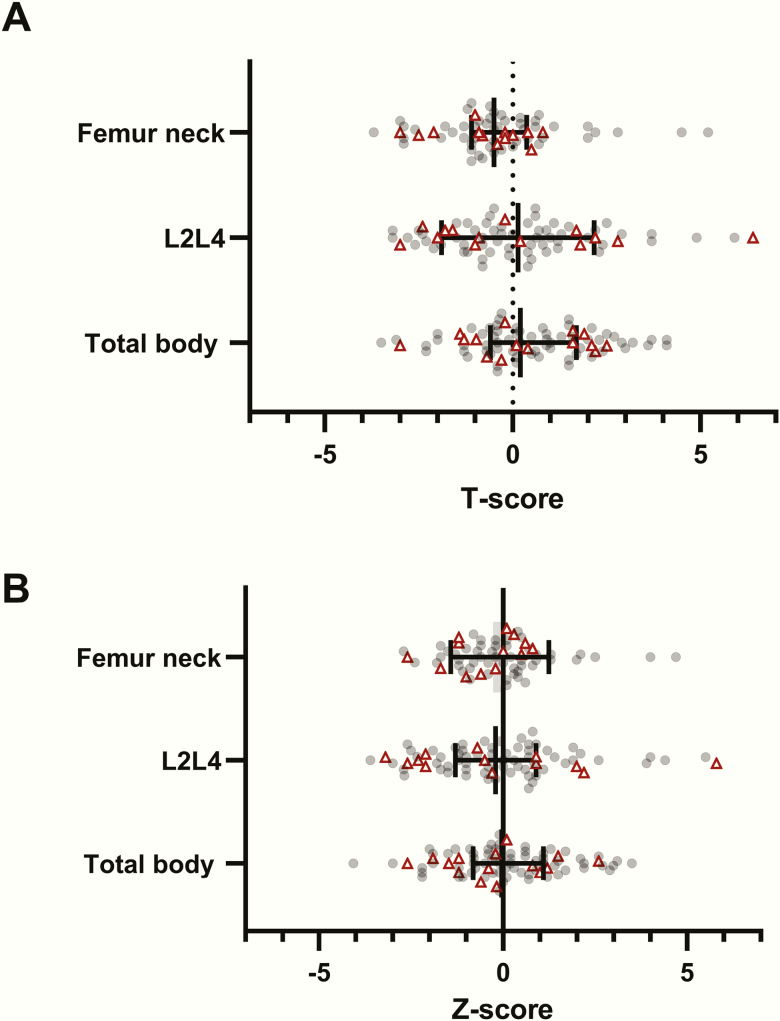
Fractures occurred in 31 patients (18%) and were more frequent in men than in women (26% vs. 8%, P = .002). Mean BMD was normal (Z-score total body 0.1 [range, -4.1 to 3.5]) but T- or Z-score ≤-1 occurred in 47 (50%) patients and T-score ≤-2.5 or Z-score ≤-2.0 in 22 (24%) patients. Men received less often treatment for low BMD than women (7% vs. 18%, P = .02). Female sex (OR 0.3, P = .004) and surgery (odds ratio [OR], 0.2; P = .01) were both independent protective factors for fractures, whereas antiepileptic medication was a risk factor (OR, 3.6; P = .03), whereas T-score ≤-2.5 or Z-score ≤-2.0 was not (OR, 2.1; P = .21). Mean final height was normal and did not differ between men and women, or adulthood and childhood-onset patients.
Men with craniopharyngioma are at higher risk than women for fractures. In patients with craniopharyngioma, a very low BMD (T-score ≤-2.5 or Z-score ≤-2.0) seems not to be a good predictor for fracture risk.
颅咽管瘤患者的垂体激素缺乏可能会损害其骨骼健康。
研究颅咽管瘤患者的骨骼健康状况。
回顾性横断面研究。
荷兰和瑞典的转诊中心。
纳入了 177 名颅咽管瘤患者(中位随访时间为 16 年[范围为 1-62 年],可获得骨骼健康数据)(106 名[60%]荷兰人,93 名[53%]男性,84 名[48%]为儿童发病)。
骨折、双能 X 线吸收法测定的骨密度(BMD)和最终身高。低 BMD 定义为 T-或 Z-评分≤-1,极低 BMD 定义为≤-2.5 或≤-2.0。
31 名患者(18%)发生骨折,男性比女性更常见(26%比 8%,P=.002)。平均 BMD 正常(全身 Z-评分 0.1[范围-4.1 至 3.5]),但 47 名(50%)患者的 T-或 Z-评分≤-1,22 名(24%)患者的 T-评分≤-2.5 或 Z-评分≤-2.0。与女性相比,男性接受低 BMD 治疗的比例较低(7%比 18%,P=.02)。女性(OR 0.3,P=.004)和手术(OR 0.2;P=.01)是骨折的独立保护因素,而抗癫痫药物是危险因素(OR 3.6;P=.03),而 T-评分≤-2.5 或 Z-评分≤-2.0 则不是(OR 2.1;P=.21)。平均最终身高正常,男女之间或成年期和儿童期发病的患者之间无差异。
颅咽管瘤男性患者骨折风险高于女性。在颅咽管瘤患者中,极低的 BMD(T-评分≤-2.5 或 Z-评分≤-2.0)似乎不是骨折风险的良好预测指标。