Department of Thoracic Surgery, West China Hospital of Sichuan University, Chengdu 610041, Sichuan Province, China.
Department of Ophthalmology, West China Hospital of Sichuan University, Chengdu 610041, Sichuan Province, China.
World J Gastroenterol. 2020 Feb 28;26(8):839-849. doi: 10.3748/wjg.v26.i8.839.
The impact of body mass index (BMI) on survival in patients with esophageal squamous cell carcinoma (ESCC) undergoing surgery remains unclear. Therefore, a definition of clinically significant BMI in patients with ESCC is needed.
To explore the impact of preoperative weight loss (PWL)-adjusted BMI on overall survival (OS) in patients undergoing surgery for ESCC.
This retrospective study consisted of 1545 patients who underwent curative resection for ESCC at West China Hospital of Sichuan University between August 2005 and December 2011. The relationship between PWL-adjusted BMI and OS was examined, and a multivariate analysis was performed and adjusted for age, sex, TNM stage and adjuvant therapy.
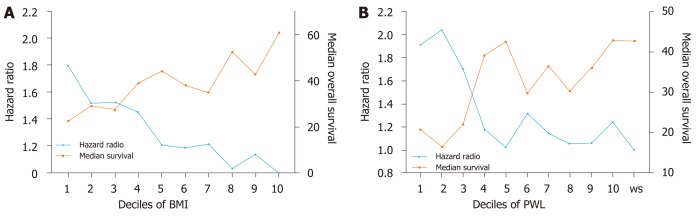
Trends of poor survival were observed for patients with increasing PWL and decreasing BMI. Patients with BMI ≥ 20.0 kg/m and PWL < 8.8% were classified into Group 1 with the longest median OS (45.3 mo). Patients with BMI < 20.0 kg/m and PWL < 8.8% were classified into Group 2 with a median OS of 29.5 mo. Patients with BMI ≥ 20.0 kg/m and PWL ≥ 8.8% (HR = 1.9, 95%CI: 1.5-2.5), and patients with BMI < 20.0 kg/m and PWL ≥ 8.8% (HR = 2.0, 95%CI: 1.6-2.6), were combined into Group 3 with a median OS of 20.1 mo. Patients in the three groups were associated with significantly different OS ( < 0.05). In multivariate analysis, PWL-adjusted BMI, TNM stage and adjuvant therapy were identified as independent prognostic factors.
PWL-adjusted BMI has an independent prognostic impact on OS in patients with ESCC undergoing surgery. BMI might be an indicator for patients with PWL < 8.8% rather than ≥ 8.8%.
体重指数(BMI)对接受手术的食管鳞癌(ESCC)患者的生存影响尚不清楚。因此,需要定义 ESCC 患者的临床显著 BMI。
探讨术前体重减轻(PWL)调整后的 BMI 对接受 ESCC 手术患者总生存(OS)的影响。
本回顾性研究纳入了 2005 年 8 月至 2011 年 12 月在四川大学华西医院接受根治性切除术治疗的 1545 例 ESCC 患者。研究检查了 PWL 调整后的 BMI 与 OS 的关系,并进行了多变量分析,并根据年龄、性别、TNM 分期和辅助治疗进行了调整。
随着 PWL 增加和 BMI 降低,观察到患者生存状况恶化的趋势。BMI≥20.0kg/m 和 PWL<8.8%的患者归入 OS 最长的第 1 组(45.3 个月)。BMI<20.0kg/m 和 PWL<8.8%的患者归入 OS 为 29.5 个月的第 2 组。BMI≥20.0kg/m 和 PWL≥8.8%(HR=1.9,95%CI:1.5-2.5)和 BMI<20.0kg/m 和 PWL≥8.8%(HR=2.0,95%CI:1.6-2.6)的患者归入 OS 为 20.1 个月的第 3 组。三组患者 OS 差异有统计学意义(<0.05)。多变量分析显示,PWL 调整后的 BMI、TNM 分期和辅助治疗是独立的预后因素。
PWL 调整后的 BMI 对接受手术的 ESCC 患者的 OS 有独立的预后影响。BMI 可能是 PWL<8.8%而非≥8.8%患者的一个指标。