Graduate Institute of Dental Sciences, School of Dental Medicine, Kaohsiung Medical University, Kaohsiung, Taiwan.
Department of Dentistry, Kaohsiung Municipal Ta-Tung Hospital, Kaohsiung, Taiwan.
Biomed Res Int. 2020 Feb 13;2020:2571534. doi: 10.1155/2020/2571534. eCollection 2020.
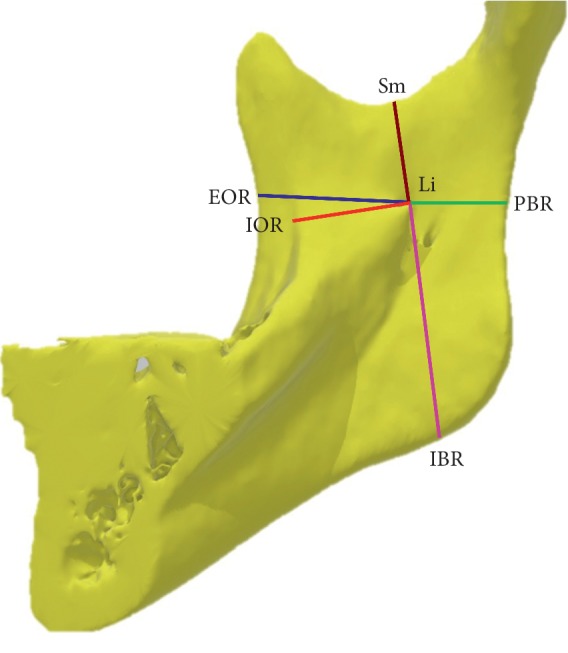
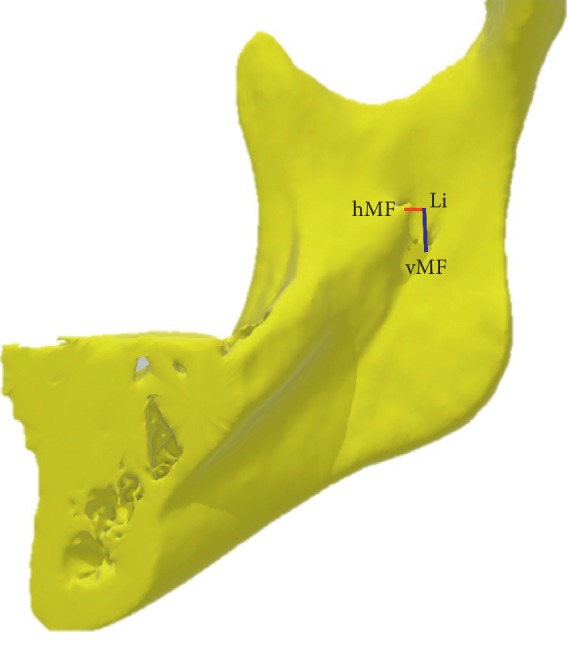
The study aimed to investigate and measure the anatomical relationship between the mandibular lingula (Li) and skeletal patterns using cone-beam computed tomography (CBCT). . In total, 72 participants (23 men and 49 women) were categorized into three groups according to their skeletal patterns (specifically, the A point-nasion-B point (ANB]) angle) as follows: Class I (0° < ANB < 4°), Class II (ANB ≥ 4°), and Class III (ANB ≤ 0°). The CBCT images of 144 rami were collected, and the distance from the Li to the external oblique ridge (Li-EOR), internal oblique ridge (Li-IOR), posterior border of the ramus (Li-PBR), inferior border of the ramus (Li-IBR), sigmoid notch (Li-Sm), and mandibular foramen (Li-MF) was examined. The Li-hMF (horizontal distance from the Li to the MF) and Li-vMF (vertical distance from the Li to the MF) were measured. The comparisons of gender, side (right and left), and skeletal patterns were then evaluated by statistical analysis.
The values of the Li-EOR and Li-PBR (19.99 mm and 15.93 mm, respectively) were significantly higher in men than in women (18.85 mm and 14.89 mm, respectively). Moreover, the Li-IBR was higher in men (32.91 mm) than in women (30.40 mm). Both sides (right and left) and skeletal patterns demonstrated that the Li-EOR, Li-IOR, and Li-PBR were not significantly different. Pearson's correlation test reported a strong correlation between the Li-EOR and Li-IOR (=0.610).
The distances from mandibula lingula to the external oblique ridge, posterior border of ramus, and inferior border of ramus were significantly longer in men than in women. Similarly, both horizontal and vertical distances from the lingula to the mandibular foramen were significantly longer in men than in women. Therefore, the results demonstrated that the Li was longer and more protruding in men than in women. With respect to the horizontal distance from the mandibular lingula to the mandibular foramen, of the three types of the skeletal system (Class I, Class II, and Class III), Class III was the significantly largest.
本研究旨在通过锥形束 CT(CBCT)来探讨和测量下颌舌骨棘(Li)与骨骼形态之间的解剖关系。共有 72 名参与者(23 名男性和 49 名女性)根据其骨骼形态(具体为 A 点-鼻根点-B 点(ANB)角)分为三组:I 类(0°<ANB<4°)、II 类(ANB≥4°)和 III 类(ANB≤0°)。采集了 144 个支的 CBCT 图像,并检查了 Li 到外斜嵴(Li-EOR)、内斜嵴(Li-IOR)、下颌支后缘(Li-PBR)、下颌支下缘(Li-IBR)、乙状切迹(Li-Sm)和下颌孔(Li-MF)的距离。测量了 Li-hMF(Li 到 MF 的水平距离)和 Li-vMF(Li 到 MF 的垂直距离)。然后通过统计分析对性别、侧别(右侧和左侧)和骨骼形态进行了比较。
男性的 Li-EOR 和 Li-PBR 值(19.99mm 和 15.93mm)明显高于女性(18.85mm 和 14.89mm)。此外,男性的 Li-IBR 更高(32.91mm),女性的 Li-IBR 更低(30.40mm)。左右两侧和骨骼形态均显示 Li-EOR、Li-IOR 和 Li-PBR 无显著差异。Pearson 相关检验显示 Li-EOR 和 Li-IOR 之间存在强相关(=0.610)。
男性的下颌舌骨棘到外斜嵴、支后缘和支下缘的距离明显长于女性。同样,男性的 Li 到下颌孔的水平和垂直距离均明显长于女性。因此,结果表明男性的 Li 更长、更突出。就下颌舌骨棘到下颌孔的水平距离而言,在三种骨骼类型(I 类、II 类和 III 类)中,III 类明显最大。