Cheng Zhipeng, Fang Minghui, Chen Xuexue, Zhang Yitong, Wang Yaxin, Li Haojie, Qian Jun
Key Laboratory of Specially Functional Polymeric Materials and Related Technology of the Ministry of Education, School of Materials Science and Engineering, East China University of Science and Technology, Shanghai 200237, China.
ACS Omega. 2020 Feb 24;5(8):4200-4212. doi: 10.1021/acsomega.9b04050. eCollection 2020 Mar 3.
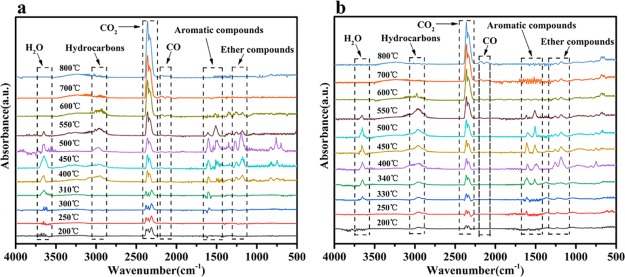
An amino curing agent containing silicon/titanium flame-retardant elements (STCA) based on (3-aminopropyl)triethoxysilane (APTES) and tetrabutyl titanate was successfully prepared. The thermal decomposition and flame-retardant properties of a STCA-cured trifunctional epoxy resin, which was facilely synthesized by 1,1,1-tris(4-hydroxyphenyl)ethane and epichlorohydrin via a two-step method, were compared with those of another amino curing agent containing silicon (SCA) based on APTES and methyltrimethoxysilane. The structures of STCA and SCA were characterized by Fourier transform infrared (FT-IR), Si NMR, and Raman spectroscopies. The STCA-cured thermoset not only had good thermal stability with an initial decomposition temperature of 344.8 °C and a char yield of 52.7% at 800 °C but also exhibited the overall improvement of flame-retardant properties. V-0 rating was achieved using the UL-94 test, and the value of limiting oxygen index reached 33.8%. From the thermogravimetry-infrared test, the yield of pyrolysis products of the STCA-cured thermoset was significantly decreased, indicating the lower toxicity in contrast to the SCA-cured thermoset. Flame-retardant performances were also investigated using the cone calorimetry test, and the flame retardancy mechanism was studied using scanning electron microscopy, FT-IR, and energy-dispersive spectrometry. The results indicate that the introduction of silicon/titanium to the system reveals the synergistic effects to promote the formation of an intumescent, sufficient, and compact char layer during combustion, which could effectively prevent heat, oxygen, and flame from penetrating into the interior structure, and lead to the retardance of further combustion.
成功制备了一种基于(3-氨丙基)三乙氧基硅烷(APTES)和钛酸四丁酯的含硅/钛阻燃元素的氨基固化剂(STCA)。通过1,1,1-三(4-羟基苯基)乙烷和环氧氯丙烷经两步法简便合成的STCA固化三官能环氧树脂的热分解和阻燃性能,与另一种基于APTES和甲基三甲氧基硅烷的含硅氨基固化剂(SCA)进行了比较。通过傅里叶变换红外光谱(FT-IR)、硅核磁共振(Si NMR)和拉曼光谱对STCA和SCA的结构进行了表征。STCA固化的热固性材料不仅具有良好的热稳定性,初始分解温度为344.8℃,800℃时的残炭率为52.7%,而且阻燃性能整体得到提高。通过UL-94测试达到了V-0等级,极限氧指数值达到33.8%。从热重-红外测试可知,STCA固化热固性材料的热解产物产率显著降低,表明与SCA固化热固性材料相比毒性更低。还使用锥形量热法测试研究了阻燃性能,并使用扫描电子显微镜、FT-IR和能谱分析法研究了阻燃机理。结果表明,向体系中引入硅/钛显示出协同效应,促进了燃烧过程中膨胀、充分且致密的炭层的形成,这可以有效地防止热量、氧气和火焰渗透到内部结构中,并导致进一步燃烧的延迟。