Bioinformatics Postgraduate Program, Metrópole Digital Institute, Federal University of Rio Grande do Norte, Natal, Brazil.
Biomedical Engineering Department, Center of Technology, Federal University of Rio Grande do Norte, Natal, Brazil.
BMC Med Inform Decis Mak. 2020 Mar 10;20(1):52. doi: 10.1186/s12911-020-1060-0.
A variant of unknown significance (VUS) is a variant form of a gene that has been identified through genetic testing, but whose significance to the organism function is not known. An actual challenge in precision medicine is to precisely identify which detected mutations from a sequencing process have a suitable role in the treatment or diagnosis of a disease. The average accuracy of pathogenicity predictors is 85%. However, there is a significant discordance about the identification of mutational impact and pathogenicity among them. Therefore, manual verification is necessary for confirming the real effect of a mutation in its casuistic.
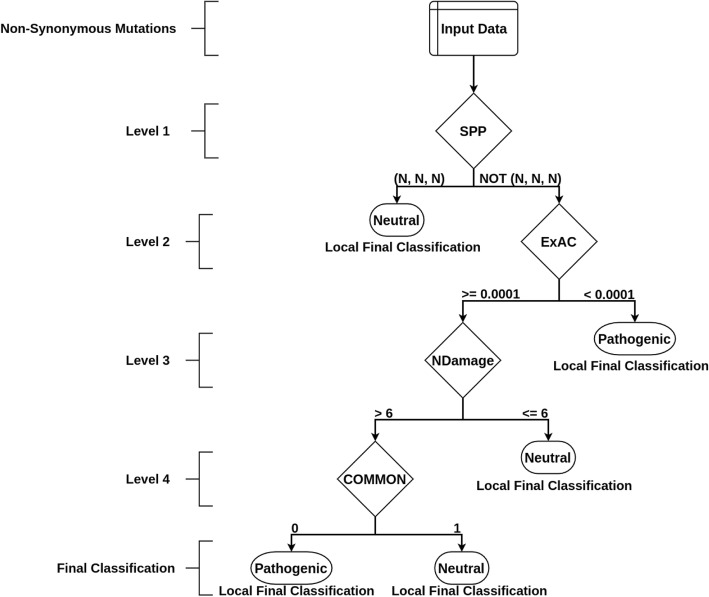
In this work, we use variables categorization and selection for building a decision tree model, and later we measure and compare its accuracy with four known mutation predictors and seventeen supervised machine-learning (ML) algorithms.
The results showed that the proposed tree reached the highest precision among all tested variables: 91% for True Neutrals, 8% for False Neutrals, 9% for False Pathogenic, and 92% for True Pathogenic.
The decision tree exceptionally demonstrated high classification precision with cancer data, producing consistently relevant forecasts for the sample tests with an accuracy close to the best ones achieved from supervised ML algorithms. Besides, the decision tree algorithm is easier to apply in clinical practice by non-IT experts. From the cancer research community perspective, this approach can be successfully applied as an alternative for the determination of potential pathogenicity of VOUS.
意义未明的变异(VUS)是一种通过基因检测发现的基因变异形式,但它对生物体功能的意义尚不清楚。精准医学的一个实际挑战是准确识别测序过程中检测到的突变,这些突变在疾病的治疗或诊断中有合适的作用。致病性预测器的平均准确率为 85%。然而,它们在识别突变影响和致病性方面存在显著差异。因此,需要进行人工验证来确认突变在具体情况下的真实效应。
在这项工作中,我们使用变量分类和选择来构建决策树模型,然后测量并比较其与四个已知突变预测器和十七个监督机器学习(ML)算法的准确性。
结果表明,所提出的决策树在所有测试变量中达到了最高的精度:91%的真中性、8%的假中性、9%的假致病性和 92%的真致病性。
决策树在癌症数据中表现出极高的分类精度,对样本测试产生了始终相关的预测,准确率接近从监督 ML 算法获得的最佳结果。此外,决策树算法更容易由非 IT 专家在临床实践中应用。从癌症研究社区的角度来看,这种方法可以成功地应用于确定意义未明的变异的潜在致病性。