Bröcker Anna-Lena, Bayer Samuel, Stuke Frauke, Just Sandra, Bertram Gianna, Funcke Jakob, Grimm Imke, Lempa Günter, von Haebler Dorothea, Montag Christiane
Department of Psychiatry and Psychotherapy, Charité Universitätsmedizin Berlin, Berlin, Germany.
International Psychoanalytic University Berlin, Berlin, Germany.
Front Psychol. 2020 Feb 21;11:269. doi: 10.3389/fpsyg.2020.00269. eCollection 2020.
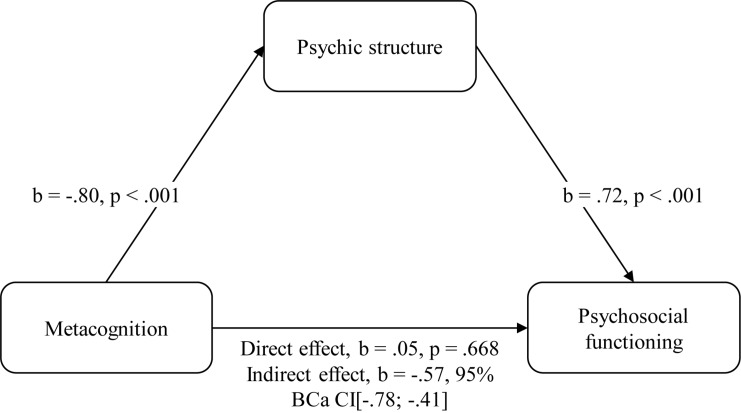
Synthetic metacognition is defined by integrative and contextualizing processes of discrete reflexive moments. These processes are supposed to be needed to meet intrapsychic as well as interpersonal challenges and to meaningfully include psychotic experience in a personal life narrative. A substantial body of evidence has linked this phenomenon to psychosocial functioning and treatment options were developed. The concept of synthetic metacognition, measured with the Metacognition Assessment Scale-Abbreviated (MAS-A), rises hope to bridge gaps between therapeutic orientations and shares valuable parallels to modern psychodynamic constructs, especially the 'levels of structural integration' of the Operationalized Psychodynamic Diagnosis (OPD-2). As theoretical distinctions remain, aim of this study was to compare the predictive value of both constructs with regard to psychosocial functioning of patients with non-affective psychoses, measured with the International Classification of Functioning, Disability and Health (MINI-ICF-APP). It was further explored if levels of structural integration (OPD-LSIA) would mediate the impact of metacognition (MAS-A) on function (MINI-ICF-APP). Expert ratings of synthetic metacognition (MAS-A), the OPD-2 'levels of structural integration' axis (OPD-LSIA), psychosocial functioning (MINI-ICF-APP) and assessments of general cognition and symptoms were applied to 100 individuals with non-affective psychoses. Whereas both, MAS-A and OPD-LSIA, significantly predicted MINI-ICF-APP beyond cognition and symptoms, OPD-LSIA explained a higher share of variance and mediated the impact of MAS-A on MINI-ICF-APP. Levels of structural integration, including the quality of internalized object representations and unconscious interpersonal schemas, might therefore be considered as valuable predictors of social functioning and as one therapeutic focus in patients with non-affective psychoses. Structural integration might go beyond and form the base of a person's actual reflexive and metacognitive capabilities. Psychotherapeutic procedures specific for psychoses may promote and challenge a patient's metacognitive capacities, but should equally take the need for maturing structural skills into account. Modern psychodynamic approaches to psychosis are shortly presented, providing concepts and techniques for the implicit regulation of interpersonal experience and aiming at structural integration in this patient group.
合成元认知由离散的反思时刻的整合和情境化过程所定义。这些过程被认为是应对内心以及人际挑战并将精神病体验有意义地纳入个人生活叙事所必需的。大量证据将这一现象与心理社会功能联系起来,并开发了相应的治疗方案。用元认知评估量表简版(MAS-A)测量的合成元认知概念,有望弥合治疗取向之间的差距,并与现代精神动力学结构有宝贵的相似之处,尤其是操作性精神动力学诊断(OPD-2)的“结构整合水平”。由于理论上仍有区别,本研究的目的是比较这两种结构对非情感性精神病患者心理社会功能的预测价值,用国际功能、残疾和健康分类(MINI-ICF-APP)进行测量。还进一步探讨了结构整合水平(OPD-LSIA)是否会介导元认知(MAS-A)对功能(MINI-ICF-APP)的影响。对100名非情感性精神病患者应用了合成元认知(MAS-A)、OPD-2“结构整合水平”轴(OPD-LSIA)、心理社会功能(MINI-ICF-APP)的专家评分以及一般认知和症状评估。虽然MAS-A和OPD-LSIA都显著预测了超出认知和症状的MINI-ICF-APP,但OPD-LSIA解释了更高比例的方差,并介导了MAS-A对MINI-ICF-APP的影响。因此,包括内化客体表征和无意识人际图式质量在内的结构整合水平,可能被视为社会功能的有价值预测指标,以及非情感性精神病患者的一个治疗重点。结构整合可能超越并构成一个人实际反思和元认知能力的基础。针对精神病的心理治疗程序可能会促进和挑战患者的元认知能力,但同样应考虑到培养结构技能的必要性。简要介绍了现代精神动力学治疗精神病的方法,提供了用于人际体验隐性调节的概念和技术,并旨在使该患者群体实现结构整合。