Stokke Runar, Reeves Eoghan P, Dahle Håkon, Fedøy Anita-Elin, Viflot Thomas, Lie Onstad Solveig, Vulcano Francesca, Pedersen Rolf B, Eijsink Vincent G H, Steen Ida H
Department of Biological Sciences, University of Bergen, Bergen, Norway.
K.G. Jebsen Centre for Deep Sea Research, University of Bergen, Bergen, Norway.
Front Microbiol. 2020 Feb 21;11:249. doi: 10.3389/fmicb.2020.00249. eCollection 2020.
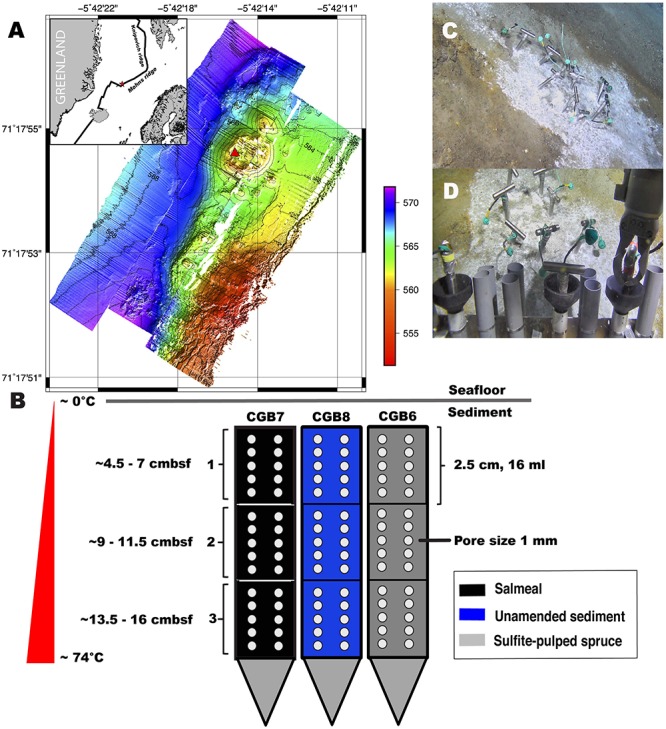
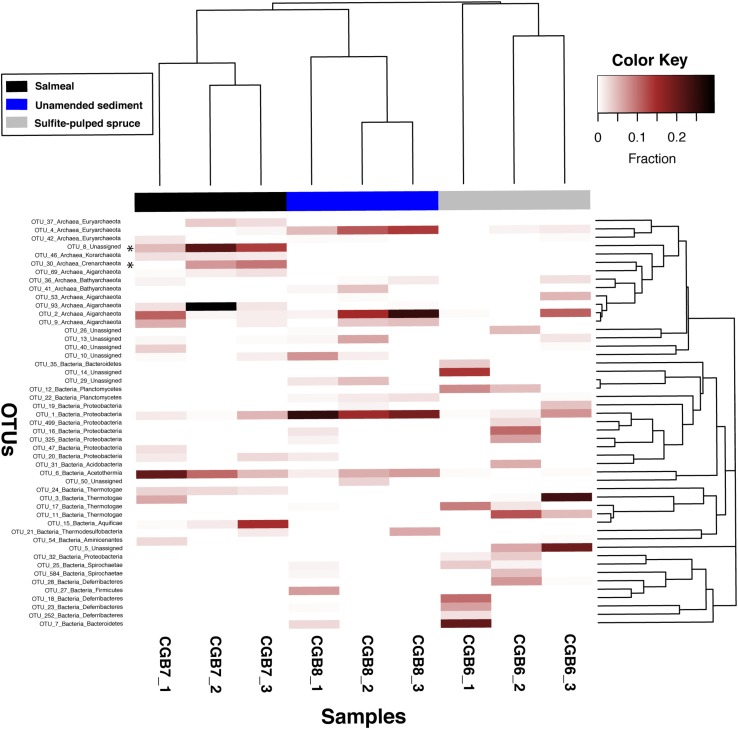
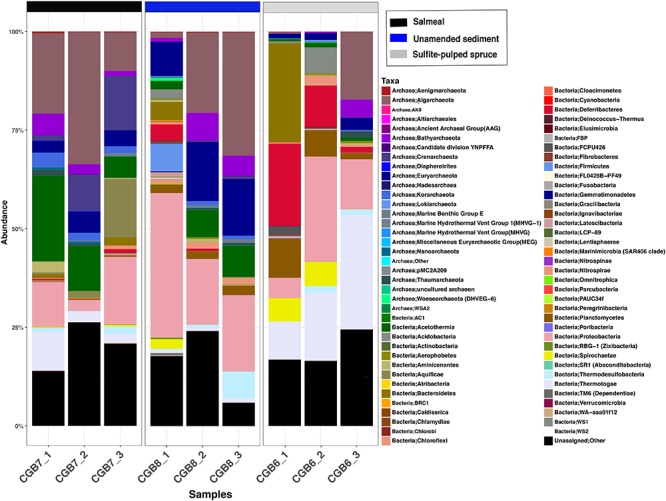
Deep-sea hydrothermal vents are amongst the most extreme environments on Earth and represent interesting targets for marine bioprospecting and biodiscovery. The microbial communities in hydrothermal vents are often dominated by chemolithoautotrophs utilizing simple chemical compounds, though the full extent of their heterotrophic abilities is still being explored. In the bioprocessing industry, where degradation of complex organic materials often is a major challenge, new microbial solutions are heavily needed. To meet these needs, we have developed novel incubators and tested if deployment of recalcitrant materials from fish farming and wood-pulping industries introduced changes in the microbial community structure in hot marine hydrothermal sediments. The incubation chambers were deployed in sediments at the Bruse vent site located within the Jan Mayen vent field for 1 year, after which the microbial populations in the chambers were profiled by 16S rRNA Ion Torrent amplicon sequencing. A total of 921 operational taxonomic units (OTUs) were assigned into 74 different phyla where differences in community structure were observed depending on the incubated material, chamber depth below the sea floor and/or temperature. A high fraction of putative heterotrophic microbial lineages related to cultivated members within the Thermotogales were observed. However, considerable fractions of previously uncultivated and novel Thermotogales and Bacteroidetes were also identified. Moreover, several novel lineages (e.g., members within the DPANN superphylum, unidentified archaeal lineages, unclassified Thermoplasmatales and division BRC-1 bacterium) of as-yet uncultivated thermophilic archaea and bacteria were identified. Overall, our data illustrate that amendment of hydrothermal vent communities by incubation of biomass induces shifts in community structure toward increased fractions of heterotrophic microorganisms. The technologies utilized here could aid in subsequent metagenomics-based enzyme discovery for diverse industries.
深海热液喷口是地球上最极端的环境之一,是海洋生物勘探和生物发现的有趣目标。热液喷口中的微生物群落通常由利用简单化合物的化能自养生物主导,不过它们异养能力的全部范围仍在探索之中。在生物加工行业,复杂有机材料的降解往往是一项重大挑战,因此迫切需要新的微生物解决方案。为满足这些需求,我们开发了新型培养箱,并测试了投放来自养鱼业和制浆业的难降解材料是否会改变热海热液沉积物中的微生物群落结构。将培养箱部署在扬马延岛热液区的布鲁斯喷口处的沉积物中1年,之后通过16S rRNA离子激流扩增子测序对培养箱中的微生物种群进行分析。总共921个操作分类单元(OTU)被归入74个不同的门,根据培养的材料、海底以下的培养箱深度和/或温度观察到群落结构存在差异。观察到与嗜热栖热菌属内已培养成员相关的大量假定异养微生物谱系。然而,也鉴定出了相当一部分以前未培养的新型嗜热栖热菌属和拟杆菌属。此外,还鉴定出了几个尚未培养的嗜热古菌和细菌的新型谱系(例如,DPANN超门内的成员、未鉴定的古菌谱系、未分类的嗜热放线菌目和BRC-1细菌门)。总体而言,我们的数据表明,通过培养生物质来改变热液喷口群落会导致群落结构向异养微生物比例增加的方向转变。这里使用的技术有助于随后基于宏基因组学的多种行业酶的发现。