Imnadze Guram, Hofmann Steffen, Billion Michael, Ferdosi Abbas, Kowalski Marek, Rajab Ehab, Bramlage Karin, Bramlage Peter, Warnecke Henning, Franz Norbert
Institut für Gesundheitsforschung und Bildung, Universität Osnabrück, Osnabrück, Germany.
Department of Cardiac Surgery, Schüchtermann Clinic, Bad Rothenfelde, Germany.
Open Heart. 2020 Feb 19;7(1):e001194. doi: 10.1136/openhrt-2019-001194. eCollection 2020.
A logistic European System for Cardiac Operative Risk Evaluation (logEuroSCORE) ≥20% is frequently recognised as a finite criteria for transcatheter aortic valve implantation (TAVI) reimbursement, despite guideline modifications to reflect the appropriacy of TAVI in selected lower-risk patients. The aim was to evaluate the clinical value of this threshold cut-off in TAVI patients and to identify factors associated with mortality in those below this threshold.
We analysed data from a single-centre, German, observational, TAVI-patient registry, gathered between 2008 and 2016. Patients were stratified by logEuroSCORE (≥ or <20%) for comparisons. Logistic regression was performed to identify predictors of mortality at 1 year, with this analysis used to generate a calculated ('real') risk value for each patient.
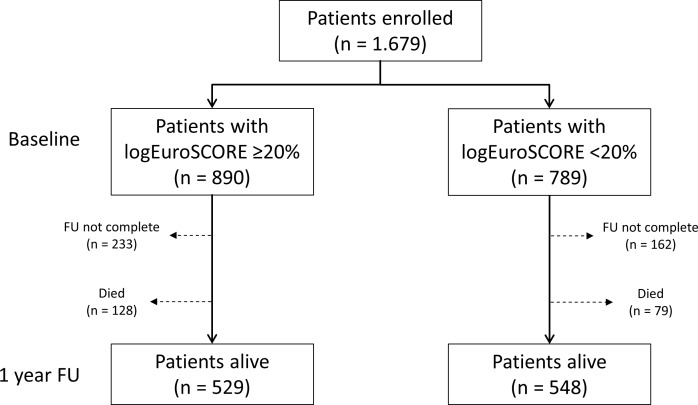
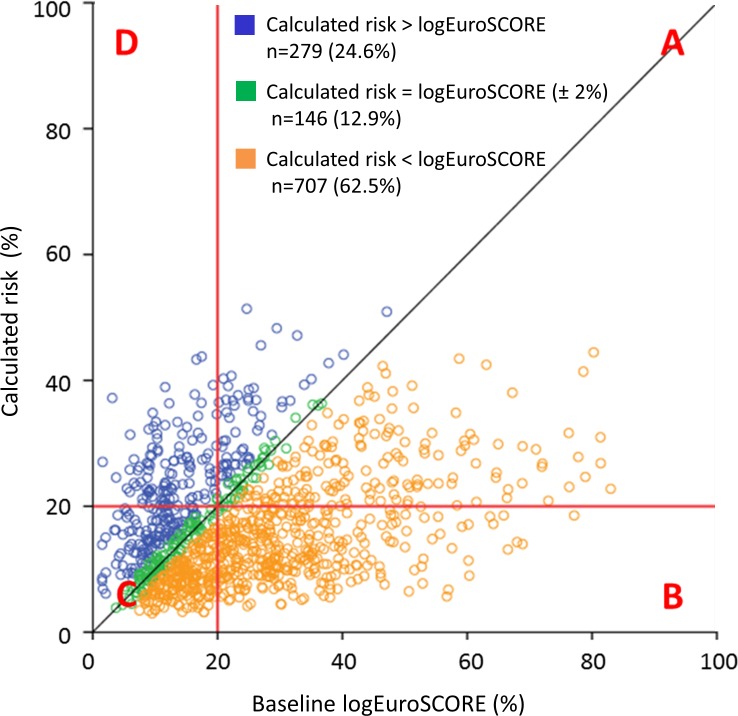
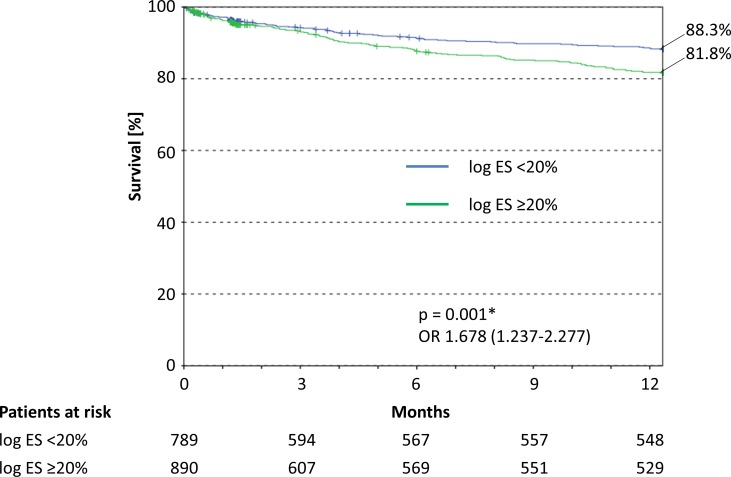
1679 patients (logEuroSCORE <20%: n=789; logEuroSCORE ≥20%: n=890) were included. LogEuroSCORE <20% patients were significantly younger (80.1 vs 81.6 years; p<0.001) and less comorbid than logEuroSCORE ≥20% patients, with a higher rate of transfemoral TAVI (35.6% vs 26.1%; p<0.001) and predilation (70.0% vs 63.3%; p=0.004). Patients with a logEuroSCORE <20% experienced more vascular complications (3.4% vs 1.5%; p=0.010). One-year survival was 88.3% in the logEuroSCORE <20% and 81.8% in the logEuroSCORE ≥20% group (p=0.005), with the calculated mortality risk falling within 2% of the logEuroSCORE in just 12.9% of patients. In the logEuroSCORE <20% group, only coronary artery disease was significantly predictive of 1-year mortality (OR 2.408; 95% CI 1.361 to 4.262; p=0.003).
At our institution, patients with a logEuroSCORE <20% selected for TAVI have excellent outcomes. The decision not to reimburse TAVI in such patients may be viewed as inappropriate.
尽管指南已修改以反映经导管主动脉瓣植入术(TAVI)在部分低风险患者中的适用性,但欧洲心脏手术风险评估逻辑系统(logEuroSCORE)≥20%仍常被视为TAVI报销的限定标准。本研究旨在评估该阈值在TAVI患者中的临床价值,并确定低于该阈值患者的死亡相关因素。
我们分析了2008年至2016年间收集的来自德国单中心TAVI患者观察性注册研究的数据。根据logEuroSCORE(≥或<20%)对患者进行分层以进行比较。进行逻辑回归分析以确定1年死亡率的预测因素,该分析用于为每位患者生成计算得出的(“实际”)风险值。
共纳入1679例患者(logEuroSCORE<20%:n = 789;logEuroSCORE≥20%:n = 890)。logEuroSCORE<20%的患者比logEuroSCORE≥20%的患者明显更年轻(80.1岁对81.6岁;p<0.001)且合并症更少,经股动脉TAVI率更高(35.6%对26.1%;p<0.001)以及预扩张率更高(70.0%对63.3%;p = 0.004)。logEuroSCORE<20%的患者发生血管并发症更多(3.4%对1.5%;p = 0.010)。logEuroSCORE<20%组的1年生存率为88.3%,logEuroSCORE≥20%组为81.8%(p = 0.005),仅12.9%的患者计算得出的死亡风险在logEuroSCORE的2%范围内。在logEuroSCORE<20%组中,仅冠状动脉疾病是1年死亡率的显著预测因素(OR 2.408;95%CI 1.361至4.262;p = 0.003)。
在我们机构,选择进行TAVI的logEuroSCORE<20%的患者预后良好。对这类患者不报销TAVI的决定可能被视为不合适。