Cheng Yi-Shan, Chien Andy, Lai Dar-Ming, Lee Ya-Yun, Cheng Chih-Hsiu, Wang Shwu-Fen, Chang Ya-Ju, Wang Jaw-Lin, Hsu Wei-Li
School and Graduate Institute of Physical Therapy, College of Medicine, National Taiwan University, Taipei, Taiwan.
Division of Physical Therapy, Department of Physical Medicine and Rehabilitation, Shin Kong Wu Ho-Su Memorial Hospital, Taipei, Taiwan.
Front Bioeng Biotechnol. 2020 Feb 20;8:108. doi: 10.3389/fbioe.2020.00108. eCollection 2020.
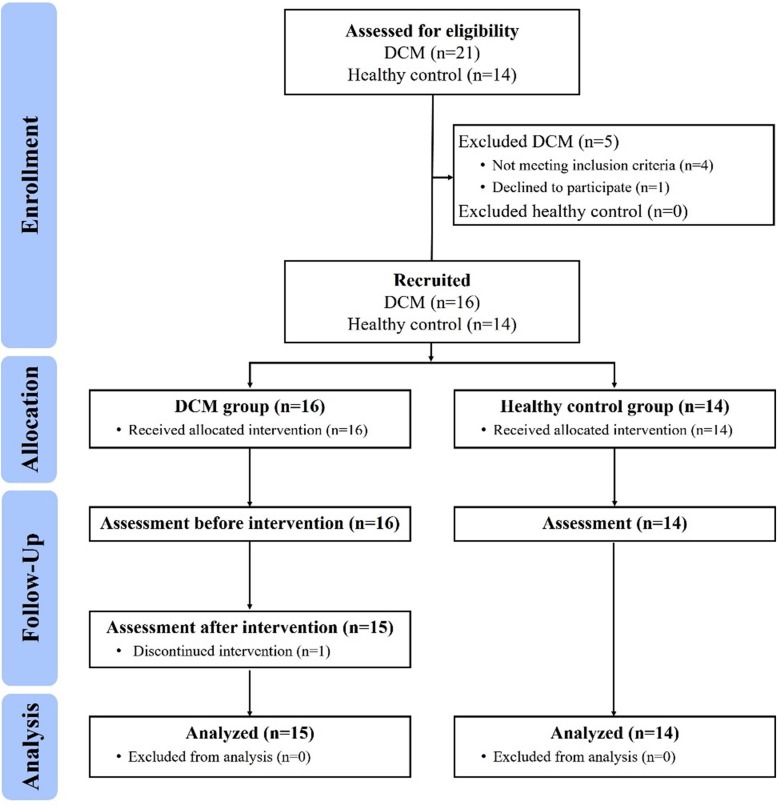
Degenerative cervical myelopathy (DCM) is a common aging condition caused by spinal cord compression. Individuals with DCM often presented with residual balance and functional impairments postoperatively. Perturbation-based balance training (PBT) has been shown to have positive effects on populations with neurological disorders but has yet to be investigated in DCM. The objective of this study was therefore to evaluate the effects of PBT on balance and functional performance in postoperative individuals with DCM. Fifteen postoperative individuals with DCM (DCM group) and 14 healthy adults (healthy control group) were recruited. The DCM group received a 4-weeks PBT using a perturbation treadmill. The outcome measures included mean velocity of center of pressure (COP) during quiet standing; center of mass (COM) variance and reaction time to balance perturbation during standing with forward and backward perturbation; gait speed during level ground walking; Timed Up and Go Test (TUG) and disability questionnaire scores including Visual Analog Scale, Neck Disability Index, and Lower Extremity Function of Japanese Orthopaedic Association Cervical Myelopathy Evaluation Questionnaire. The assessments were conducted pre- and post-training postoperatively for the DCM group but only once for the healthy control group. Significant improvements were observed in the mean velocity of COP, COM variance, reaction time, gait speed, and TUG in the DCM group. Disability questionnaire scores were not significantly different after training in DCM group. For between-group comparisons, significant differences that were observed pre-training were not observed post-training. The 4-weeks PBT is a potential rehabilitation strategy for addressing balance and functional impairment in postoperative individuals with DCM. In addition, the post-training performance in the DCM group exhibited trends comparable to those of age-matched healthy controls. Furthermore, the training regimens offer a practical reference for future studies on populations with balance disorders. Future studies complemented with neurophysiological assessments could reveal more information of the underlying mechanisms of PBT.
退行性颈椎脊髓病(DCM)是一种由脊髓受压引起的常见衰老病症。患有DCM的个体术后常伴有残余平衡和功能障碍。基于扰动的平衡训练(PBT)已被证明对患有神经疾病的人群有积极影响,但尚未在DCM中进行研究。因此,本研究的目的是评估PBT对DCM术后个体平衡和功能表现的影响。招募了15名DCM术后个体(DCM组)和14名健康成年人(健康对照组)。DCM组使用扰动跑步机接受为期4周的PBT。结果测量包括安静站立时压力中心(COP)的平均速度;站立时向前和向后扰动时质心(COM)的方差和对平衡扰动的反应时间;平地行走时的步态速度;定时起立行走测试(TUG)以及残疾问卷分数,包括视觉模拟量表、颈部残疾指数和日本骨科协会颈椎脊髓病评估问卷的下肢功能。对DCM组在术后训练前后进行评估,而健康对照组仅进行一次评估。DCM组在COP平均速度、COM方差、反应时间、步态速度和TUG方面有显著改善。DCM组训练后残疾问卷分数无显著差异。对于组间比较,训练前观察到的显著差异在训练后未观察到。为期4周的PBT是解决DCM术后个体平衡和功能障碍的一种潜在康复策略。此外,DCM组训练后的表现与年龄匹配的健康对照组表现出相似趋势。此外,训练方案为未来关于平衡障碍人群的研究提供了实际参考。未来结合神经生理学评估的研究可能会揭示PBT潜在机制的更多信息。