Bradbury Peta, Wu Hanjie, Choi Jung Un, Rowan Alan E, Zhang Hongyu, Poole Kate, Lauko Jan, Chou Joshua
Respiratory Technology, Woolcock Institute of Medical Research, Sydney, NSW, Australia.
School of Biomedical Engineering, Faculty of Engineering and Information Technology, University of Technology Sydney, Sydney, NSW, Australia.
Front Cell Dev Biol. 2020 Feb 21;8:96. doi: 10.3389/fcell.2020.00096. eCollection 2020.
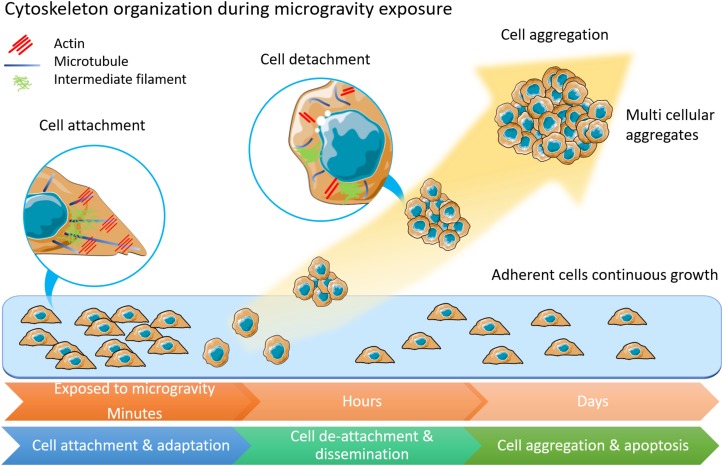
A lack of gravity experienced during space flight has been shown to have profound effects on human physiology including muscle atrophy, reductions in bone density and immune function, and endocrine disorders. At present, these physiological changes present major obstacles to long-term space missions. What is not clear is which pathophysiological disruptions reflect changes at the cellular level versus changes that occur due to the impact of weightlessness on the entire body. This review focuses on current research investigating the impact of microgravity at the cellular level including cellular morphology, proliferation, and adhesion. As direct research in space is currently cost prohibitive, we describe here the use of microgravity simulators for studies at the cellular level. Such instruments provide valuable tools for cost-effective research to better discern the impact of weightlessness on cellular function. Despite recent advances in understanding the relationship between extracellular forces and cell behavior, very little is understood about cellular biology and mechanotransduction under microgravity conditions. This review will examine recent insights into the impact of simulated microgravity on cell biology and how this technology may provide new insight into advancing our understanding of mechanically driven biology and disease.
太空飞行期间经历的失重已被证明对人体生理有深远影响,包括肌肉萎缩、骨密度降低、免疫功能下降以及内分泌紊乱。目前,这些生理变化是长期太空任务的主要障碍。尚不清楚哪些病理生理紊乱反映了细胞水平的变化,哪些是由于失重对全身的影响而发生的变化。本综述重点关注当前研究在细胞水平上对微重力影响的研究,包括细胞形态、增殖和黏附。由于目前直接在太空进行研究成本过高,我们在此描述使用微重力模拟器进行细胞水平研究的情况。这些仪器为经济高效的研究提供了有价值的工具,以便更好地识别失重对细胞功能的影响。尽管在理解细胞外作用力与细胞行为之间的关系方面最近取得了进展,但对于微重力条件下的细胞生物学和机械转导了解甚少。本综述将探讨模拟微重力对细胞生物学影响的最新见解,以及这项技术如何为推进我们对机械驱动生物学和疾病的理解提供新的见解。