
循环肿瘤细胞作为微小残留病的一种工具可预测肺癌复发:一项纵向前瞻性试验。
Circulating Tumor Cells as a Tool of Minimal Residual Disease Can Predict Lung Cancer Recurrence: A longitudinal, Prospective Trial.
作者信息
Wu Ching-Yang, Lee Chia-Lin, Wu Ching-Feng, Fu Jui-Ying, Yang Cheng-Ta, Wen Chi-Tsung, Liu Yun-Hen, Liu Hui-Ping, Hsieh Jason Chia-Hsun
机构信息
Division of Thoracic and Cardiovascular Surgery, Department of Surgery, Chang Gung Memorial Hospital, Linkou 333423, Taiwan.
College of Medicine, Chang Gung University, Taoyuan 333323, Taiwan.
出版信息
Diagnostics (Basel). 2020 Mar 6;10(3):144. doi: 10.3390/diagnostics10030144.
BACKGROUND
The role of circulating tumor cells (CTCs) for predicting the recurrence of cancer in lung cancer patients after surgery remains unclear.
METHODS
A negatively selected protocol of CTC identification was applied. For all the enrolled patients, CTC testing was performed before and after surgery on the operation day (day 0), postoperative day 1, and day 3. The daily decline and trend of CTCs were analyzed to correlate with cancer relapse. The mixed model repeated measures (MMRM) adjusted by cancer characteristics was applied for statistical significance.
RESULTS
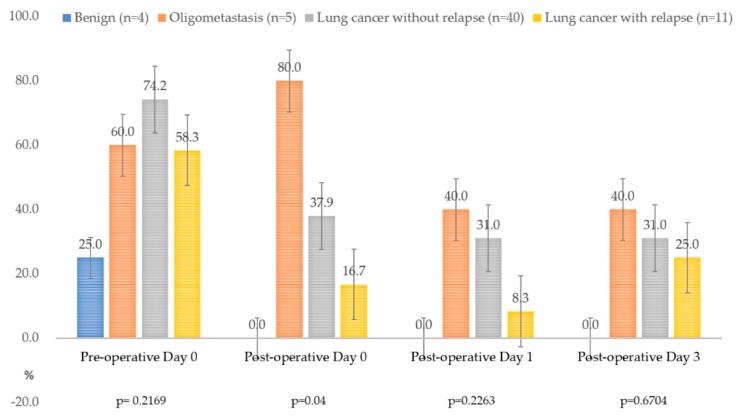
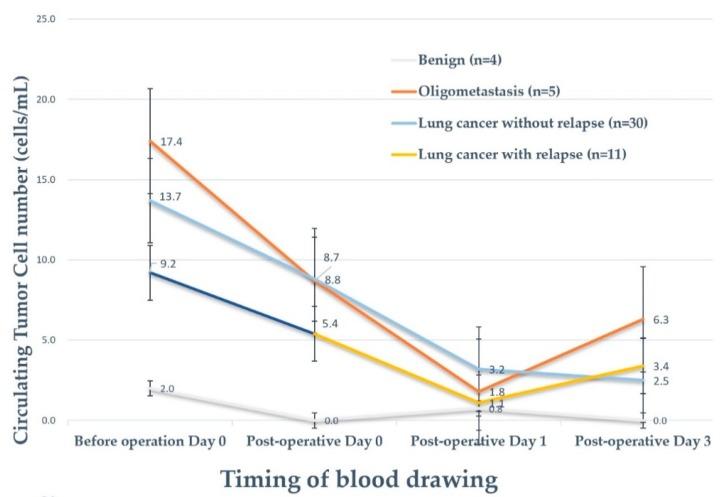
Fifty patients with lung mass undergoing surgery were enrolled. Among 41 primary lung cancers, 26 (63.4%) were pathological stage Tis and I. A total of 200 CTC tests were performed. MMRM analysis indicated that surgery could contribute to a CTC decline after surgery in all patients with statistical significance ( = 0.0005). The daily decrease of CTCs was statistically different between patients with and without recurrence ( = 0.0068). An early rebound of CTC counts on postoperative days 1 and 3 was associated with recurrence months later.
CONCLUSION
CTC testing can potentially serve as a tool for minimal residual disease detection in early-staged lung cancer after curative surgery.
背景
循环肿瘤细胞(CTC)在预测肺癌患者术后癌症复发中的作用仍不明确。
方法
应用一种负选的CTC识别方案。对于所有入组患者,在手术日(第0天)、术后第1天和第3天手术前后进行CTC检测。分析CTC的每日下降情况和趋势,以与癌症复发相关联。采用经癌症特征调整的混合模型重复测量(MMRM)进行统计学显著性分析。
结果
纳入50例接受手术的肺部肿块患者。在41例原发性肺癌中,26例(63.4%)为病理分期Tis和I期。共进行了200次CTC检测。MMRM分析表明,手术可使所有患者术后CTC下降,具有统计学显著性(P = 0.0005)。复发患者和未复发患者之间CTC的每日下降情况有统计学差异(P = 0.0068)。术后第1天和第3天CTC计数的早期反弹与数月后的复发相关。
结论
CTC检测可能作为根治性手术后早期肺癌微小残留病检测的一种工具。


 Zotero 插件