University Group for ID Technologies (GUTI), University Carlos III of Madrid (UC3M), Av. de la Universidad 30, 28911 Leganés, Madrid, Spain.
Sensors (Basel). 2020 Mar 7;20(5):1469. doi: 10.3390/s20051469.
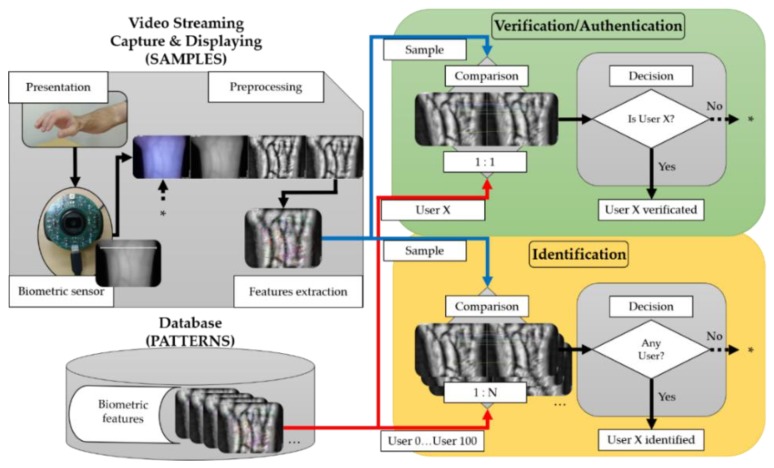
Human wrist vein biometric recognition is one of the least used vascular biometric modalities. Nevertheless, it has similar usability and is as safe as the two most common vascular variants in the commercial and research worlds: hand palm vein and finger vein modalities. Besides, the wrist vein variant, with wider veins, provides a clearer and better visualization and definition of the unique vein patterns. In this paper, a novel vein wrist non-contact system has been designed, implemented, and tested. For this purpose, a new contactless database has been collected with the software algorithm TGS-CVBR. The database, called UC3M-CV1, consists of 1200 near-infrared contactless images of 100 different users, collected in two separate sessions, from the wrists of 50 subjects (25 females and 25 males). Environmental light conditions for the different subjects and sessions have been not controlled: different daytimes and different places (outdoor/indoor). The software algorithm created for the recognition task is PIS-CVBR. The results obtained by combining these three elements, TGS-CVBR, PIS-CVBR, and UC3M-CV1 dataset, are compared using two other different wrist contact databases, PUT and UC3M (best value of Equal Error Rate (EER) = 0.08%), taken into account and measured the computing time, demonstrating the viability of obtaining a contactless real-time-processing wrist system.
人体手腕静脉生物识别是使用最少的血管生物识别模式之一。然而,它具有相似的可用性,并且与商业和研究领域中两种最常见的血管变体一样安全:手掌静脉和手指静脉模式。此外,手腕静脉变体,具有更宽的静脉,提供了更清晰和更好的可视化和独特的静脉模式的定义。在本文中,设计、实现和测试了一种新型的手腕非接触式系统。为此,使用 TGS-CVBR 软件算法收集了一个新的非接触式数据库。该数据库名为 UC3M-CV1,包含 100 个不同用户的 1200 张近红外非接触图像,由 50 个对象(25 名女性和 25 名男性)的手腕采集,分为两个单独的会话。不同对象和会话的环境光线条件未受控制:不同的白天和不同的地方(户外/室内)。为识别任务创建的软件算法是 PIS-CVBR。将这三个元素(TGS-CVBR、PIS-CVBR 和 UC3M-CV1 数据集)组合在一起的结果使用另外两个不同的手腕接触数据库 PUT 和 UC3M 进行比较(最佳等错误率(EER)= 0.08%),考虑并测量了计算时间,证明了获得非接触式实时处理手腕系统的可行性。