Immune Therapies Laboratory, Burnet Institute, Melbourne, Australia.
Department of Immunology and Pathology, Central Clinical School, Monash University, Melbourne, Australia.
Immunol Cell Biol. 2020 Apr;98(4):287-304. doi: 10.1111/imcb.12326. Epub 2020 Apr 12.
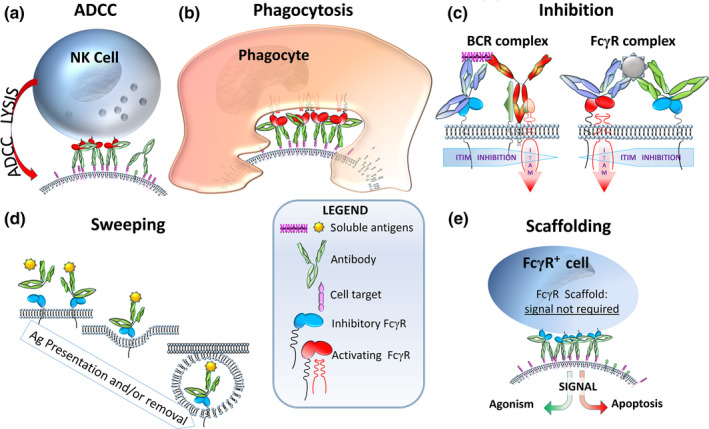
The human fragment crystallizable (Fc)γ receptor (R) interacts with antigen-complexed immunoglobulin (Ig)G ligands to both activate and modulate a powerful network of inflammatory host-protective effector functions that are key to the normal physiology of immune resistance to pathogens. More than 100 therapeutic monoclonal antibodies (mAbs) are approved or in late stage clinical trials, many of which harness the potent FcγR-mediated effector systems to varying degrees. This is most evident for antibodies targeting cancer cells inducing antibody-dependent killing or phagocytosis but is also true to some degree for the mAbs that neutralize or remove small macromolecules such as cytokines or other Igs. The use of mAb therapeutics has also revealed a "scaffolding" role for FcγR which, in different contexts, may either underpin the therapeutic mAb action such as immune agonism or trigger catastrophic adverse effects. The still unmet therapeutic need in many cancers, inflammatory diseases or emerging infections such as severe acute respiratory syndrome coronavirus 2 (SARS-CoV-2) requires increased effort on the development of improved and novel mAbs. A more mature appreciation of the immunobiology of individual FcγR function and the complexity of the relationships between FcγRs and antibodies is fueling efforts to develop more potent "next-gen" therapeutic antibodies. Such development strategies now include focused glycan or protein engineering of the Fc to increase affinity and/or tailor specificity for selective engagement of individual activating FcγRs or the inhibitory FcγRIIb or alternatively, for the ablation of FcγR interaction altogether. This review touches on recent aspects of FcγR and IgG immunobiology and its relationship with the present and future actions of therapeutic mAbs.
人类片段可结晶 (Fc)γ 受体 (R) 与抗原结合的免疫球蛋白 (Ig)G 配体相互作用,既能激活又能调节强大的炎症宿主保护性效应功能网络,这是对病原体产生免疫抵抗的正常生理的关键。超过 100 种治疗性单克隆抗体 (mAb) 已获得批准或处于临床研究后期,其中许多利用有效的 FcγR 介导的效应系统在不同程度上发挥作用。这在针对诱导抗体依赖杀伤或吞噬作用的癌细胞的抗体最为明显,但对于中和或去除小分子大分子(如细胞因子或其他 Ig)的 mAb 在某种程度上也是如此。mAb 治疗的应用也揭示了 FcγR 的“支架”作用,在不同的情况下,这种作用要么为治疗性 mAb 作用提供支撑,如免疫激动作用,要么引发灾难性的不良反应。在许多癌症、炎症性疾病或新兴感染(如严重急性呼吸综合征冠状病毒 2 (SARS-CoV-2))中,仍存在未满足的治疗需求,这需要加大努力开发改进型和新型 mAb。对个体 FcγR 功能的免疫生物学和 FcγR 与抗体之间关系的复杂性的更成熟认识,推动了开发更有效“下一代”治疗性抗体的努力。这些开发策略现在包括对 Fc 进行有针对性的聚糖或蛋白质工程,以提高亲和力和/或针对选择性结合个体激活 FcγR 或抑制性 FcγRIIb 的特异性,或者完全消除 FcγR 相互作用。本综述涉及 FcγR 和 IgG 免疫生物学及其与当前和未来治疗性 mAb 作用的关系的最新方面。