Lee Hak-Jae, No Hyo-Keun, Choi Nak-Joon, Sun Hyun-Woo, Lee Jae-Suk, Jung Yoon-Joong, Hong Suk-Kyung
Division of Acute Care Surgery, Department of Surgery, Asan Medical Center, University of Ulsan College of Medicine, Seoul, Korea.
Korean Army Academy Hospital, Yeongcheon, Korea.
Ann Surg Treat Res. 2020 Mar;98(3):146-152. doi: 10.4174/astr.2020.98.3.146. Epub 2020 Feb 28.
Unstable pelvic fracture with bleeding can be fatal, with a mortality rate of up to 40%. Therefore, early detection and treatment are important in unstable pelvic trauma. We investigated the early predictive factors for possible embolization in patients with hemodynamically unstable pelvic trauma.
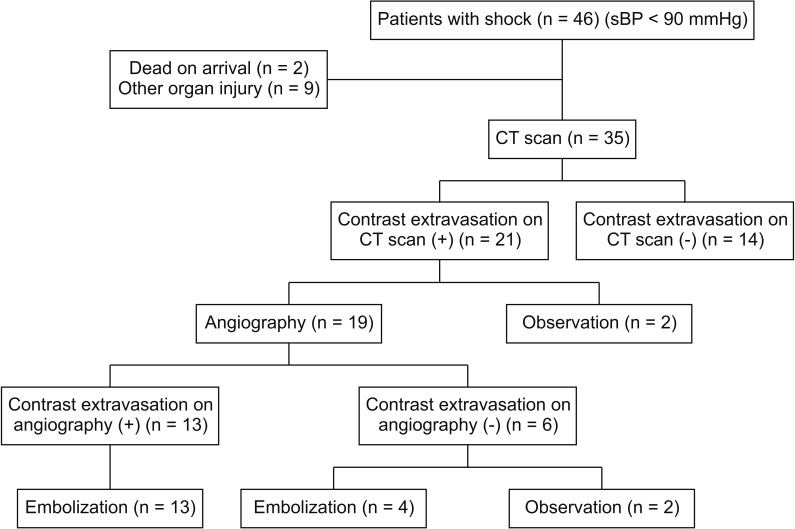
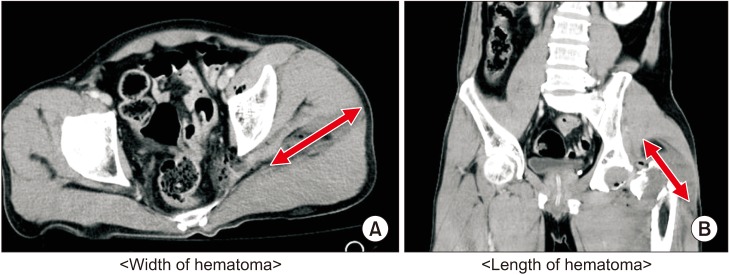
From January 2011 to December 2013, 46 patients with shock arrived at a single hospital within 24 hours after injury. Of them, 44 patients underwent CT scan after initial resuscitation, except for 2 who were dead on arrival. Nine patients with other organ injuries were excluded. Seventeen patients underwent embolization. A single radiologist measured the width (longest length in axial view) and length (longest length in coronal view) of pelvic hematoma on CT scans. Demographic, clinical, and radiological data were reviewed retrospectively.
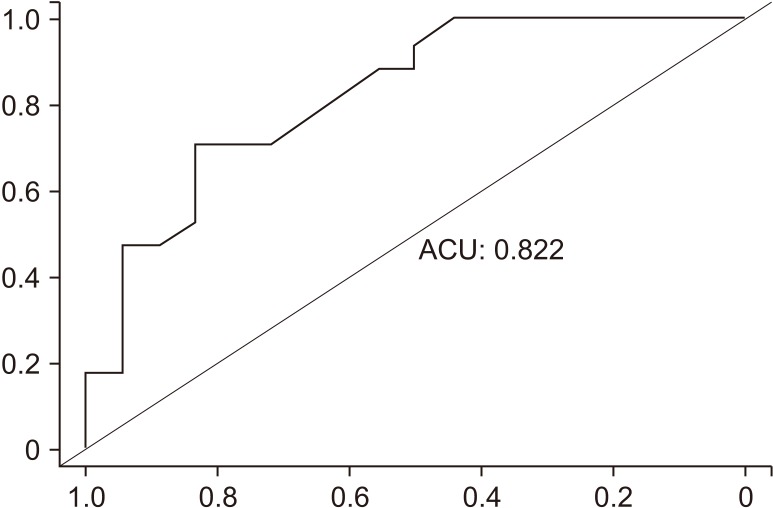
Among 35 patients with hemodynamically unstable pelvic fracture, 22 (62.9%) were men. Width (P = 0.002) and length (P = 0.006) of hematoma on CT scans were significantly different between the embolization and nonembolization groups. The predictors of embolization were width of pelvic hematoma (odds ratio [OR], 1.07; P = 0.028) and female sex (OR, 10.83; P = 0.031). The cutoff value was 3.35 cm. More embolization was performed (OR, 12.00; P = 0.003) and higher mortality was observed in patients with hematoma width >3.35 cm (OR, 4.96; P = 0.048).
Patients with hemodynamically unstable pelvic trauma have a high mortality rate. CT is useful for the initial identification of the need for embolization among these patients. The width of pelvic hematoma can predict possible embolization in patients with unstable pelvic trauma.
伴有出血的不稳定骨盆骨折可能致命,死亡率高达40%。因此,早期发现和治疗对于不稳定骨盆创伤至关重要。我们研究了血流动力学不稳定骨盆创伤患者可能需要栓塞治疗的早期预测因素。
2011年1月至2013年12月,46例休克患者在受伤后24小时内抵达一家医院。其中,44例患者在初始复苏后接受了CT扫描,2例入院时死亡。9例伴有其他器官损伤的患者被排除。17例患者接受了栓塞治疗。由一名放射科医生在CT扫描上测量骨盆血肿的宽度(轴位视图中的最长长度)和长度(冠状位视图中的最长长度)。对人口统计学、临床和放射学数据进行回顾性分析。
在35例血流动力学不稳定骨盆骨折患者中,22例(62.9%)为男性。CT扫描上血肿的宽度(P = 0.002)和长度(P = 0.006)在栓塞组和非栓塞组之间有显著差异。栓塞的预测因素为骨盆血肿宽度(比值比[OR],1.07;P = 0.028)和女性(OR,10.83;P = 0.031)。截断值为3.35 cm。血肿宽度>3.35 cm的患者进行栓塞治疗的更多(OR,12.00;P = 0.003),且死亡率更高(OR,4.96;P = 0.048)。
血流动力学不稳定骨盆创伤患者死亡率高。CT有助于初步确定这些患者中是否需要栓塞治疗。骨盆血肿宽度可预测不稳定骨盆创伤患者可能需要栓塞治疗。