Huitema Ashlay A, Alemayehu Mistre, Steiner Orna L, Bagur Rodrigo, Lavi Shahar
Department of Medicine, Western University, London, Ontario, Canada.
Division of Cardiology, London Health Sciences Centre, London, Ontario, Canada.
CJC Open. 2019 Jan 23;1(1):28-34. doi: 10.1016/j.cjco.2018.11.006. eCollection 2019 Jan.
Accuracy of electrocardiogram (ECG) interpretation is important for identification of ST-elevation myocardial infarction (STEMI) by Emergency Medical Services (EMS) personnel who recognize STEMI in the field and activate the coronary catheterization laboratory. According to previous research, there is improvement in diagnosis of STEMIs for healthcare providers who read an average of > 20 ECGs per week. This study evaluated the effectiveness of online ECG modules on improving diagnostic accuracy.
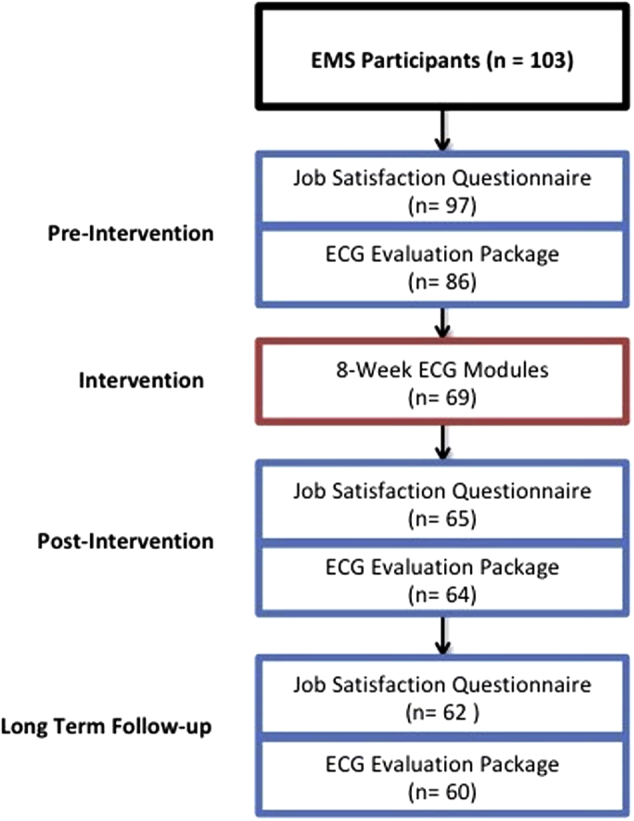
EMS personnel received 25 ECGs per week to interpret via an online program. Diagnostic accuracy was assessed for improvement via completion of an ECG evaluation package before and after the intervention. Job satisfaction data were collected to determine the impact of the educational initiative.
A total of 64 participants completed the study. Overall, there was an improvement in ECG diagnostic accuracy from 50.8% to 61.2% (95% confidence interval [CI], 7.7-13.2; < 0.0001). Specifically, there was significant improvement in the diagnosis of STEMI (8.5%; 95% CI, 4.9-12.3; < 0.003) and supraventricular tachycardia (39.0%; 95% CI, 17.2-60.8; < 0.008), with a trend toward improvement in all other diagnoses. These effects were sustained to 3 months (9.6%; 95% CI, 6.4-12.7; < 0.0001). Improvement was seen regardless of employment experience and training. There was no significant impact on job satisfaction.
ECG exposure remains an important factor in improving the accuracy of ECG diagnosis in EMS personnel. Online education modules provide an easily accessible way of improving ECG interpretation with the opportunity for positive downstream effects on patient outcomes and resource use.
心电图(ECG)解读的准确性对于紧急医疗服务(EMS)人员识别ST段抬高型心肌梗死(STEMI)至关重要,这些人员在现场识别STEMI并启动冠状动脉导管插入实验室。根据先前的研究,对于每周平均阅读超过20份心电图的医疗保健提供者,STEMI的诊断有所改善。本研究评估了在线心电图模块对提高诊断准确性的有效性。
EMS人员每周通过在线程序接收25份心电图进行解读。通过干预前后完成心电图评估包来评估诊断准确性的提高。收集工作满意度数据以确定教育举措的影响。
共有64名参与者完成了研究。总体而言,心电图诊断准确性从50.8%提高到61.2%(95%置信区间[CI],7.7-13.2;P<0.0001)。具体而言,STEMI(8.5%;95%CI,4.9-12.3;P<0.003)和室上性心动过速(39.0%;95%CI,17.2-60.8;P<0.008)的诊断有显著改善,所有其他诊断有改善趋势。这些效果持续到3个月(9.6%;95%CI,6.4-12.7;P<0.0001)。无论工作经验和培训如何,均可见改善。对工作满意度没有显著影响。
接触心电图仍然是提高EMS人员心电图诊断准确性的重要因素。在线教育模块提供了一种易于获取的方式来改善心电图解读,并有机会对患者结局和资源利用产生积极的下游影响。