Yıldırım Tuğrul, Ünsal Seyyid Şerif, Armangil Mehmet
Deparment of Orthopedics and Traumatology, Division of Hand Surgery, Ankara University Faculty of Medicine, Ankara, Turkey.
Jt Dis Relat Surg. 2020;31(1):56-61. doi: 10.5606/ehc.2020.71185.
This study aims to analyze the nationwide trends in carpal tunnel surgery by surgeons practicing in Turkey according to experience in years, training received (plastic surgery or orthopedics), and working location (Turkey or abroad) by slightly modifying Munns' survey.
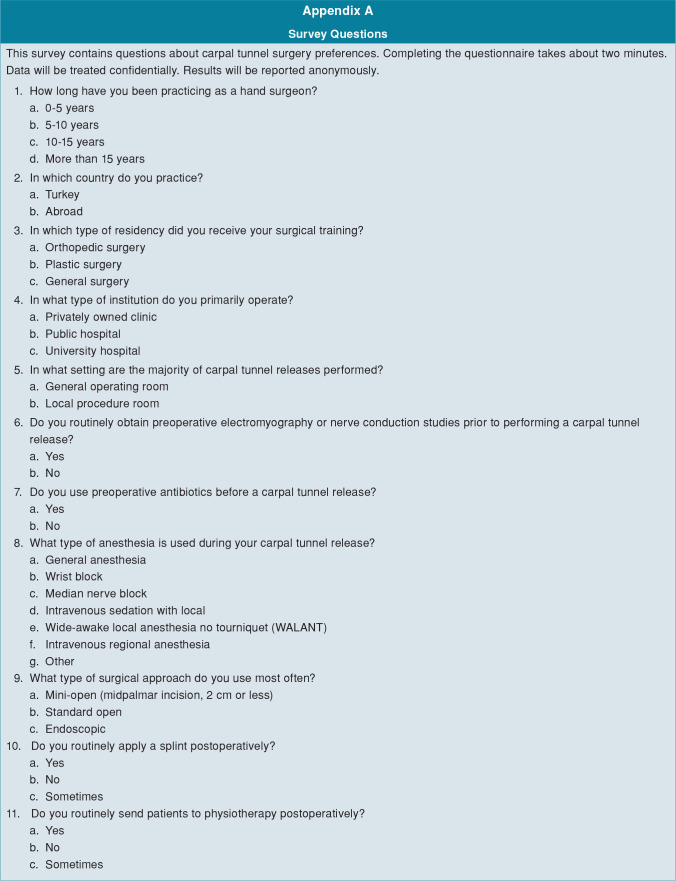
A printed and online survey consisting of 11 questions was sent to Turkish and international surgeons. The surgeon's province of practice, years in practice, type of education received as a resident, preferred operation room, preferred surgical approach, type of anesthesia used, use of postoperative orthosis and therapy were assessed in the survey.
The survey was completed by 198 surgeons (a 25% response rate). The majority of surgeons practicing in Turkey (87%) and 67% of surgeons practicing abroad demanded electromyography (EMG) and nerve conduction studies. Sixty- one percent of respondents from Turkey and 76% of respondents practicing abroad did not administer antibiotics preoperatively. While the most common anesthetic technique used by international surgeons was subcutaneous local anesthesia (42%), Turkish surgeons preferred wrist block (18%). Surgeons practicing in Turkey with fewer than five years of experience were more likely to administer antibiotics preoperatively, use EMG/nerve conduction studies, utilize a mini-open approach and apply an orthosis postoperatively (p<0.05).
There are comparable differences between Turkish and international surgeons regarding pre- and postoperative management of carpal tunnel surgery. Province of practice, years in practice, and type of education received as a resident have influence over the management of carpal tunnel syndrome.
本研究旨在通过对芒恩斯的调查进行微调,根据土耳其外科医生的从业年限、接受的培训(整形外科或骨科)以及工作地点(土耳其或国外),分析土耳其外科医生进行腕管手术的全国趋势。
向土耳其和国际外科医生发送了一份包含11个问题的纸质和在线调查问卷。该调查评估了外科医生的执业省份、从业年限、住院医师阶段接受的教育类型、首选手术室、首选手术入路、使用的麻醉类型、术后矫形器的使用情况以及治疗方法。
198名外科医生完成了调查(回复率为25%)。在土耳其执业的大多数外科医生(87%)和在国外执业的67%的外科医生要求进行肌电图(EMG)和神经传导研究。来自土耳其的61%的受访者和在国外执业的76%的受访者术前不使用抗生素。国际外科医生最常用的麻醉技术是皮下局部麻醉(42%),而土耳其外科医生更喜欢腕部阻滞(18%)。在土耳其执业年限少于五年的外科医生术前更有可能使用抗生素、进行EMG/神经传导研究、采用小切口入路并在术后使用矫形器(p<0.05)。
土耳其和国际外科医生在腕管手术的术前和术后管理方面存在类似差异。执业省份、从业年限以及住院医师阶段接受的教育类型对腕管综合征的管理有影响。