Department of Echocardiography, The Affiliated Changzhou No.2 People's Hospital of Nanjing Medical University, Changzhou, 213003, China.
BMC Cardiovasc Disord. 2020 Jan 9;20(1):126. doi: 10.1186/s12872-019-01324-z.
This study investigated the value of layer-specific strain analysis by two-dimensional speckle tracking echocardiography (2D-STE) for evaluating left ventricular (LV) systolic function and synchrony in maintenance hemodialysis (MHD) patients.
A total of 34 MHD patients and 35 healthy controls were enrolled in this study. Dynamic images were collected at the LV apical long-axis, the four- and two- chamber, and the LV short-axis views at the basal, middle, and apical segments. The layer-specific speckle tracking (LST) technique was used to analyze the longitudinal strain (LS) and circumferential strain (CS) of LV sub-endocardium, mid-myocardium, sub-epicardium, global longitudinal strain (GLS), global circumferential strain (GCS), the LV 17 segment time to peak LS (TTP), and the peak strain dispersion (PSD). The differences in these parameters were compared between control and MHD groups, and the correlation between PSD and each LS parameter was examined. The receiver operator characteristic (ROC) curve was used to evaluate the efficacy of three myocardial layer LS and CS in the assessment of LV systolic dysfunction in MHD patients.
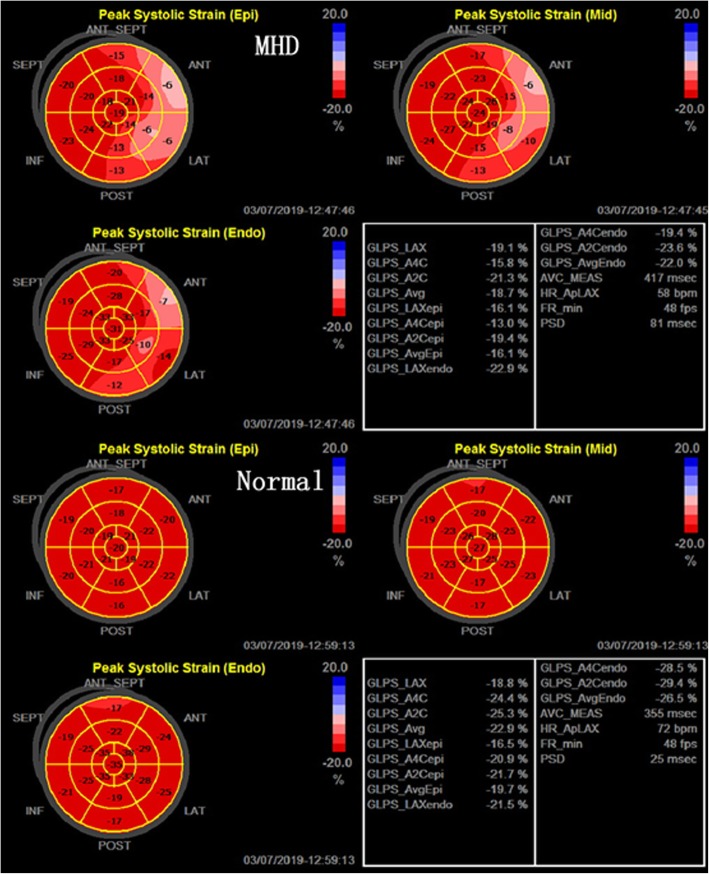
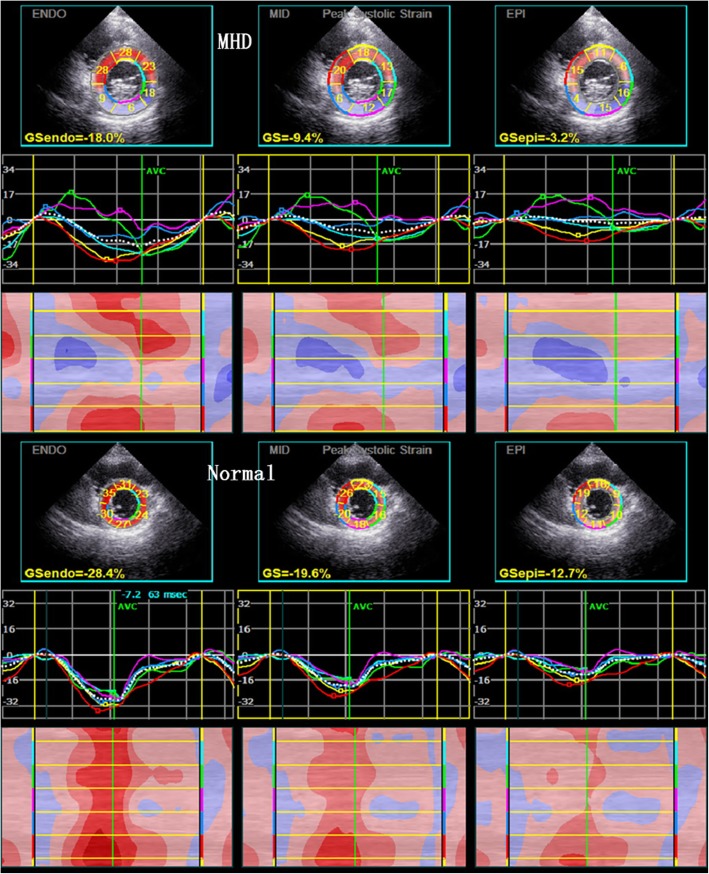
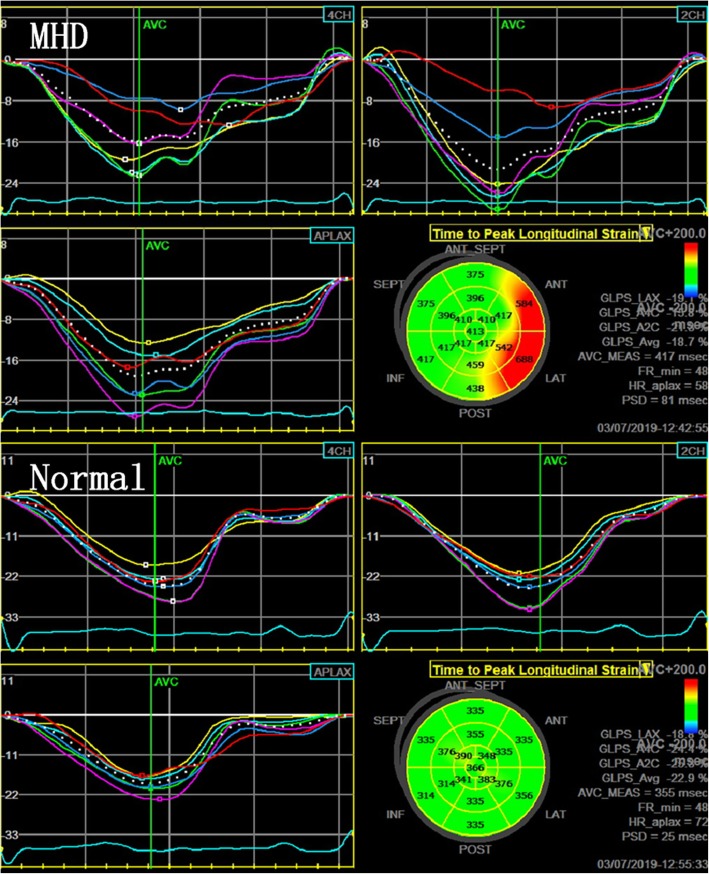
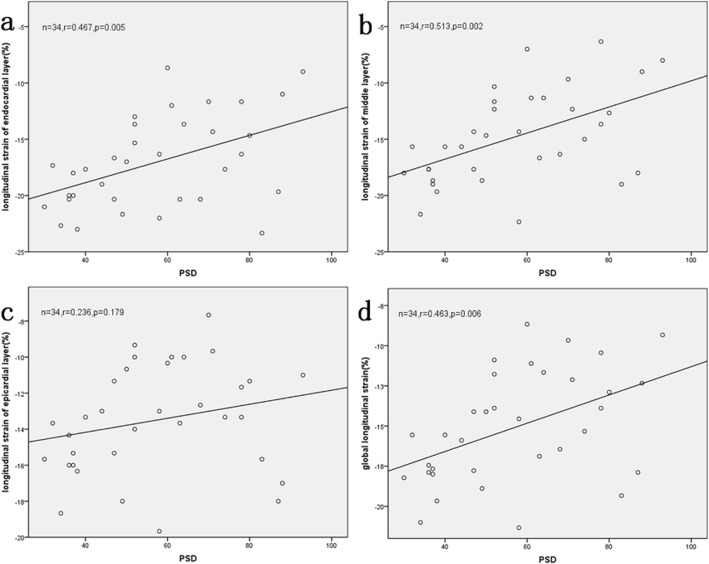
MHD patients had comparable left ventricular ejection fraction (LVEF), but significantly smaller LV GLS, GCS, and three-layer LS and CS compared to the control group. The three myocardial layer LS of the basal segment, middle segment, and apex segment was significantly reduced in the MHD patients compared to the normal subjects, while the three myocardial layer CS of the basal segment, middle segment, and apex segment was significantly reduced in the MHD patients compared to the normal subjects, except for the sub-endocardium of the middle and apex segment. MHD patients had significantly higher TTP of LV 17 segments and PSD compared to controls, and had delayed peak time in most segments. In addition, PSD of MHD patients was positively correlated with sub-endocardial and mid-myocardial LS and GLS, but not with sub-epicardial LS. The area under the curves (AUCs) of sub-endocardial, mid-myocardial, and sub-epicardial LS in MHD patients were 0.894, 0.852, and 0.870, respectively; the AUCs of sub-epicardial, mid-myocardial, and sub-endocardial CS were 0.852, 0.837, and 0.669, respectively.
LST may detect early changes of all three-layer LS and CS and PSD in MHD patients, and is therefore a valuable tool to diagnose LV systolic dysfunction in MHD patients.
本研究通过二维斑点追踪超声心动图(2D-STE)探讨层特异性应变分析在评价维持性血液透析(MHD)患者左心室(LV)收缩功能和同步性中的价值。
共纳入 34 例 MHD 患者和 35 例健康对照者。采集 LV 心尖长轴、四腔心和两腔心以及 LV 基底、中间和心尖段短轴切面的动态图像。采用层特异性斑点追踪(LST)技术分析 LV 心内膜下、心肌中层和心外膜下的纵向应变(LS)和圆周应变(CS)、整体纵向应变(GLS)、整体圆周应变(GCS)、LV17 节段达峰 LS 时间(TTP)和峰值应变离散度(PSD)。比较对照组和 MHD 组各参数的差异,分析 PSD 与各 LS 参数的相关性。采用受试者工作特征(ROC)曲线评估 MHD 患者 3 个心肌层 LS 和 CS 评估 LV 收缩功能障碍的效能。
MHD 患者左心室射血分数(LVEF)相当,但与对照组相比,LV GLS、GCS 和 3 个心肌层 LS 和 CS 明显更小。与正常组相比,MHD 患者的基底段、中间段和心尖段 3 个心肌层 LS 明显降低,而基底段、中间段和心尖段 3 个心肌层 CS 除中间段和心尖段的心内膜下外,其余均明显降低。与对照组相比,MHD 患者的 LV17 节段 TTP 和 PSD 明显升高,大多数节段达峰时间延迟。此外,MHD 患者的 PSD 与心内膜下和心肌中层 LS 和 GLS 呈正相关,而与心外膜下 LS 无相关性。MHD 患者心内膜下、心肌中层和心外膜下 LS 的曲线下面积(AUC)分别为 0.894、0.852 和 0.870,心外膜下、心肌中层和心内膜下 CS 的 AUC 分别为 0.852、0.837 和 0.669。
LST 可检测 MHD 患者 3 个心肌层 LS 和 CS 及 PSD 的早期变化,是诊断 MHD 患者左心室收缩功能障碍的一种有价值的工具。