University of California, Los Angeles, Los Angeles, California, USA.
Institut Paoli-Calmettes, Marseille, France.
Oncologist. 2020 Mar;25(3):e439-e450. doi: 10.1634/theoncologist.2019-0493. Epub 2019 Nov 25.
In the EMBRACA phase III study (NCT01945775), talazoparib was associated with a significantly prolonged progression-free survival (PFS) compared with physician's choice of chemotherapy (PCT) in germline BRCA1/2-mutated HER2-negative advanced breast cancer (ABC). Herein, the safety profile of talazoparib is explored in detail.
Overall, 412 patients received ≥1 dose of talazoparib (n = 286) or PCT (n = 126). Adverse events (AEs) were evaluated, including timing, duration, and potential overlap of selected AEs. The relationship between talazoparib plasma exposure and grade ≥3 anemia was analyzed. Time-varying Cox proportional hazard models assessed the impact of dose reductions on PFS. Patient-reported outcomes (PROs) in patients with common AEs and health resource utilization (HRU) were assessed in both treatment arms.
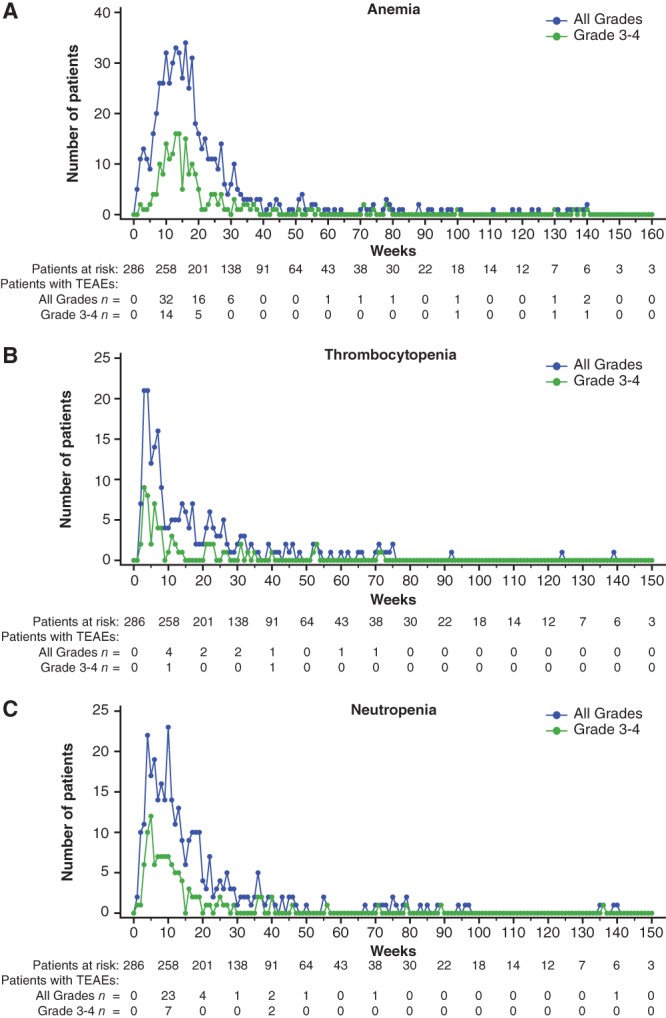
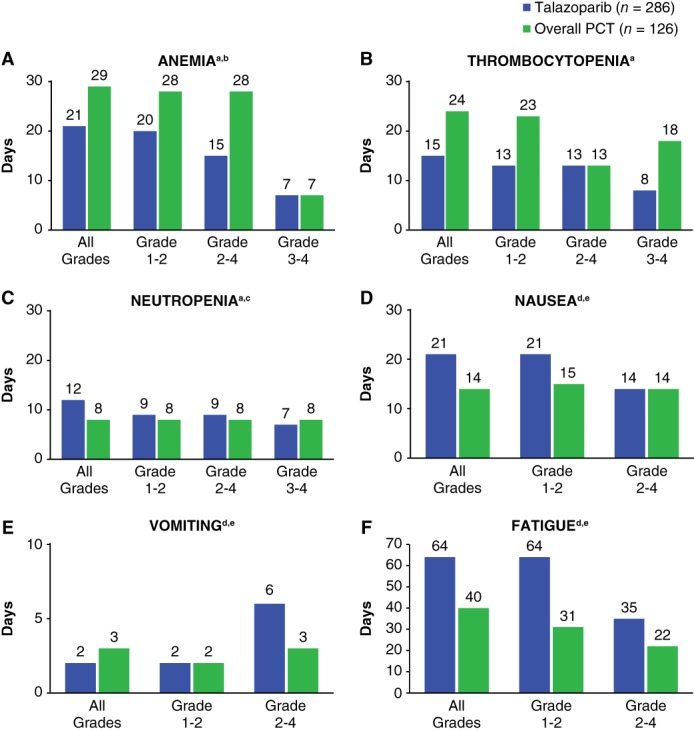
The most common AEs with talazoparib were hematologic (195 [68.2%] patients) and typically occurred within the first 3-4 months of receiving talazoparib. Grade 3-4 anemia lasted approximately 7 days for both arms. Overlapping grade 3-4 hematologic AEs were infrequent with talazoparib. Higher talazoparib exposure was associated with grade ≥3 anemia. Permanent discontinuation of talazoparib due to hematologic AEs was low (<2%). A total of 150 (52.4%) patients receiving talazoparib had AEs associated with dose reduction. Hematologic toxicities were managed by supportive care medication (including transfusion) and dose modifications. Among patients with anemia or nausea and/or vomiting AEs, PROs favored talazoparib. After accounting for the treatment-emergent period, talazoparib was generally associated with a lower rate of hospitalization and supportive care medication use compared with chemotherapy.
Talazoparib was associated with superior efficacy, favorable PROs, and lower HRU rate versus chemotherapy in gBRCA-mutated ABC. Toxicities were manageable with talazoparib dose modification and supportive care.
Talazoparib was generally well tolerated in patients with germline BRCA-mutated HER2-negative advanced breast cancer in the EMBRACA trial. Common toxicities with talazoparib were primarily hematologic and infrequently resulted in permanent drug discontinuation (<2% of patients discontinued talazoparib due to hematologic toxicity). Hematologic toxicities typically occurred during the first 3-4 months of treatment and were managed by dose modifications and supportive care measures. A significant efficacy benefit, improved patient-reported outcomes, lower rate of health resource utilization and a tolerable safety profile support incorporating talazoparib into routine management of germline BRCA-mutated locally advanced/metastatic breast cancer.
在 EMBRACA Ⅲ 期研究(NCT01945775)中,与医生选择的化疗(PCT)相比,talazoparib 显著延长了种系 BRCA1/2 突变的 HER2 阴性晚期乳腺癌(ABC)患者的无进展生存期(PFS)。在此,详细探讨了 talazoparib 的安全性特征。
总体而言,412 名患者接受了≥1 剂 talazoparib(n=286)或 PCT(n=126)。评估了不良事件(AE),包括选定 AE 的发生时间、持续时间和潜在重叠。分析了 talazoparib 血浆暴露与≥3 级贫血之间的关系。时变 Cox 比例风险模型评估了剂量减少对 PFS 的影响。评估了两个治疗臂中常见 AE 患者的患者报告结局(PRO)和卫生资源利用(HRU)。
talazoparib 最常见的 AE 是血液学的(195[68.2%]例患者),通常发生在接受 talazoparib 的前 3-4 个月内。两个治疗组中,3-4 级贫血的持续时间约为 7 天。talazoparib 发生重叠的 3-4 级血液学 AE 很少见。talazoparib 暴露越高,与≥3 级贫血的相关性越强。由于血液学 AE 而永久停用 talazoparib 的比例较低(<2%)。共有 150(52.4%)名接受 talazoparib 的患者因 AE 而减少了剂量。血液学毒性通过支持性治疗药物(包括输血)和剂量调整来治疗。在患有贫血或恶心和/或呕吐 AE 的患者中,PRO 支持 talazoparib。在考虑到治疗出现的时期后,与化疗相比,talazoparib 通常与较低的住院率和支持性治疗药物使用率相关。
与化疗相比,talazoparib 在种系 BRCA 突变的 ABC 患者中具有更好的疗效、良好的 PRO 和较低的 HRU 率。通过 talazoparib 剂量调整和支持性治疗可以控制毒性。
在 EMBRACA 试验中,talazoparib 通常在种系 BRCA 突变的 HER2 阴性晚期乳腺癌患者中具有良好的耐受性。talazoparib 的常见毒性主要是血液学的,很少导致药物永久停药(<2%的患者因血液学毒性而停止使用 talazoparib)。血液学毒性通常发生在治疗的前 3-4 个月,通过剂量调整和支持性治疗措施进行管理。显著的疗效获益、改善的患者报告结局、较低的卫生资源利用率和可耐受的安全性特征支持将 talazoparib 纳入种系 BRCA 突变的局部晚期/转移性乳腺癌的常规治疗。