Zhao Jing, He Ling, Yin Lingling
Department of Neonatology, Affiliated Hospital of North Sichuan Medical College, Nanchong 637000, P.R. China.
Department of Neonatology, Affiliated Hospital of North Sichuan Medical College, Nanchong 637000, P.R. China.
Mol Ther Nucleic Acids. 2020 Jun 5;20:117-127. doi: 10.1016/j.omtn.2020.01.009. Epub 2020 Jan 17.
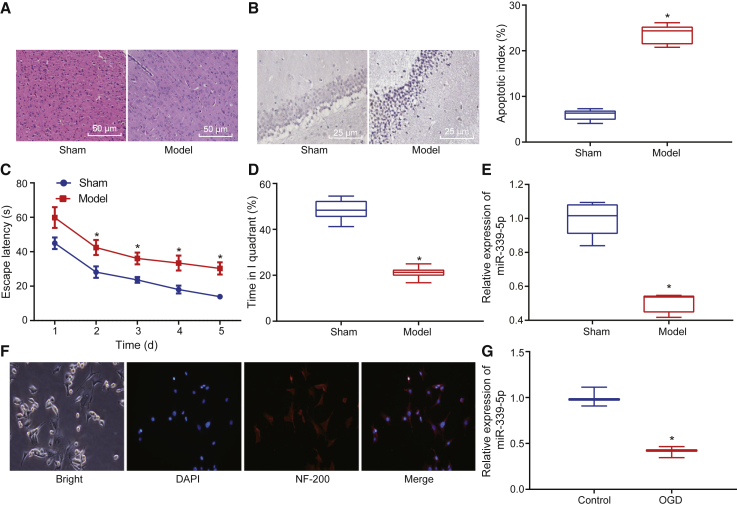
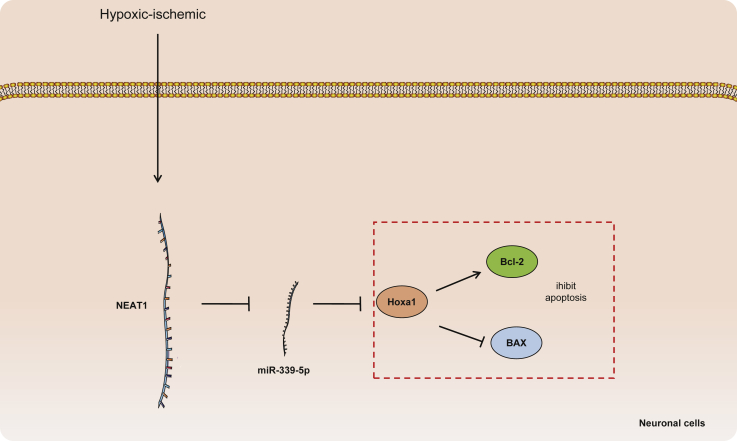
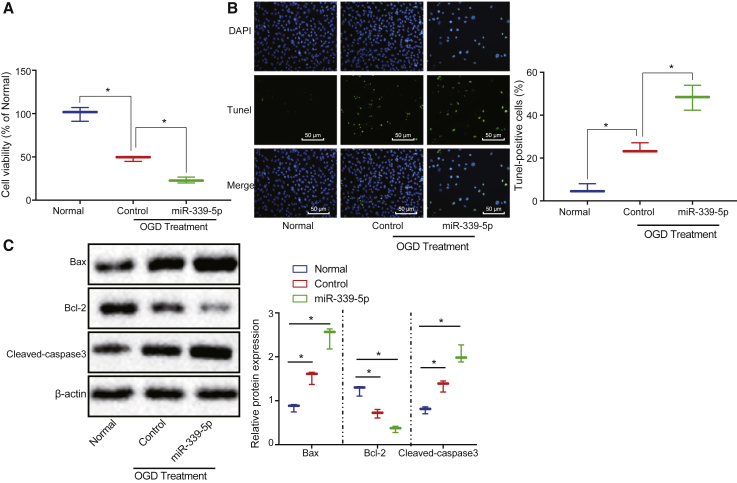
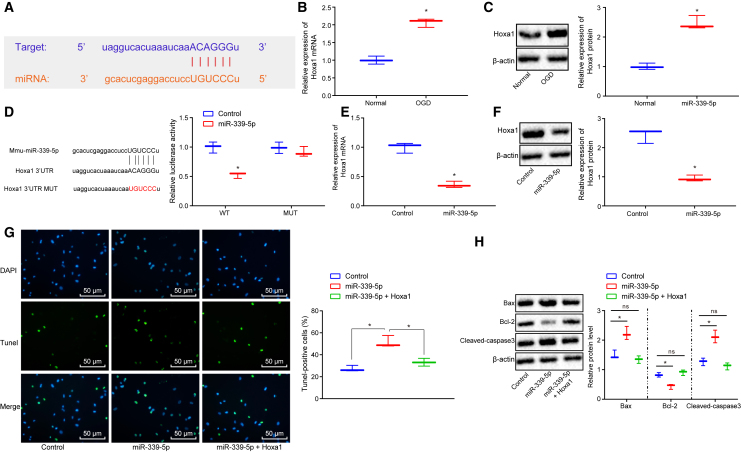
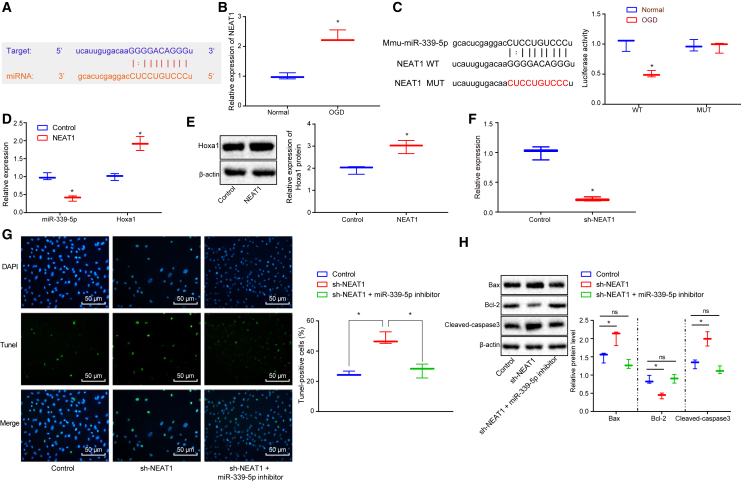
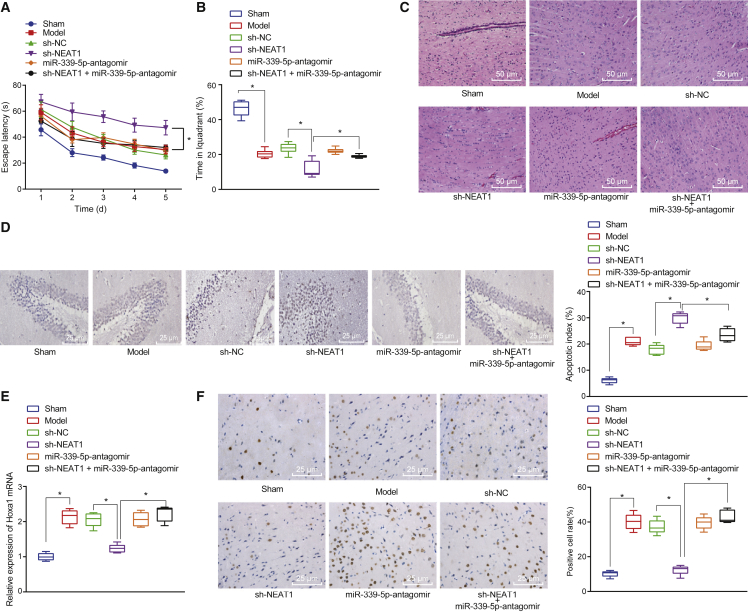
Hypoxic-ischemic brain damage (HIBD) is a major cause of fatality and morbidity in neonates. However, current treatment approaches to alleviate HIBD are not effective. Various studies have highlighted the role of microRNAs (miRNAs) in various biological functions in multiple diseases. This study investigated the role of miR-339-5p in HIBD progression. Neonatal HIBD mouse model was induced by ligation of the right common carotid artery. Neuronal cell model exposed to oxygen-glucose deprivation (OGD) was also established. The miR-339-5p expression in mouse brain tissues and neuronal cells was quantified, and the effects of miR-339-5p on neuronal cell activity and apoptosis induced by hypoxia-ischemia were explored. The overexpression or knockdown of long non-coding RNA (lncRNA) nuclear-enriched abundant transcript 1 (NEAT1) in hippocampal neurons was used to determine the effect of lncRNA NEAT1 on the expression of miR-339-5p and homeobox A1 (HOXA1) and apoptosis. Short hairpin RNA targeting lncRNA NEAT1 and miR-339-5p antagomir were used in neonatal HIBD mice to identify their roles in HIBD. Our results revealed that miR-339-5p was downregulated in neonatal HIBD mice and neuronal cells exposed to OGD. Downregulated miR-339-5p promoted neuronal cell viability and suppressed apoptosis during hypoxia-ischemia. Moreover, lncRNA NEAT1 competitively bound to miR-339-5p to increase HOXA1 expression and inhibited neuronal cell apoptosis under hypoxic-ischemic conditions. The key observations of the current study present evidence demonstrating that lncRNA NEAT1 upregulated HOXA1 to alleviate HIBD in mice by binding to miR-339-5p.
缺氧缺血性脑损伤(HIBD)是新生儿死亡和发病的主要原因。然而,目前缓解HIBD的治疗方法并不有效。各种研究强调了微小RNA(miRNA)在多种疾病的各种生物学功能中的作用。本研究调查了miR-339-5p在HIBD进展中的作用。通过结扎右侧颈总动脉诱导建立新生小鼠HIBD模型。还建立了暴露于氧糖剥夺(OGD)的神经元细胞模型。对小鼠脑组织和神经元细胞中的miR-339-5p表达进行定量,并探讨miR-339-5p对缺氧缺血诱导的神经元细胞活性和凋亡的影响。利用海马神经元中长链非编码RNA(lncRNA)富核丰富转录本1(NEAT1)的过表达或敲低来确定lncRNA NEAT1对miR-339-5p和同源盒A1(HOXA1)表达及凋亡的影响。将靶向lncRNA NEAT1的短发夹RNA和miR-339-5p拮抗剂用于新生HIBD小鼠,以确定它们在HIBD中的作用。我们的结果显示,miR-339-5p在新生HIBD小鼠和暴露于OGD的神经元细胞中表达下调。下调的miR-339-5p在缺氧缺血期间促进神经元细胞活力并抑制凋亡。此外,lncRNA NEAT1与miR-339-5p竞争性结合以增加HOXA1表达,并在缺氧缺血条件下抑制神经元细胞凋亡。本研究的关键观察结果提供了证据,证明lncRNA NEAT1通过与miR-339-5p结合上调HOXA1以减轻小鼠的HIBD。