Ito Tadashi, Sakai Yoshihito, Ito Yohei, Yamazaki Kazunori, Morita Yoshifumi
Three-Dimensional Motion Analysis Room, Aichi Prefectural Mikawa Aoitori Medical and Rehabilitation Center for Developmental Disabilities, Okazaki 444-0002, Japan.
Department of Physical Therapy, Graduate School of Medicine, Nagoya University, Nagoya 461-8673, Japan.
Healthcare (Basel). 2020 Mar 10;8(1):58. doi: 10.3390/healthcare8010058.
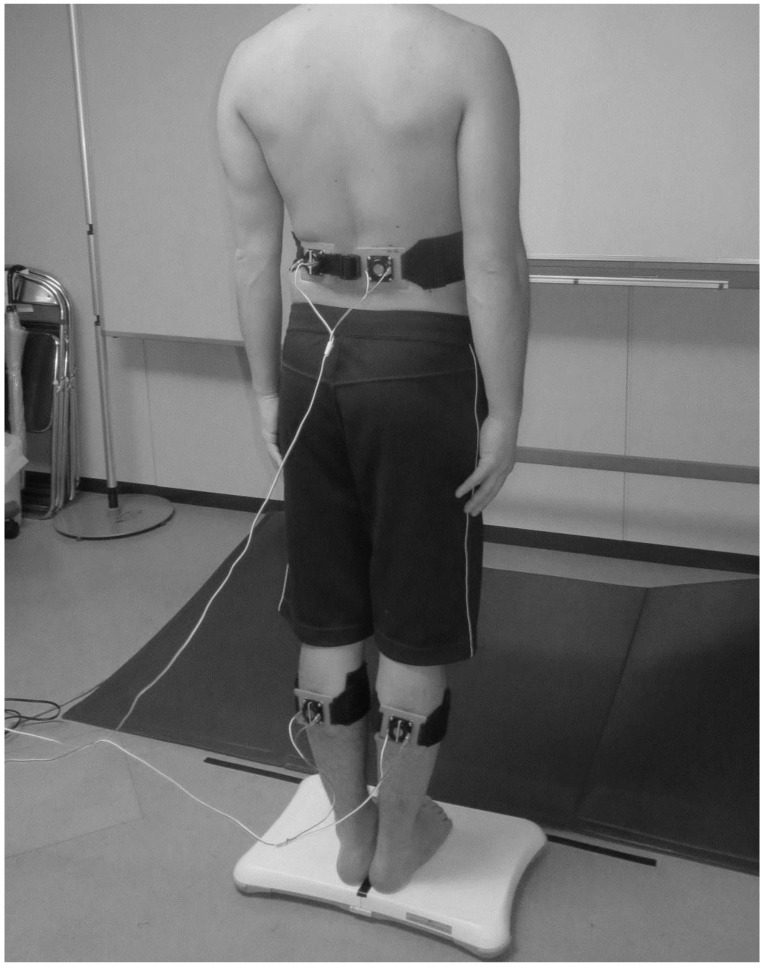
This study aimed to investigate the relationship between back muscle strength and proprioception or mechanoreceptor control strategies used for postural balance in elderly adults with lumbar spondylosis. The displacement of the center of pressure (COP) excursion was determined in 24 elderly adults with lumbar spondylosis and 24 healthy young adults while the participants were standing upright on a balance board with their eyes closed. Vibratory stimulations of 30, 60, and 240 Hz were applied to the gastrocnemius (GS) and lumbar multifidus (LM) muscles to evaluate the effect of different proprioceptive signals on postural control. Back muscle strength was evaluated. Spearman's rank correlation analysis was performed to determine the relationship between back muscle strength and significant COP excursion. Compared with young adults, elderly adults with lumbar spondylosis showed an increase in COP excursion displacement when a vibratory stimulation of 240 Hz was applied to the GS ( = 0.002) and LM muscles ( < 0.001). LM stimulation at 240 Hz was significantly associated with back muscle strength ( = 0.038). Postural control assessment with 240-Hz mechanoreceptor stimulation of the trunk could be a good indicator of postural instability due to over-dependence on mechanoreceptors and back muscle weakness in elderly adults with lumbar spondylosis.
本研究旨在探讨腰椎间盘退变的老年人背部肌肉力量与用于姿势平衡的本体感觉或机械感受器控制策略之间的关系。在24名腰椎间盘退变的老年人和24名健康年轻人闭眼站立在平衡板上时,测定其压力中心(COP)偏移的位移。对腓肠肌(GS)和腰多裂肌(LM)施加30、60和240Hz的振动刺激,以评估不同本体感觉信号对姿势控制的影响。评估背部肌肉力量。进行Spearman等级相关分析,以确定背部肌肉力量与显著的COP偏移之间的关系。与年轻人相比,当对GS(P = 0.002)和LM肌肉施加240Hz的振动刺激时,腰椎间盘退变的老年人COP偏移位移增加(P < 0.001)。240Hz的LM刺激与背部肌肉力量显著相关(P = 0.038)。对患有腰椎间盘退变的老年人躯干进行240Hz机械感受器刺激的姿势控制评估,可能是由于对机械感受器过度依赖和背部肌肉无力导致姿势不稳定的一个良好指标。