Department of Orthopedics, The Affiliated Lianyungang Hospital of Xuzhou Medical University/the First People's Hospital of Lianyungang, Lianyungang, China.
School of Materials Engineering, Shanghai University of Engineering Science, Shanghai, China.
BMC Musculoskelet Disord. 2020 Mar 12;21(1):165. doi: 10.1186/s12891-020-3189-5.
Individualized and accurate implantation of a tibial prosthesis during total knee arthroplasty (TKA) can assist in uniformly distributing the load and reducing the polyethylene wear to obtain a long-term prosthetic survival rate, but individualized and accurate implantation of a tibial prosthesis during TKA remains challenging. The purpose of this study was to optimize and individualize the positioning parameters of a tibial prosthesis to improve its accurate implantation using a new method of finite element analysis in combination with orthogonal experimental design.
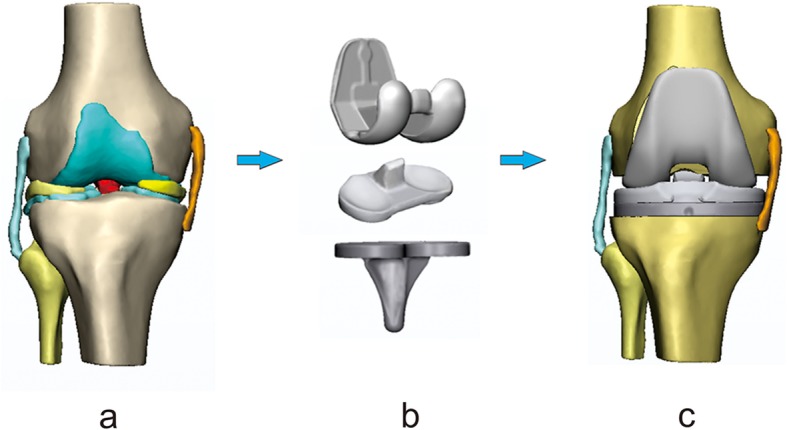
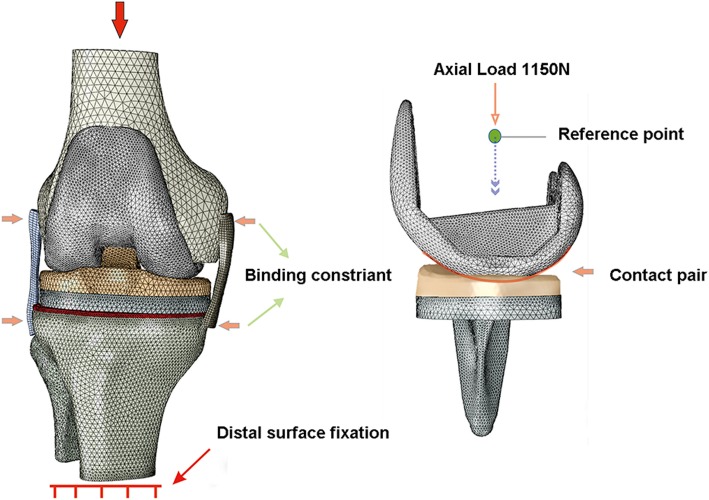
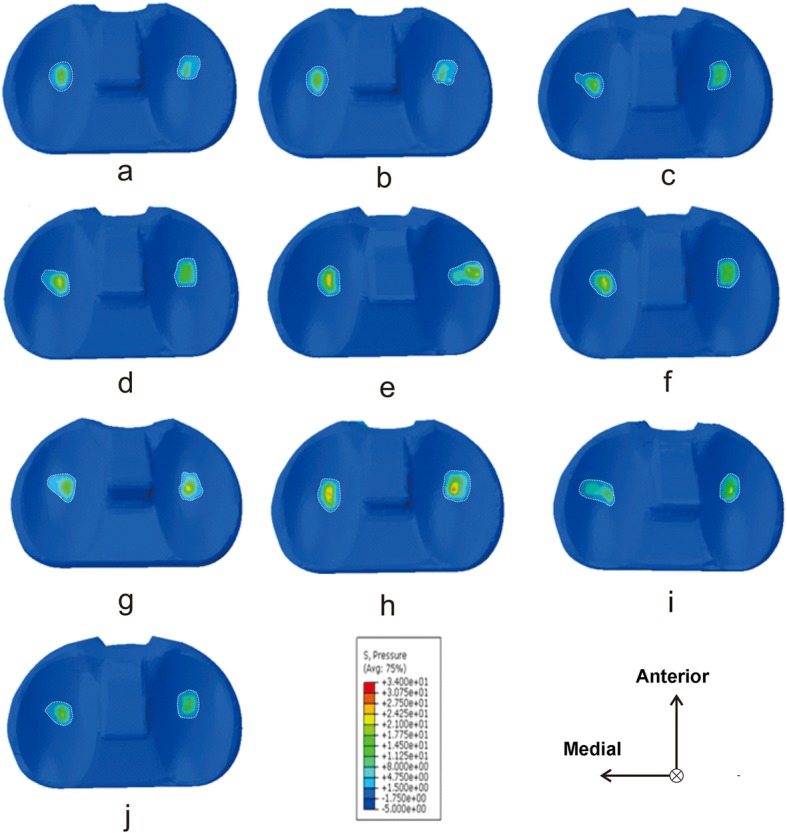
Ten finite element models of TKA knee joint were developed to optimize the implantation parameters (varus angle, posterior slope angle, and external rotation angle) of tibial prosthesis to reduce the peak value of the contact pressure on the polyethylene liner according to the method of finite element analysis in combination with orthogonal experimental design. The influence of implantation parameters on the peak value of the contact pressure on the polyethylene liner was evaluated based on a range analysis in orthogonal experimental design.
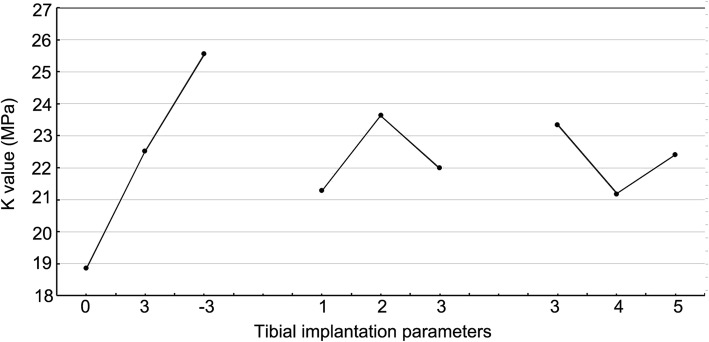
The optimal implantation parameters for tibial prosthesis included 0° varus, 1° posterior slope, and 4° external rotation. Under these conditions, the peak value of the contact pressure on the polyethylene liner remained the smallest (16.37 MPa). Among the three parameters that affect the peak value of the contact pressure, the varus angle had the greatest effect (range = 6.70), followed by the posterior slope angle (range = 2.36), and the external rotation angle (range = 2.15).
The optimization method based on finite element analysis and orthogonal experimental design can guide the accurate implantation of the tibial prosthesis, reducing the peak value of the contact pressure on the polyethylene liner. This method provides new insights into the TKA preoperative plan and biomechanical decision-making for accurately implanting TKA prosthesis.
在全膝关节置换术(TKA)中,个体化和精确的胫骨假体植入可以帮助均匀分布负荷并减少聚乙烯磨损,从而获得长期假体生存率,但 TKA 中个体化和精确的胫骨假体植入仍然具有挑战性。本研究旨在通过有限元分析与正交实验设计相结合的新方法,优化和个体化胫骨假体的定位参数,以提高其精确植入的准确性。
建立了 10 个 TKA 膝关节的有限元模型,以优化胫骨假体的植入参数(内翻角、后倾角和外旋角),根据有限元分析与正交实验设计相结合的方法,降低聚乙烯衬垫上接触压力的峰值。基于正交实验设计的极差分析,评估植入参数对聚乙烯衬垫上接触压力峰值的影响。
胫骨假体的最佳植入参数为 0°内翻、1°后倾和 4°外旋。在这些条件下,聚乙烯衬垫上的接触压力峰值最小(16.37MPa)。在影响接触压力峰值的三个参数中,内翻角的影响最大(范围=6.70),其次是后倾角(范围=2.36),外旋角(范围=2.15)。
基于有限元分析和正交实验设计的优化方法可以指导胫骨假体的精确植入,降低聚乙烯衬垫上的接触压力峰值。该方法为 TKA 术前计划和准确植入 TKA 假体的生物力学决策提供了新的思路。