Bartlett Mitchell J, So Lisa Y, Szabò Lajos, Skinner David P, Parent Kate L, Heien Michael L, Vanderah Todd W, Polt Robin, Sherman Scott J, Falk Torsten
Department of Neurology, The University of Arizona, Tucson, AZ, 85724, USA.
Department of Pharmacology, The University of Arizona, Tucson, AZ, 85724, USA.
BMC Res Notes. 2020 Mar 12;13(1):149. doi: 10.1186/s13104-020-04994-7.
Dopamine-replacement utilizing L-DOPA is still the mainstay treatment for Parkinson's disease (PD), but often leads to development of L-DOPA-induced dyskinesia (LID), which can be as debilitating as the motor deficits. There is currently no satisfactory pharmacological adjunct therapy. The endogenous opioid peptides enkephalin and dynorphin are important co-transmitters in the direct and indirect striatofugal pathways and have been implicated in genesis and expression of LID. Opioid receptor antagonists and agonists with different selectivity profiles have been investigated for anti-dyskinetic potential in preclinical models. In this study we investigated effects of the highly-selective μ-opioid receptor antagonist CTAP (> 1200-fold selectivity for μ- over δ-opioid receptors) and a novel glycopeptide congener (gCTAP5) that was glycosylated to increase stability, in the standard rat LID model.
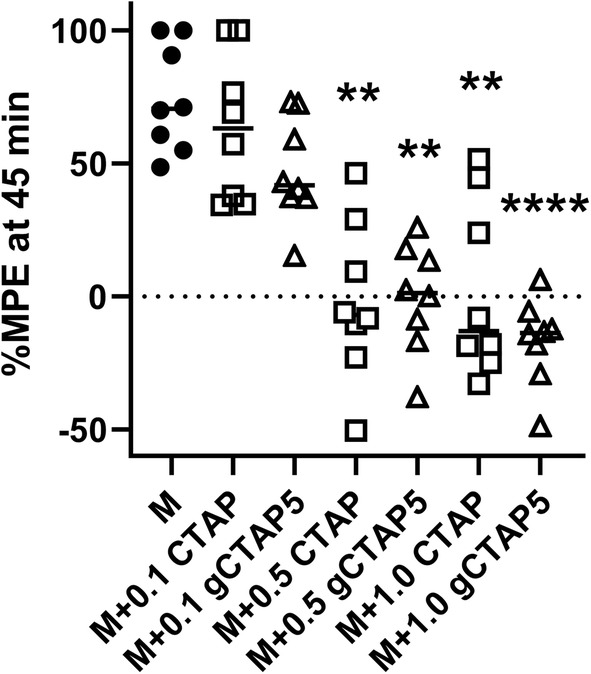
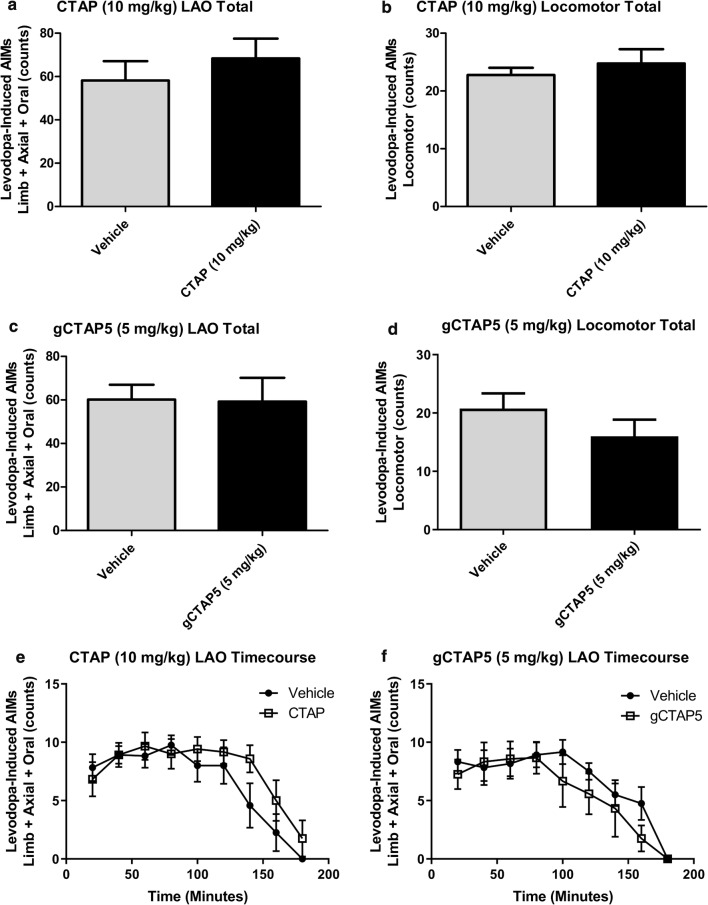
Intraperitoneal administration (i.p.) of either 0.5 mg/kg or 1 mg/kg CTAP and gCTAP5 completely blocked morphine's antinociceptive effect (10 mg/kg; i.p.) in the warm water tail-flick test, showing in vivo activity in rats after systemic injection. Neither treatment with CTAP (10 mg/kg; i.p.), nor gCTAP5 (5 mg/kg; i.p.) had any effect on L-DOPA-induced limb, axial, orolingual, or locomotor abnormal involuntary movements. The data indicate that highly-selective μ-opioid receptor antagonism alone might not be sufficient to be anti-dyskinetic.
利用左旋多巴进行多巴胺替代治疗仍是帕金森病(PD)的主要治疗方法,但常导致左旋多巴诱导的运动障碍(LID),其可能与运动功能缺损一样使人衰弱。目前尚无令人满意的药物辅助治疗方法。内源性阿片肽脑啡肽和强啡肽是直接和间接纹状体传出通路中的重要共递质,并与LID的发生和表现有关。在临床前模型中,已对具有不同选择性谱的阿片受体拮抗剂和激动剂的抗运动障碍潜力进行了研究。在本研究中,我们在标准大鼠LID模型中研究了高选择性μ-阿片受体拮抗剂CTAP(对μ-阿片受体的选择性比对δ-阿片受体高1200倍以上)和一种新型糖基化类似物(gCTAP5)(其进行了糖基化以提高稳定性)的作用。
在温水甩尾试验中,腹腔注射(i.p.)0.5mg/kg或1mg/kg的CTAP和gCTAP5完全阻断了吗啡(10mg/kg;i.p.)的抗伤害感受作用,表明全身注射后在大鼠体内具有活性。CTAP(10mg/kg;i.p.)或gCTAP5(5mg/kg;i.p.)治疗均对左旋多巴诱导的肢体、轴向、口面部或运动性异常不自主运动没有任何影响。数据表明,单独的高选择性μ-阿片受体拮抗作用可能不足以产生抗运动障碍作用。